Search used to be simple.
You typed a few words into a search box, received a page of links, opened several results and worked out the answer yourself.
That model still works. But it is not always what people want.
Sometimes you do not want ten websites to browse. You want to ask a question and get a useful answer.
That is where an AI answer engine comes in.
An AI answer engine is designed to understand a question, identify the information needed and return an answer rather than simply giving you a list of pages to explore. The focus shifts from helping you find where the answer might be to helping you understand the answer itself.
The Qoob is built around this idea, combining AI-powered search with concise answers designed to help people make everyday decisions.
What Is an AI Answer Engine?
An AI answer engine is a search experience that uses artificial intelligence to understand the intent behind a query and produce a direct response.
Instead of only matching keywords, it can consider what you are actually trying to accomplish.
For example, you could search:
“Best laptop under $1,000.”
A traditional search engine may show shopping pages, reviews, comparison articles and videos.
An AI answer engine can take the question and turn the available information into a concise comparison or recommendation.
The difference is not simply the use of AI.
It is the format and purpose of the result.
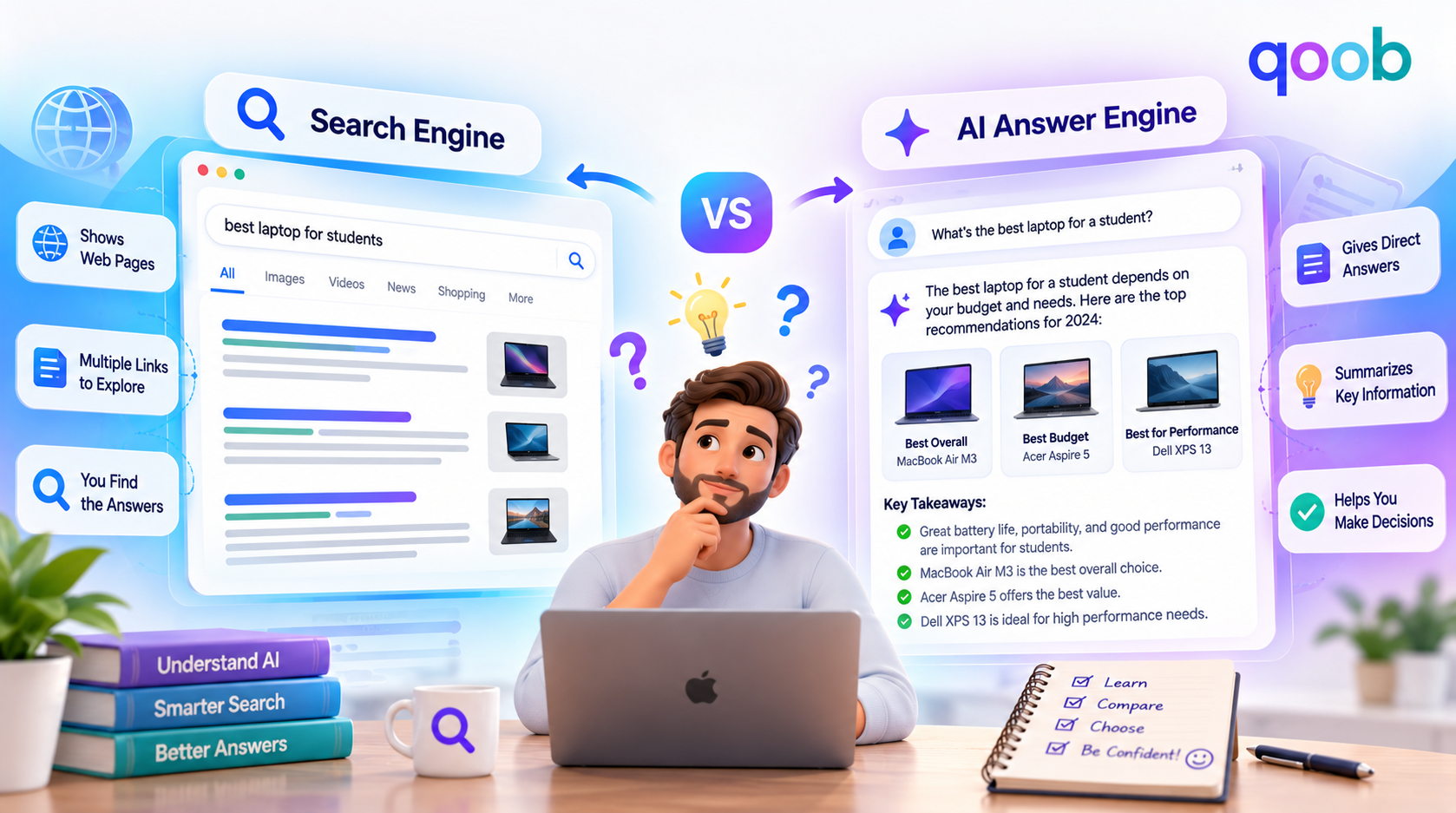
Search Engine vs AI Answer Engine
A traditional search engine is primarily designed to help you discover web pages.
An AI answer engine is designed to help you get to the useful information within those pages and organise it around your question.
|
Traditional Search Engine |
AI Answer Engine |
|
Returns a list of results |
Returns a direct response |
|
Focuses heavily on matching queries to pages |
Focuses on understanding intent |
|
Requires more browsing |
Reduces the need for repeated browsing |
|
You compare information yourself |
AI can summarise and organise information |
|
Useful for exploring many sources |
Useful for getting clear answers quickly |
This does not make traditional search obsolete.
Search engines remain useful when you want to browse sources, locate a specific website, read original documents or explore a topic from multiple perspectives.
The difference is that an AI answer engine is designed for the moments when your main goal is an answer rather than a list of places to look.
Why Smart Answers Matter
The phrase smart answers can sound vague, but the basic idea is simple.
A useful answer should respond to the question you actually asked.
Suppose you ask:
“What should I cook tonight with chicken, rice and broccoli?”
A traditional search engine may return recipes that contain those words.
A smarter search experience can consider the context and provide a few options based on the ingredients you mentioned.
That is particularly useful for everyday decisions.
You are not trying to become an expert in recipes. You are trying to decide what to make for dinner.
The Qoob describes this approach as smart search: understand the question, provide a concise response and help the user decide what to do next.
Why Short Answers Can Be More Useful
More information is not always better.
Imagine asking:
“Where should I go for a three-day weekend?”
You could receive hundreds of articles, travel guides and destination pages.
Or you could get a concise comparison of a few destinations based on your budget, interests and available time.
That is the role of short answers.
Short does not mean incomplete.
It means the answer focuses on the information most relevant to the question instead of making the user work through unnecessary material.
The Qoob’s search experience is specifically designed around short, useful answers instead of a long page of links or an oversized block of AI-generated text.
Direct Answers Change the Search Experience
A direct answer changes what happens after you enter a search.
With traditional search, the next step is often another search.
You find one result, open it, realise it does not quite answer your question and search again.
With an AI answer engine, the first response can become the starting point for a more focused interaction.
You can ask:
“Why?”
Then:
“What are the cheaper alternatives?”
Then:
“Which one is better for a beginner?”
The search becomes more conversational without requiring you to restart the process each time.
AI Answer Engines Understand More Than Keywords
Traditional search has become very good at interpreting queries, but its core output remains a ranked collection of pages.
AI answer engines move further towards understanding the meaning behind a question.
Consider these two searches:
“running shoes”
and
“I run three times a week on pavement and need comfortable shoes for longer distances. What should I look for?”
The second query tells the system much more about your goal.
An AI answer engine can use that context to shape the response around your actual situation.
That makes AI search particularly useful for recommendations, comparisons, explanations and everyday decisions. The Qoob’s current product positioning emphasises this decision-focused approach rather than simply returning pages that match keywords.
An AI Answer Engine Is Not Just a Chatbot
AI search and chat can look similar because both let you type questions.
The purpose can still be very different.
A general chatbot is often built around conversation, generation, brainstorming or open-ended interaction.
An AI answer engine is more focused on finding information and turning it into an answer.
The Qoob describes itself as a personal AI search and decision-making app rather than a general-purpose chatbot. Its purpose is to help users find useful information and make everyday decisions with concise responses.
That narrower purpose can be useful.
You do not always need an extended conversation.
Sometimes you just need to know which option makes more sense.
When Should You Use an AI Answer Engine?
AI answer engines are particularly useful when your question has a clear decision or explanation behind it.
For example:
Comparison: “Which of these two phones is better for photography?”
Planning: “How should I plan a four-day trip to Melbourne?”
Explanation: “Explain compound interest in simple terms.”
Recommendation: “What should I buy for a beginner home gym?”
Everyday decisions: “What can I make with the ingredients in my fridge?”
These questions are not just requests for webpages.
They are requests for help understanding or deciding.
When Traditional Search Is Still Better
An AI answer engine should not replace traditional search for every task.
There are times when you want the original source.
You may need to find a government website, read a company’s official policy, inspect a scientific paper or compare several sources yourself.
Traditional search is also useful when you want to discover information rather than receive a condensed answer.
The distinction is discussed in our comparison of AI search and traditional search, where the two approaches are positioned around different user needs.
The best approach is not always one or the other.
It is knowing which experience fits the question.
How an AI Answer Engine Builds a Better Response
The exact technology can vary between products, but the basic process can be understood in a few stages.
First, the system interprets the question.
Then, it determines what information is relevant.
It can retrieve or work with available information and organise it around the user’s intent.
Finally, it generates a response in a format that is easier to understand and act on.
That final step is important.
The objective is not merely to collect information.
It is to turn information into something useful.
This is why an answer engine can feel different from a traditional search engine even when both ultimately rely on information from the web.
Context Makes the Answer More Relevant
The more specific your question, the easier it is to produce a useful response.
Compare:
“Best restaurants?”
with:
“I want a quiet Italian restaurant for two people near the city centre, with a moderate budget. What should I consider?”
The second question gives the system a goal, constraints and context.
That does not mean you need to write long prompts.
The important information can often fit into one or two sentences.
The Qoob’s approach encourages users to ask questions naturally rather than learn specialised AI prompting techniques.
Why AI Answer Engines Are Useful for Everyday Questions
Not every search is important enough to justify extensive research.
Sometimes you want to settle a small question and move on.
Which ingredients work together?
Which neighbourhood should you stay in?
What should you compare before buying something?
What does a technical term mean?
Which option fits your budget?
These questions make up a large part of everyday search activity.
An AI answer engine can reduce the amount of time spent turning those small questions into research projects.
That is the basic philosophy behind The Qoob’s focus on concise answers for everyday decisions.
What Makes a Good AI Answer Engine?
The technology behind the answer matters, but so does the experience around it.
A useful AI answer engine should make it easy to ask questions in plain language.
It should provide answers that are relevant to the question rather than filling the screen with unnecessary information.
It should also make it easy to refine the question when the first answer is not enough.
And for information that matters, users should have a way to understand where the answer came from and verify important claims.
These factors are what turn AI from a novelty into a useful search tool.
The Qoob’s Approach to AI Answers
The Qoob focuses on a specific problem with modern search: too often, a simple question turns into a long browsing session.
Its smart search experience is built to provide concise answers and reduce the amount of manual searching needed for everyday decisions.
The idea is straightforward.
Ask naturally.
Get a useful answer.
Ask another question when you need more context.
Then move on.
You can see how this approach works through The Qoob’s AI answer engine, where the focus is on getting from a question to a useful response without unnecessary friction.
How to Get Better Answers From an AI Answer Engine
You do not need complicated prompting to improve your results.
Start by saying exactly what you need.
Instead of asking:
“Laptop?”
try:
“What should I look for in a laptop for remote work under $1,000?”
Then add constraints when they matter:
“Battery life matters more than gaming performance.”
Or:
“I travel twice a month, so portability is important.”
This gives the answer engine a better understanding of what matters to you.
For more practical guidance, The Qoob’s guide to getting better answers from AI Search explains how simple changes in the way you ask a question can improve the usefulness of the response.
Are AI Answer Engines Always Right?
No.
That is an important distinction.
An AI answer engine can produce a clear and confident response and still be wrong.
Information can be outdated, incomplete or misunderstood.
For ordinary questions, that may simply mean asking a follow-up or checking another source.
For important decisions involving health, finance, law, safety or other high-stakes matters, you should verify the information using reliable sources and qualified professionals where appropriate.
Clear answers are useful.
They should not be confused with guaranteed certainty.
The Future of Search May Be About Answers
For decades, search was built around the idea that users wanted to find pages.
That remains useful.
But people increasingly ask search engines questions that are really requests for help.
They want comparisons.
They want explanations.
They want recommendations.
They want to know what to do next.
That is why the idea of an AI answer engine matters.
It represents a shift from searching for information towards using information to answer a question.
The technology will continue to evolve, but the basic expectation is simple: people want useful information without unnecessary friction.
Final Thoughts
An AI answer engine is different from a traditional search engine because its primary goal is not simply to return links. It is designed to understand what you are asking and provide a response that helps you understand, compare or decide.
Traditional search remains valuable when you want to browse sources or find specific information.
AI answer engines are useful when you want to move from a question to a clear response.
For everyday searches, that difference can save time and reduce the work involved in finding useful information. The Qoob takes this approach further by focusing on smart answers, concise responses and search designed around everyday decisions.
When you want search to feel more like getting an answer and less like opening another dozen tabs, The Qoob is built around that idea.
Frequently Asked Questions
What is an AI answer engine?
An AI answer engine is a search system that uses artificial intelligence to understand a user’s question and provide a direct response rather than simply returning a list of webpages.
How is an AI answer engine different from a search engine?
A traditional search engine mainly helps users find webpages. An AI answer engine focuses on understanding the question and producing a concise response based on relevant information.
Are smart answers the same as AI answers?
Not necessarily. “Smart answers” is a broader term for answers that are designed to be relevant and useful to the user’s specific question. AI can be used to generate these answers.
Why are short answers useful?
Short answers can make everyday searches faster by presenting the key information without requiring users to open multiple pages and compare them manually.
Can an AI answer engine replace Google?
Not completely. Traditional search remains useful for finding specific websites, browsing sources and conducting broad research. An AI answer engine is better suited to questions where the main goal is a direct answer, comparison or recommendation.
Are direct answers always accurate?
No. AI-generated answers can contain mistakes or outdated information. Important information should be verified against reliable sources before you act on it.
How can I get better answers from an AI answer engine?
Ask clear questions and include useful context. Mention your goal, budget, preferences, timeframe or other constraints when they affect the answer. Follow-up questions can then help refine the result.
Leave a Reply