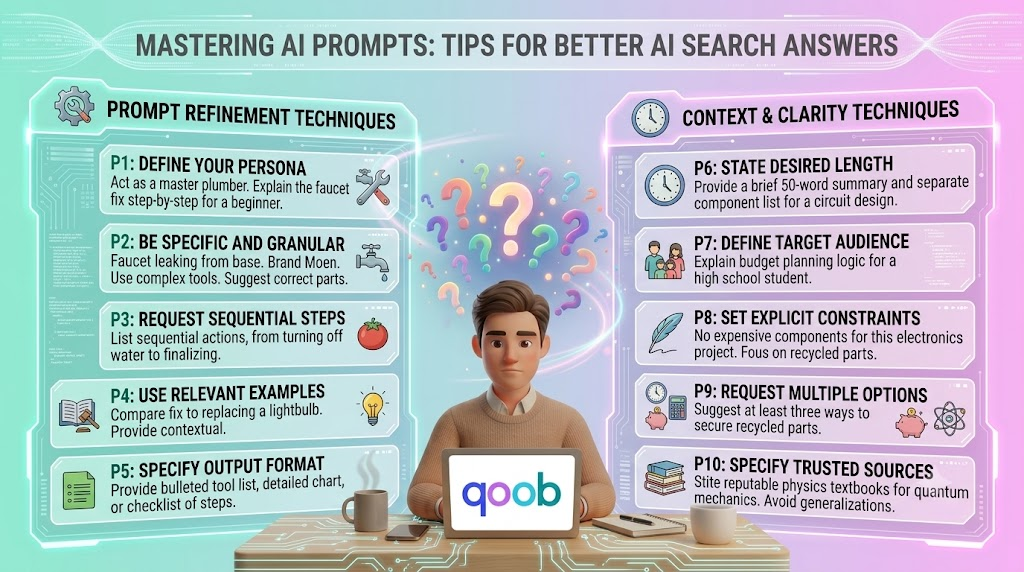
AI Search can save time, but the quality of the answer depends on the quality of the question. A short, vague prompt often leads to a broad reply. A clear prompt usually leads to a better one. That is why learning how to ask well is one of the most useful skills for everyday search.
If you want a more personal search experience, the AI Search approach from The Qoob is worth understanding. It shows how a better search flow can help you move from a simple question to a more useful answer without extra effort.
Why prompting matters
Many people think AI search is only about the tool itself. In reality, the prompt does most of the work. The same system can give two very different answers depending on how the question is written. A weak prompt may leave out context, goals, or limits. A strong prompt gives the tool enough information to respond in a useful way. That does not mean writing a long message every time. It means giving the right details.The goal is clarity, not complexity
You do not need technical language. You do not need special formatting. You only need to make the request easier to understand. The best prompts are often short, direct, and specific.What makes a better AI Search prompt
A good prompt usually answers four simple questions:- What do you want?
- What is the topic?
- What kind of answer do you need?
- What should the result help you do?
A simple prompt formula
A practical way to write prompts is to use this structure: Task + Topic + Context + Output style For example:- Explain this in simple language
- Compare these two options for home use
- Give me quick steps for fixing this
- Summarise this for a beginner
Everyday prompting tips that improve answers
The tips below work well for common questions. They are easy to use and do not require special knowledge.1. Be specific about the result you want
Do not just ask what something is. Ask what you need from the answer. For example:- Weak: Tell me about email marketing
- Better: Explain email marketing for a small business owner
- Better still: Explain email marketing for a small business owner in simple steps
2. Add the level of detail you want
Some questions need a short answer. Others need more detail. AI Search works better when you say which one you want. For example:- Give me a short summary
- Explain it in simple terms
- Give me three practical examples
- Break it into steps
3. Give context when the topic is not obvious
Context helps AI Search avoid guessing. It also helps the response fit your situation better. For example:- I need this for a work email
- I am new to this topic
- I want a comparison for personal use
- I need a quick answer before a meeting
4. Ask for the format you want
Sometimes the answer is fine, but the structure is not. You can fix that by asking for a clear format. For example:- Give me a bullet list
- Show me a table
- Write it in plain English
- Summarise the main points first
5. Use follow-up questions
Good AI Search use often happens in two steps. The first answer gives you a starting point. The second question makes it better. For example:- Can you make that shorter?
- Can you explain the second point more clearly?
- What would this look like in practice?
- Can you compare that with the other option?
6. Avoid packed questions
When one prompt contains too many unrelated things, the answer can become messy. Try to keep one main goal per question. For example:- Weak: Compare these tools, explain the differences, and tell me which one is better for a beginner
- Better: Compare these tools for a beginner
- Better still: Compare these tools for a beginner and show the differences in a table
Good and bad prompt examples
The table below shows how small changes can improve the result.| Weak prompt | Better prompt | Why it works better |
|---|---|---|
| Tell me about AI search | Explain AI search in simple terms | Gives the tool a clear task and tone |
| Compare these two tools | Compare these two tools for daily use | Adds the use case |
| How do I do this? | Give me step-by-step instructions for this task | Makes the format clear |
| What is the best one? | Which one is better for a beginner and why? | Defines the audience |
| Help me understand this | Summarise this in plain language with one example | Improves focus and output style |
How to ask better questions for everyday use
Everyday questions are usually simple on the surface, but they still benefit from a little structure.For quick facts
Use short prompts like:- What does this mean?
- Why is this happening?
- What is the difference?
- What should I know first?
For decisions
When you need help choosing, ask for comparison and reasoning. For example:- Which option is better for a small team?
- What are the pros and cons of each one?
- Which one is easier to use?
- Which one saves more time?
For how-to questions
When asking for steps, say so clearly. For example:- Show me the steps
- Explain the process simply
- Give me a beginner guide
- Tell me what to do first
For writing help
AI Search can also improve wording. For example:- Rewrite this in plain language
- Make this sound more professional
- Shorten this message
- Make this easier to understand
How The Qoob supports better search habits
Good prompting becomes even more useful when the search tool is built around clear, personal use. That is part of The Qoob’s approach. If you want to understand the platform from the ground up, the homepage is a useful place to start. The real value is not only in answering questions. It is in helping users shape better questions and get a result that fits the moment. For a deeper view of how the product is framed, the Why Qoob page gives more context on the thinking behind the platform.A simple checklist before you hit enter
Before you send a prompt, check these points:- Is the question specific enough?
- Did I add the context that matters?
- Did I say how detailed I want the answer?
- Did I mention the format I need?
- Is there a simpler way to ask this?
When a better prompt changes the outcome
A stronger prompt can save time, reduce confusion, and give you a better first answer. That matters most when you are asking about everyday topics that come up often. Think about how often people search for things like:- A short explanation
- A simple comparison
- A quick next step
- A better way to phrase something
- A plain-language summary
A few prompt templates you can reuse
Here are some simple templates you can adapt:- Explain [topic] in simple terms
- Compare [option A] and [option B] for [use case]
- Give me three steps to solve [problem]
- Rewrite this message to sound clearer
- Summarise this for a beginner in plain English
FAQ
What is AI Search?
AI Search is a way of asking questions that uses artificial intelligence to return direct, useful answers instead of only a list of links.
Why do prompts matter so much?
Prompts matter because the tool uses your wording to decide what kind of answer to give. Clear prompts usually lead to better results.
How long should an AI Search prompt be?
It should be as short as possible while still giving enough context. A few clear words are often enough.
Can I ask follow-up questions?
Yes. Follow-up questions are one of the best ways to improve the first answer and make it more useful.
What is the easiest way to get better answers?
Be specific, add context, and say what kind of answer you want. That usually improves the result right away.