Tag: AI technology

  • From Amazon to Qoob: How Mikael Quist Keeps a Simple App Reliable

    From Amazon to Qoob: How Mikael Quist Keeps a Simple App Reliable

    Quick Answer: Mikael Quist is the CTO of Qoob Technologies. Before Qoob, he led technology and infrastructure work at Amazon, including Amazon Prime’s technology and global freight routing. That experience is why Qoob, a personal AI search app, can feel simple to use: ask a plain question, get one short, relevant answer, and move on.

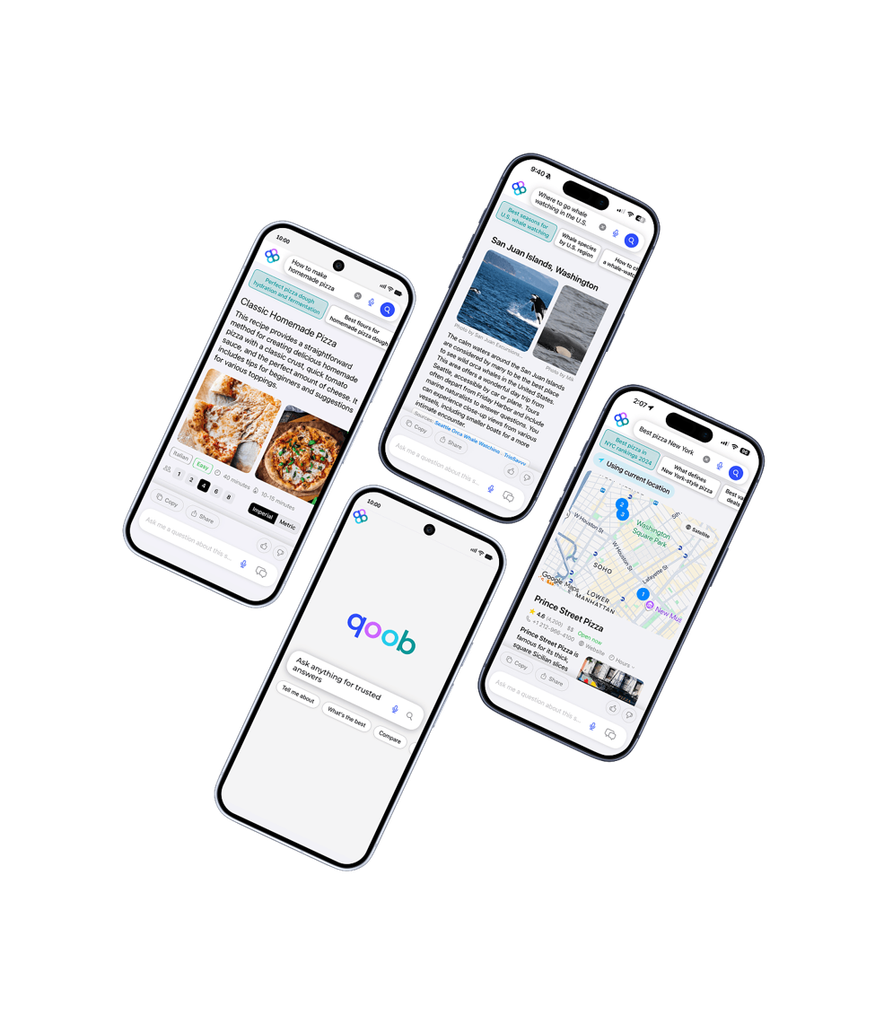
    Most people never think about what’s running behind an app they use to answer a quick question. That’s the point. Qoob is a personal AI search app built to feel simple: ask a plain question, get one short answer, get on with your day. Making that feel effortless takes serious engineering underneath, and that’s where Qoob CTO Mikael Quist comes in.

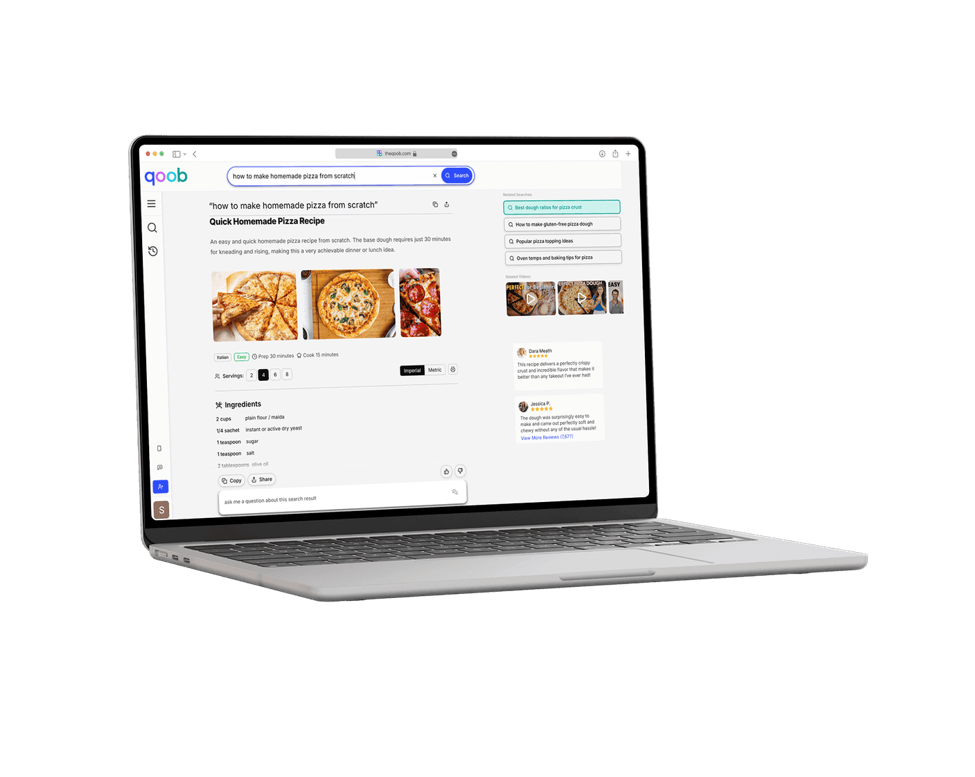
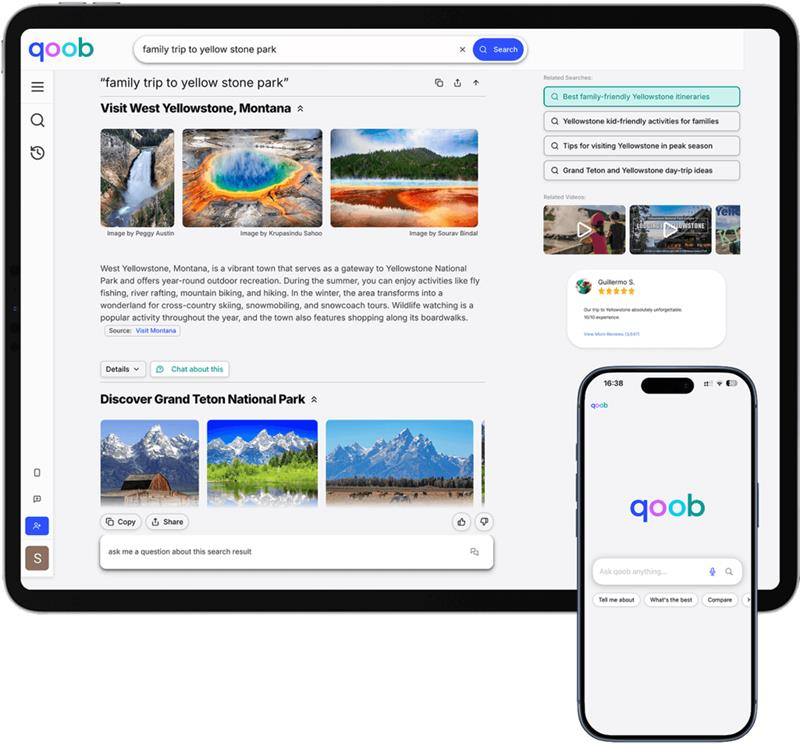
    Qoob personal AI search app giving one short answer on a phone

    A background built for scale

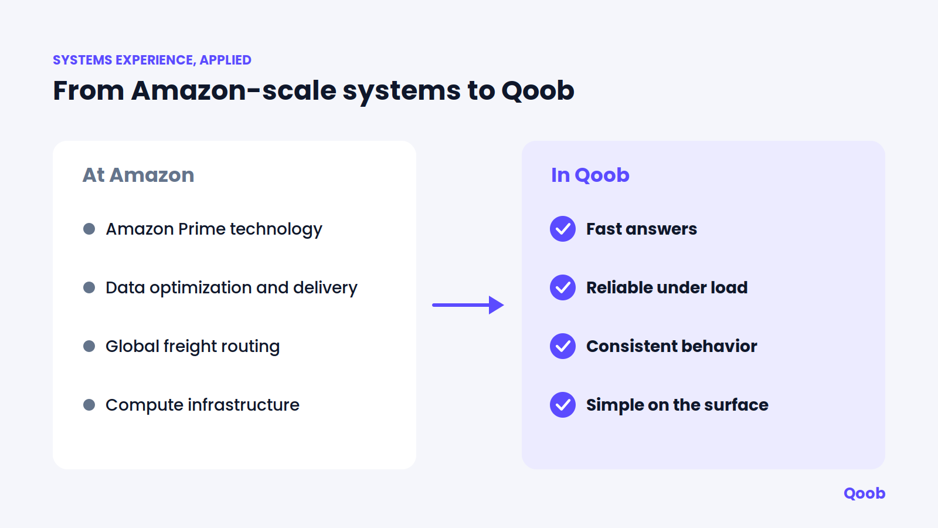
    Before joining Qoob, Quist spent years leading technology, engineering, and compute infrastructure work at Amazon. His work there included:

    • Scaling parts of Amazon Prime’s technology
    • Data optimization and delivery systems
    • Global freight routing, work that helped create billions in value

    That kind of experience teaches more than how to write code. It teaches how systems behave under real pressure, at real scale, with real consequences when something breaks. Quist also has a wider background across IT, including multi-platform data centers and large-scale energy optimization. He holds an MS in Industrial and Systems Engineering from the University of Minnesota.

    That mix of software, systems, and operations thinking is exactly what a product like Qoob needs behind the scenes.

    Amazon-scale systems experience applied to Qoob

    Why reliability matters more in AI search

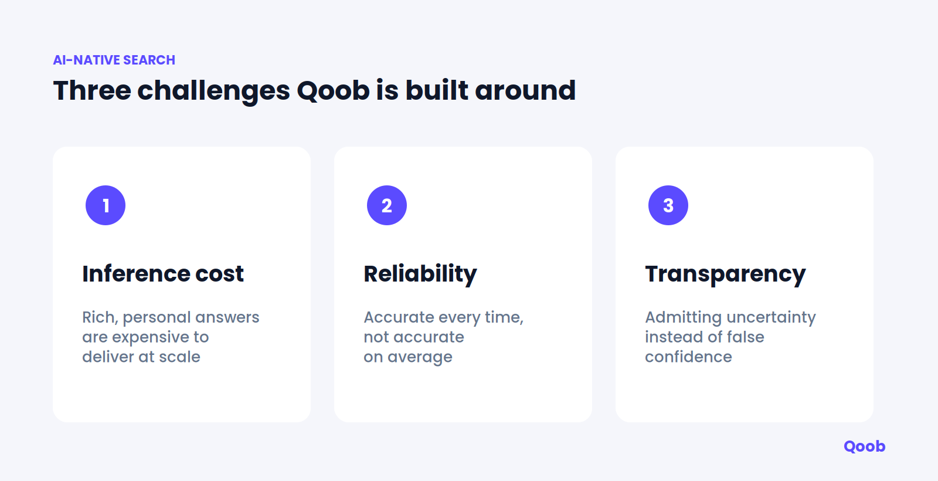
    In a recent interview with Information Security Media Group (ISMG), Quist explained why AI-native search faces a different set of challenges than traditional search engines:

    • High inference costs, which make rich, personalized answers harder to deliver at scale
    • Reliability, since answers need to be consistently accurate, not accurate on average
    • Transparency, especially admitting uncertainty instead of answering with false confidence
    Three challenges of AI search: inference cost, reliability, transparency

    These aren’t abstract concerns. They’re operational problems, and someone who has run large systems at Amazon scale is well placed to solve them. It’s a big part of why Quist’s background translates directly into how Qoob AI is built.

    Preparing for the shift from answers to actions

    Quist has also talked about where search goes next: from systems that answer questions to AI that can take action on your behalf. Most of today’s search infrastructure wasn’t built for that:

    • Results pages designed to hand traffic to other sites, not finish tasks
    • Ad systems built around clicks and impressions rather than outcomes

    Meeting that shift means building with different assumptions from day one. That’s a core part of Quist’s role at Qoob: making sure the systems underneath deliver fast, reliable answers now, while leaving room for more capable features later. For his full take, read why keyword search is reaching its limit.

    Trust comes from consistent behavior

    Quist has been clear that trust in AI isn’t about good intentions. It comes from consistent behavior over time. In practice that means:

    • Systems that behave reliably, not only most of the time
    • Answers that stay consistent with the context a user has shared
    • Design that keeps users in control of their own personal context

    You can see this in the product. Users stay in control of the context Qoob uses, and the answer itself stays clean of ads. Learn more on the Qoob Difference.

    What this means for you

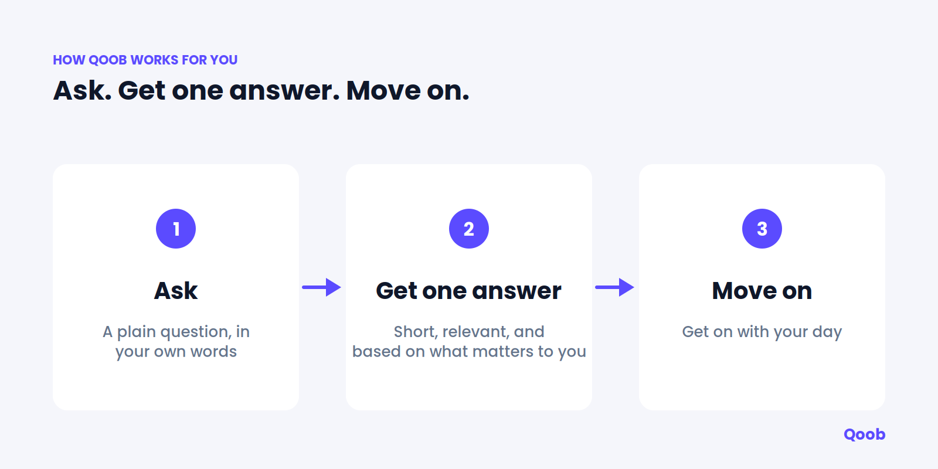
    Quist’s job is to keep the complexity behind the curtain so the experience in front of it stays simple:

    • Ask a question in plain language
    • Get one short, relevant answer
    • Move on with your day
    Three-step Qoob experience: ask, get an answer, move on

    That simplicity is only possible because of the work happening underneath. Read more about how the product works on About Qoob, or the bigger picture on Why Qoob.

    Qoob leadership team including AJ Javan and Mikael Quist

    Curious to see it in action? Get the app for free, or sign in if you already have an account.

    FAQ

    What is Mikael Quist’s professional background?

    He spent years leading technology, engineering, and compute infrastructure work at Amazon, including Amazon Prime’s technology and global freight routing, before joining Qoob Technologies as CTO.

    What is Mikael Quist’s educational background?

    He holds an MS in Industrial and Systems Engineering from the University of Minnesota.

    Why does infrastructure experience matter for a personal AI search app?

    Delivering fast, reliable, personalized answers at scale takes strong systems engineering, not only a good product idea.

    What challenges does Mikael Quist see in AI-native search?

    High inference costs, reliability of answers, and transparency about uncertainty.

    How does Mikael Quist’s thinking shape Qoob’s approach to trust?

    Through consistent system behavior, user control over personal context, and an answer that stays clean of ads.

    Where can I learn more about Qoob and its team?

    Visit About Us to meet the full leadership team, including founder AJ Javan.

  • AJ Javan’s Playbook for Building Companies That Last

    AJ Javan’s Playbook for Building Companies That Last

    Quick Answer: AJ Javan, Founder and CEO of Qoob Technologies, has built and scaled companies across energy, real estate, finance, and AI for more than 25 years. Qoob, his personal AI search app, follows the same playbook: solve a real problem, build for reliability, and hire operators who’ve already done it at scale.

    Plenty of founders launch one successful company. Fewer do it across several industries, several decades, and several economic cycles. AJ Javan, Founder and CEO of Qoob Technologies, has spent more than 25 years doing exactly that. Qoob, a personal AI search app for everyday decisions, is the latest company built on the same principles that shaped his earlier ventures. Read the story behind Qoob for how it started.

    Range, not repetition

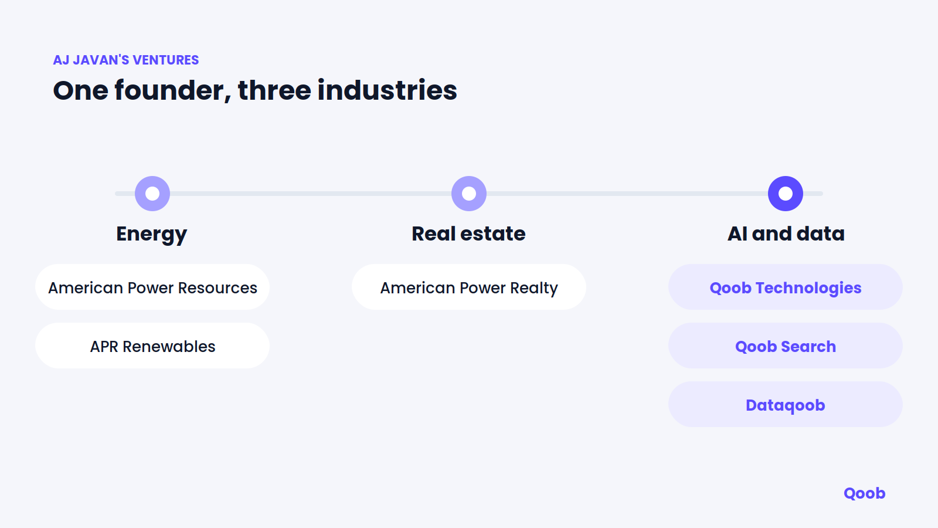
    AJ’s career spans:

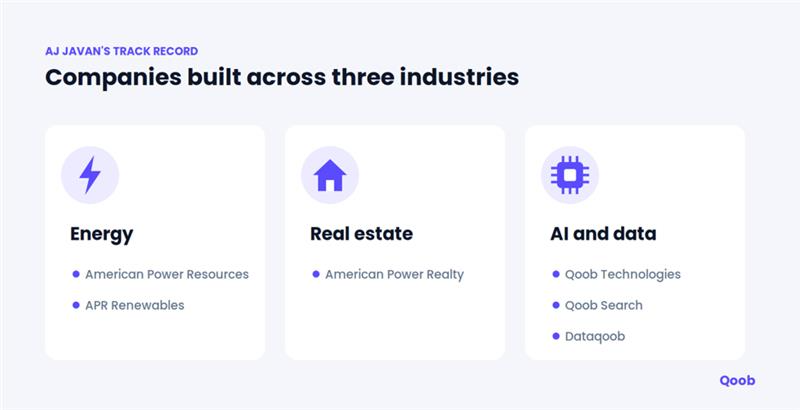
    • Energy, through American Power Resources and APR Renewables
    • Real estate, through American Power Realty
    • AI and data, through Qoob Technologies, Qoob Search, and Dataqoob
    Map of companies founded by AJ Javan across energy, real estate, and AI

    Each of these needed a different skill set, from regulated energy markets to consumer software. That range is part of what makes Qoob different. AJ isn’t building a product in a vacuum. He’s applying lessons from companies that had to work at scale, under real market pressure, for demanding clients.

    Built for the most demanding clients in finance and energy

    Over his career, AJ’s companies have delivered products for institutions including:

    • Goldman Sachs
    • BlackRock
    • Brookfield
    • NextEra

    Delivering for organizations like these takes more than a good idea. It takes reliability, rigor, and the discipline to scale without cutting corners. That same discipline shows up in Qoob. It’s built to work consistently for everyday users, not only in a demo.

    Qoob personal AI search app answering an everyday question on a phone

    What backing from experienced investors says

    AJ is backed by private equity, venture capital, and family offices. That kind of support usually reflects three things:

    • A track record of turning early companies into profitable businesses
    • Confidence from investors who’ve seen the model work before
    • The ability to execute a long-term plan, not only a short-term idea

    Add his education at Harvard Business School and Wharton, and you get a founder with both the hands-on experience of building companies and the training to structure and scale them properly.

    The principles behind Qoob

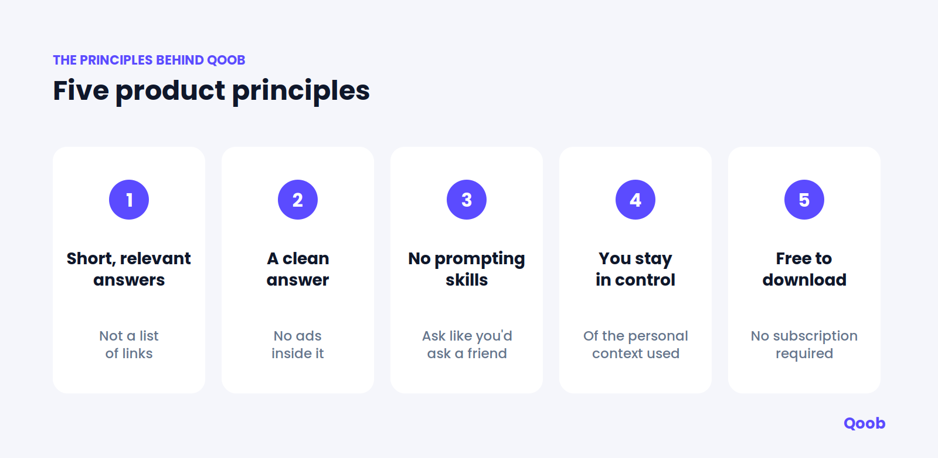
    AJ has been open about what led to Qoob: everyday decisions had turned into research projects. That frustration became a short list of product principles:

    • Answers should be short and relevant, not a list of links to sort through
    • The answer itself should stay clean. Ads don’t belong inside it.
    • Nobody should need to learn prompting to get something useful
    • People should stay in control of the personal context Qoob uses
    • The app should be free to download, with no subscription required
    Qoob product principles: short answers, clean answer block, no prompting required

    These aren’t small details. They’re a deliberate stance against how most search tools and AI chatbots work today. Read more about that stance on the Qoob Difference, and see it in the product on About Qoob.

    The right team around the vision

    A playbook is only as good as the people running it. AJ built Qoob’s leadership around operators with directly relevant experience:

    • Mikael Quist, CTO, who led technology and infrastructure work at Amazon before joining Qoob
    • Ed Pliner, CFO, who brings financial discipline to the company’s growth
    Qoob leadership team: AJ Javan, Mikael Quist, and Ed Pliner

    This mirrors a pattern across AJ’s earlier ventures: pair a clear product vision with people who’ve already proven they can execute at scale. Meet the full team on the About Us page.

    Where Qoob fits in a bigger picture

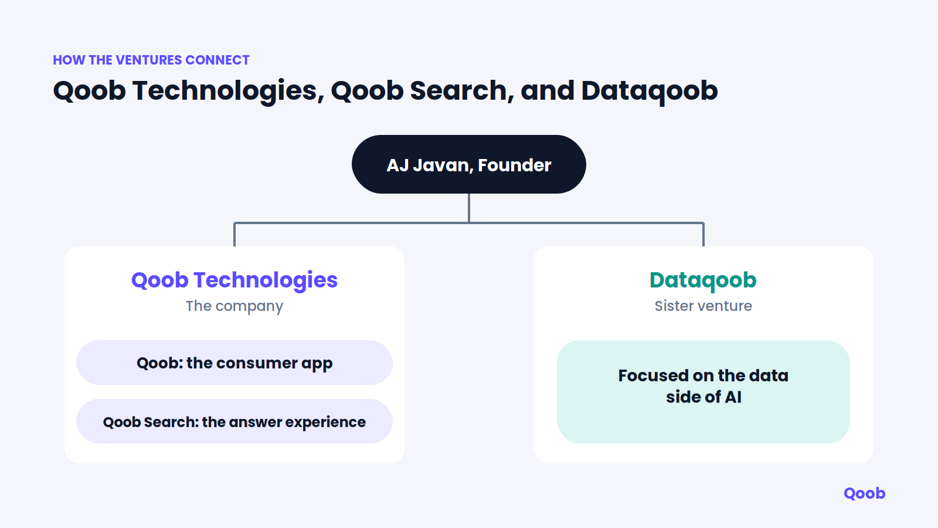
    Qoob isn’t AJ’s only bet on the future of AI. Alongside Qoob Technologies and Qoob Search, he founded Dataqoob, which focuses on the data side of AI. Taken together, they point to one thesis: the tools people use to search and decide are due for a rebuild, and so is what powers them. Qoob is the consumer-facing half of that idea.

    Qoob Technologies, Qoob Search, and Dataqoob company relationship

    Follow the Qoob blog for updates as that vision takes shape. Want to see the product first? Get the app for free, or sign in if you already have an account.

    FAQ

    What industries has AJ Javan worked in?

    AJ Javan has built companies across energy, real estate, finance, and AI. His current focus is Qoob Technologies, the company behind the Qoob personal AI search app.

    Which clients have AJ Javan’s companies delivered for?

    His companies have delivered products for institutions including Goldman Sachs, BlackRock, Brookfield, and NextEra.

    What is AJ Javan’s educational background?

    He attended Harvard Business School and Wharton.

    What principles guide how AJ Javan built Qoob?

    Short, relevant answers. A clean answer with no ads inside it. No prompting skills required. User control over personal context. Free to download with no subscription.

    What other companies has AJ Javan founded besides Qoob?

    American Power Resources, APR Renewables, American Power Realty, and Dataqoob.

    Who leads the rest of the Qoob team?

    Mikael Quist serves as CTO and Ed Pliner as CFO. See the full team on the About Us page.

  • Meet AJ Javan: The Founder Behind Qoob

    Meet AJ Javan: The Founder Behind Qoob

    Quick Answer: AJ Javan is the Founder and CEO of Qoob Technologies, the company behind Qoob, a personal AI search app. After more than 25 years building companies across energy, real estate, finance, and AI, he built Qoob to fix a problem he kept running into himself: everyday questions shouldn’t take a research project to answer.

    Every product has an origin story. Qoob’s starts with a founder who got tired of how much work a simple question had become. AJ Javan, Founder and CEO of Qoob Technologies, spent more than 25 years building companies across energy, real estate, finance, and AI. Qoob, a personal AI search app, is his answer to a problem he kept hitting in his own day: small decisions shouldn’t need ten tabs and a scroll through ads.

    A track record built across industries

    AJ’s career doesn’t sit in one lane. He’s built businesses in energy, real estate, finance, and AI, and those businesses have delivered products for some of the largest institutions in the world, including:

    • Goldman Sachs
    • BlackRock
    • Brookfield
    • NextEra

    Working with clients like these shaped how he builds today. Reliability comes first. An interesting idea only counts if it works every day, for real people, under real pressure.

    Over the course of his career, AJ has founded:

    • American Power Resources and APR Renewables, in energy
    • American Power Realty, in real estate
    • Qoob Technologies, Qoob Search, and Dataqoob, in AI and data
    Icons for the industries AJ Javan has built companies in: energy, real estate, and AI

    Backed by experienced investors

    AJ is backed by private equity, venture capital, and family offices. That kind of support tends to follow founders who’ve already turned early companies into durable, profitable businesses more than once. His formal training comes from Harvard Business School and Wharton, and it shows in how he structures and scales what he builds.

    Why AJ built Qoob

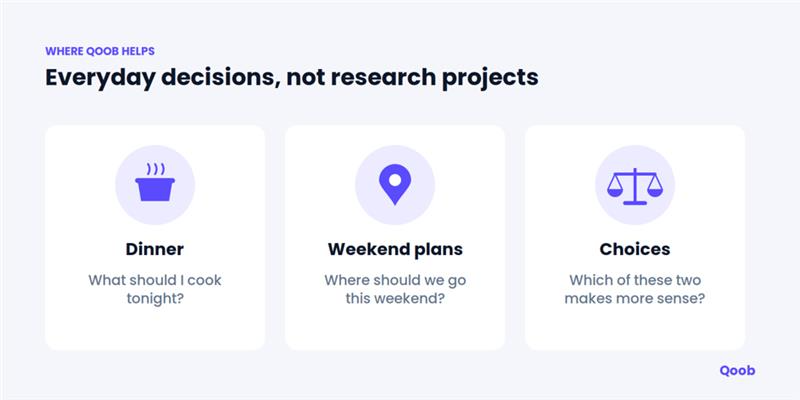
    The idea behind Qoob is simple. Most of what fills a day isn’t deep research. It’s small decisions:

    • What to cook tonight
    • Where to go this weekend
    • Which of two options makes more sense
    Everyday decisions Qoob helps with: dinner, weekend plans, shopping choices

    AJ’s view is that the tools built for these moments drifted away from the person asking. Search engines are built to sell ad space. AI chatbots often expect you to learn how to prompt before you get a usable answer. Either way, the work lands back on you.

    Qoob was built to take that work off your plate. It’s a personal AI search app that takes a plain question and gives back one short, relevant answer that fits what matters to you. That means:

    • Answers, not a list of links to sort through
    • No prompting skills needed. Ask the way you’d ask a friend.
    • Free to download, with no subscription required
    Qoob personal AI search app shown on an iPhone with a short answer on screen

    You can see how that works in practice on About Qoob, or compare it with the tools you use today on the Qoob Difference.

    Building a team to match the vision

    AJ hasn’t built Qoob alone. The leadership team brings deep experience in large-scale technology and finance:

    Qoob leadership team: AJ Javan, Mikael Quist, and Ed Pliner

    They share one belief: search should serve the person asking, not the algorithm ranking the results. Meet the full team on the About Us page, or read how AJ builds companies that last.

    What’s next

    Qoob is still early, and AJ is open about the fact that the ambition goes beyond one app. Qoob Technologies is part of a broader push into AI-native tools, alongside ventures like Dataqoob. For now, the focus is where it started: making everyday questions easier to answer.

    Download Qoob for free on iOS and Android

    Curious what AJ built? Get the app for free, or sign in if you already use Qoob.

    FAQ

    Who is AJ Javan?

    AJ Javan is the Founder and CEO of Qoob Technologies, the company behind Qoob, a personal AI search app. He’s a serial entrepreneur with more than 25 years of experience across energy, real estate, finance, and AI.

    What is Qoob?

    Qoob is a personal AI search app that gives short, relevant answers based on what matters to the user. It’s built for everyday decisions like travel, recipes, shopping, and planning.

    What other companies has AJ Javan founded?

    American Power Resources, APR Renewables, and American Power Realty in energy and real estate, plus Qoob Technologies, Qoob Search, and Dataqoob in AI and data.

    What is AJ Javan’s educational background?

    He attended Harvard Business School and Wharton.

    Why did AJ Javan start Qoob?

    He built Qoob to solve a problem he ran into himself: everyday decisions had turned into research projects because search engines and AI chatbots put too much work back on the user.

    How can I try Qoob?

    Download Qoob for free on iOS or Android. No subscription required.

  • AI for Beginners: How to Start Using AI Search Without Feeling Overwhelmed

    AI for Beginners: How to Start Using AI Search Without Feeling Overwhelmed

    Artificial intelligence can seem complicated when you are just getting started. There are new tools, unfamiliar terms, endless features and plenty of opinions about what AI can and cannot do.

    For many people, the hardest part is not learning how AI works. It is knowing how to use AI in a way that feels useful rather than overwhelming.

    You do not need to understand machine learning, write complicated prompts or experiment with dozens of AI tools. A better starting point is much simpler: ask a question, see what you get, and learn how to improve the result.

    That is where AI search can be especially useful for beginners.

    Instead of learning a complex workflow first, you can use natural language to ask questions you already have. An answer can then help you decide what to ask next.

    What Is AI Search?

    AI search uses artificial intelligence to understand a question and provide a direct response rather than simply returning a page of search results.

    Traditional search often gives you a list of links. You then open several pages, compare information and decide which result answers your question.

    AI search aims to reduce some of that work by understanding the meaning and context of your query.

    For a beginner, that difference matters because you do not need to learn a special search language.

    You can ask:

    “Explain inflation in simple terms.”

    Or:

    “What should I know before buying my first laptop?”

    Or:

    “Compare these two options for someone on a budget.”

    The question itself becomes the starting point.

    AI for Beginners: Start With Questions You Already Ask

    You do not need to search for an impressive AI use case.

    Start with ordinary questions.

    Think about the things you already search for during the week. You may want help comparing products, understanding a confusing topic, planning a trip, deciding what to cook or rewriting something more clearly.

    Those are good starting points because you already understand the problem.

    For example, instead of searching several websites for dinner ideas, you might ask:

    “I have eggs, tomatoes, rice and spinach. What can I make for dinner in 20 minutes?”

    Instead of searching through multiple articles about a technical term, you might ask:

    “Explain cloud computing as if I have never worked in technology.”

    The objective is not to use AI for everything.

    It is to find the situations where it can save you effort.

    You Do Not Need to Know How AI Works to Use It

    This is one of the biggest misconceptions for beginners.

    You can use AI without understanding neural networks, large language models or the technical infrastructure behind them.

    It is similar to using a calculator. You do not need to know how the calculator is engineered to use it for everyday maths.

    The same principle applies here.

    A beginner only needs to understand a few basic ideas:

    AI works from the information in your question, answers can vary in quality, and the way you phrase a request can affect the result.

    Once you understand those three things, the learning curve becomes much smaller.

    How to Use AI Without Writing Complicated Prompts

    There is a lot of content online suggesting that you need elaborate prompt formulas to get useful AI answers.

    That is not always necessary.

    A good beginner prompt can be one or two sentences.

    Compare these two questions:

    “Marketing?”

    and

    “Explain digital marketing in simple terms for someone starting a small business.”

    The second question gives the AI a clear task and audience.

    You can improve it even more by adding a specific goal:

    “Explain digital marketing in simple terms for someone starting a small business, and give me three practical ways to begin.”

    You do not need to make every prompt long. You simply need to give the tool enough information to understand what you are trying to accomplish.

    Our guide to better AI search prompts covers this approach in more detail, including how adding context and specifying the type of answer you want can improve results.

    The Easiest Prompt Formula for Beginners

    A simple structure can help when you do not know what to type.

    Think:

    Task + Topic + Context

    For example:

    Task: Explain

    Topic: investing

    Context: for someone who has never invested before

    Put them together:

    “Explain investing for someone who has never invested before.”

    You can then add the output you want:

    “Explain investing for someone who has never invested before and give me five basic concepts to understand first.”

    This is enough for many everyday searches.

    There is no need to make the prompt sound technical.

    Ask for Easy Answers When You Need Them

    One of the most useful habits for beginners is telling AI how you want the information explained.

    If you are new to a subject, say so.

    Try phrases such as:

    “Explain this in plain English.”

    “Assume I know nothing about this.”

    “Give me a simple example.”

    “Break this into three steps.”

    “Keep the answer brief.”

    This can make a big difference when a topic feels intimidating.

    The Qoob’s easy answers approach is built around making everyday search questions simpler to understand and easier to act on.

    The goal is not to remove useful detail. It is to remove unnecessary complexity.

    What Does “Honest AI” Mean?

    You may also come across phrases such as honest AI.

    The idea is straightforward: an AI tool should not encourage you to treat every answer as automatically correct.

    AI can be useful, but it can also make mistakes, misunderstand a question or present uncertain information too confidently.

    For beginners, one of the best habits is to ask follow-up questions instead of immediately accepting an answer.

    For example:

    “How confident are you?”

    Or:

    “What part of this should I verify?”

    Or:

    “Can you explain where this conclusion comes from?”

    This helps you treat AI as a tool for understanding rather than an unquestionable authority.

    For important subjects such as medical, legal, financial or safety matters, information should be checked against reliable sources and qualified professionals where appropriate.

    Your First AI Search Session Does Not Need to Be Complicated

    Imagine you have never used AI search before.

    Start with a problem you actually have.

    You might ask:

    “I need to choose between two laptops for office work. What should I compare?”

    The response may give you a list of factors.

    Then ask:

    “Which three factors matter most if battery life and portability are my priorities?”

    Then:

    “Create a simple comparison checklist I can use while shopping.”

    Notice what happened.

    You did not create one massive prompt.

    You started with a question and refined the answer.

    That is one of the easiest ways to learn how to use AI because you learn while solving a real problem.

    Follow-Up Questions Are a Beginner’s Best Friend

    Many people think they have to write the perfect first prompt.

    You do not.

    AI search becomes much more useful when you treat the first answer as a starting point.

    Suppose you ask:

    “What is a mortgage?”

    You might follow up with:

    “Explain that with a simple example.”

    Then:

    “What costs should I watch out for?”

    Then:

    “What should a first-time buyer compare?”

    You are building understanding one question at a time.

    This is often easier than trying to predict every detail you need before you start.

    When Traditional Search Is Still Better

    AI search is useful, but it is not the best option for every task.

    Traditional search can be better when you want to browse many sources, locate a specific website, read an original document, explore a topic broadly or compare multiple pages yourself.

    AI search is often more useful when your main goal is to understand something, compare options or decide what to do next.

    Our guide to AI search versus traditional search explains this difference in more detail.

    You do not have to choose one tool for everything.

    Good digital habits often involve using the right tool for the job.

    How Beginners Can Avoid Information Overload

    AI is supposed to make things easier, but using too many AI tools at once can have the opposite effect.

    You do not need five chatbots, three browser extensions and a collection of specialised apps to get started.

    Pick one tool.

    Use it for a few everyday tasks.

    Learn what works.

    Then expand when you have a reason to.

    You should also be clear about what information you share.

    Do not paste passwords, private account information, confidential business material or other sensitive information into an AI tool unless you have a clear reason to do so and understand how that service handles your data.

    Our discussion of AI search privacy explains why privacy is an important part of developing good AI-search habits.

    A Simple Beginner Workflow

    A practical way to start is to use this five-step process:

    Ask. Start with the question you actually need answered.

    Clarify. Add context if the first answer is too broad.

    Refine. Ask a follow-up question when you need more detail.

    Check. Verify important facts rather than assuming the answer is always correct.

    Act. Use the answer to make a decision, complete a task or understand the next step.

    This approach keeps AI practical.

    You are not learning AI for the sake of learning AI. You are learning how to use it to solve problems.

    Common Mistakes AI Beginners Make

    Trying to sound technical

    You do not need phrases such as “act as an advanced reasoning agent” unless they genuinely improve the task. Plain language is usually enough.

    Asking questions that are too vague

    “Tell me about marketing” can produce a broad answer. “Explain marketing for a local café owner” gives the AI a much clearer job.

    Treating the first response as final

    The first answer may be useful, but follow-up questions can make it more relevant to your actual needs.

    Using AI when a direct source is better

    When you need an official rule, current policy, original document or specific website, go to the source and verify it.

    Sharing more personal information than necessary

    Give the AI the context it needs, but remove details that are irrelevant to the question and unnecessarily sensitive.

    What Makes an AI Tool Beginner-Friendly?

    The best beginner experience is not necessarily the one with the most features.

    A useful tool should make it easy to understand what to ask, easy to refine the answer and easy to get back to the actual decision.

    That is one reason direct answers can feel less intimidating than a long search-results page.

    Instead of opening ten links to understand a basic concept, you can start with one clear question and continue from there.

    For someone exploring AI for beginners, that can make the technology feel less like a technical subject and more like another everyday tool.

    Why Simple AI Use Cases Are a Good Starting Point

    You do not need to begin with advanced research, coding or automation.

    Start with things such as:

    Learning: “Explain this concept in simple terms.”

    Planning: “Help me organise a three-day trip.”

    Comparing: “Compare these two products for home use.”

    Writing: “Make this email clearer and more professional.”

    Decision-making: “What should I consider before choosing between these options?”

    These tasks are easy to understand and easy to evaluate.

    You know whether the answer helped.

    That makes them ideal for learning how AI works in practice.

    How The Qoob Can Fit Into a Beginner’s Search Routine

    The Qoob is designed around a straightforward search experience where users can ask questions naturally and receive answers aimed at the decision or information need behind the query.

    For beginners, that means you can focus less on learning a complex interface and more on learning how to ask useful questions.

    You can start with a simple query, add context, ask follow-ups and decide whether the answer is enough. That is a much more practical introduction than trying to learn every AI feature at once.

    The important thing is to build confidence gradually.

    Use AI for small tasks first. Pay attention to how your questions affect the answers. Learn when you need more context, when you need verification and when traditional search is the better option.

    Your First AI Habit Should Be Simple

    The biggest change AI brings to search is not that you can ask difficult questions.

    It is that you can ask questions in the way you naturally think.

    You do not need to turn your thoughts into a list of keywords.

    You can explain the problem.

    You can ask for a simpler explanation.

    You can change your mind.

    You can ask another question.

    That makes AI much easier to approach as a beginner.

    Instead of thinking, “I need to learn AI,” think:

    “I have a question. Can AI help me answer it?”

    That is a much easier place to start.

    Final Thoughts

    Getting started with AI does not require technical knowledge or a complicated setup. Start with ordinary questions, explain what you need, add context when necessary and use follow-up questions to improve the result.

    The best beginner habit is also the simplest: stay curious, but stay critical. Ask AI for explanations, ideas and comparisons, while checking important information before you act on it.

    For a simpler way to explore everyday AI search, The Qoob provides a practical starting point for asking questions and getting useful answers without making the process feel more complicated than it needs to be.

    Frequently Asked Questions

    What is AI for beginners?

    AI for beginners refers to learning how to use artificial intelligence in simple, practical ways without needing technical expertise. Everyday uses include asking questions, explaining difficult topics, comparing options and planning tasks.

    How do I use AI for the first time?

    Start with a question you already want answered. Explain what you need in plain language, add relevant context and ask a follow-up question when the first response is not specific enough.

    Do I need to learn prompting to use AI?

    You do not need advanced prompt-writing skills. Clear, specific questions usually provide a good starting point, and you can improve the answer through follow-up questions.

    What is an honest AI?

    “Honest AI” generally refers to an approach where AI should communicate information responsibly and avoid creating a false impression of certainty. Users should still verify important information rather than treating AI-generated answers as automatically correct.

    What are easy answers in AI search?

    Easy answers are responses presented in a clear, accessible way so users can understand the key information without unnecessary complexity. Asking for plain language, examples or step-by-step guidance can help.

    Is AI search better than traditional search?

    Neither is universally better. AI search can be useful for direct explanations, comparisons and everyday decisions, while traditional search remains valuable when you want to browse sources, visit specific websites or conduct broader research.

  • Your Search History Is a Diary: Why Private AI Search Matters More Than Ever

    Your Search History Is a Diary: Why Private AI Search Matters More Than Ever

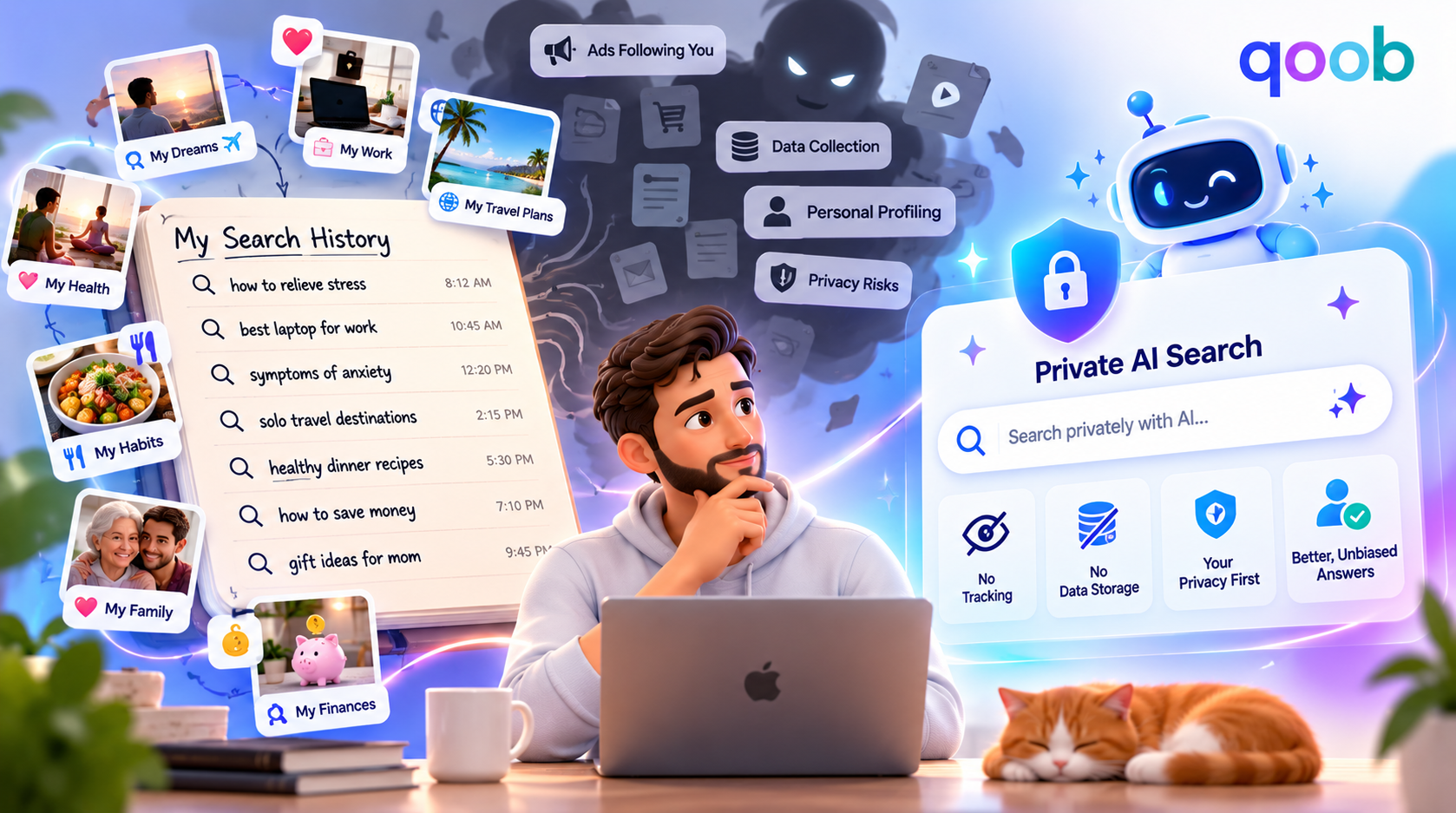
    Think about what you search for in a normal week.

    You might look up a health concern, compare financial products, research a work problem, plan a trip, ask for relationship advice, or search for something you would never say out loud. Search history can reveal interests, habits, concerns, plans and priorities over time.

    Now add AI to the experience.

    AI search is more conversational than traditional search. Instead of entering a few keywords, you may write a complete question and explain what you actually need. That extra context can make answers much more useful. It can also make privacy more important.

    This is why private AI search deserves more attention. The question is no longer just whether an AI tool can answer your question. It is also what happens to the question after you ask it.

    At The Qoob, we think search should help you get useful answers without making privacy an afterthought.

    Why Your Search History Reveals More Than You Think

    A single search may seem harmless.

    A long history of searches is different.

    Consider what someone could learn from a few months of queries. They might identify where you live, what you buy, what you are worried about, what you are planning and what you are interested in. They could also make educated guesses about your work, relationships, finances or health.

    With AI search, those clues can become even richer because users often provide more context.

    Instead of searching for:

    “best laptop”

    you might ask:

    “I work from home, travel twice a month, have a $1,500 budget and need something that can handle video editing. Which laptop should I buy?”

    The second query tells the system much more about you.

    That is not necessarily a bad thing. Context helps AI provide a better answer. But it means privacy needs to be considered alongside convenience.

    What Makes Private AI Search Different?

    Private AI search is not simply a search engine with a smaller history button.

    Privacy can involve several different questions:

    • What information is collected?
    • How long is it stored?
    • Is your search history connected to your account?
    • Is your content used to train AI models?
    • Can you delete your information?
    • Can you control what the system remembers?
    • Do third-party vendors receive any data?

    These questions matter because “private” can mean different things from one product to another.

    A service might prevent your searches from being publicly visible but still retain them internally. Another might give you controls over training or history while still collecting technical information needed to operate the service.

    The important thing is transparency.

    AI Search Creates a Different Privacy Problem

    Traditional search tends to encourage short queries.

    AI encourages conversation.

    That difference matters.

    When people use an AI assistant with privacy in mind, they may share more information because the interaction feels closer to talking to a person. They explain the problem, add context, ask follow-up questions and refine the request.

    This makes the experience powerful, but it also creates a larger information trail.

    A prompt might contain:

    • A customer’s situation
    • An unpublished business idea
    • Personal financial details
    • A family problem
    • A medical concern
    • Travel plans
    • Workplace information
    • Personal preferences

    The more useful the context, the more careful you should be about where that context goes.

    Privacy Is About Control, Not Just Secrecy

    There is an important distinction between privacy and invisibility.

    No online service should be treated as a magical black box where information disappears completely. A responsible private AI assistant should instead give users meaningful control and clearly explain how information is handled.

    At The Qoob, our public privacy policy explains that prompts, inputs and uploaded files may be used to train, test and improve AI models, while also providing users with an option to opt out of that training through account settings. The policy also explains that usage information, device information and other technical data may be collected to operate and improve the services.

    That distinction is important.

    Privacy does not mean pretending that no data exists. It means understanding what is collected, why it is collected and what choices you have.

    What Should You Look for in a Private AI Assistant?

    When comparing AI search products, do not judge privacy by marketing language alone.

    Start with the actual controls.

    1. Training controls

    Find out whether your prompts can be used to train or improve AI models. A useful privacy control is the ability to opt out when you do not want your content used for that purpose.

    The Qoob’s privacy policy currently provides an account setting that lets users opt out of having their content used for AI training.

    2. Search history controls

    Ask whether searches are stored in your account history and whether you can delete them.

    Look for products that make those controls understandable rather than hiding them behind complicated settings.

    3. Temporary or private sessions

    Some services provide a mode designed for conversations you do not want retained in normal account history.

    The Qoob’s current privacy policy notes that Temporary Sessions or Private Modes may allow interactions without saving content to account history. It also states that logs from these sessions may still be retained for up to 30 days for safety, security and abuse prevention.

    That is an important example of why reading the details matters. A conversation may not appear in your history while still being temporarily logged for operational reasons.

    4. Data sharing

    Check whether information is shared with service providers or other third parties.

    The Qoob’s privacy policy explains that third-party service providers may support areas such as cloud storage, generative AI, security, analytics and payment processing.

    A serious privacy review should look beyond the company’s own servers and consider the broader technology ecosystem.

    Why “We Don’t Sell Your Data” Is Only One Part of the Story

    Selling data is an important privacy issue, but it is not the only one.

    You should also ask:

    Is it used for training?

    Is the data stored?

    Can I delete it?

    Who can process it?

    Can I control my history?

    The Qoob states on its search page that it does not sell user data and limits what its vendors can do with that data.

    That is useful information, but users should still review the privacy policy and available settings before entering sensitive information.

    Good privacy practice is based on the whole data lifecycle, not one headline claim.

    How a Private AI Search Experience Can Be More Useful

    Privacy and usefulness do not have to work against each other.

    In fact, clear privacy controls can make people more comfortable using AI for ordinary decisions and research.

    The goal is not to make the AI know nothing about you.

    The goal is to give you a better understanding of what information it can use and greater control over how that information is handled.

    The Qoob is built around a search experience that gives short, direct answers instead of making users sort through a long list of links. That makes it closer to a decision-support tool than a traditional search box.

    When that kind of experience is combined with transparent privacy controls, users can make more informed choices about what they share.

    For more context on the broader privacy questions around AI search, our guide to AI search privacy looks at data collection, search history and the questions worth asking before using an AI search tool.

    What You Should Never Put Into an AI Search Box

    Privacy-aware search does not mean you should paste every sensitive document into an AI assistant.

    Some information should stay out of a general-purpose search tool unless you have a clear reason and understand exactly how the service handles it.

    Avoid entering things such as:

    • Passwords and authentication codes
    • Credit card numbers
    • Bank account credentials
    • Private customer records
    • Confidential contracts
    • Highly sensitive personal identifiers
    • Information that belongs to someone else and should remain confidential

    You can often ask the same question without providing the identifying details.

    For example, instead of entering a customer’s full financial information, describe the situation using fictional amounts and remove names and identifying details.

    That gives an AI system enough context to help while reducing unnecessary exposure.

    Privacy-Conscious Search Does Not Mean Searching Less

    You do not need to become afraid of AI search.

    You need to become more deliberate about it.

    A few habits can make a meaningful difference.

    Remove unnecessary details

    Ask the question without including names, account numbers, addresses or other information that does not affect the answer.

    Separate context from identity

    AI often needs the situation, not the identity of the person involved.

    Review your settings

    Privacy controls can change over time. Check your account settings rather than assuming the defaults are still what you want.

    Understand history and memory

    Search history, conversation history and AI memory can be different features. Know which one you are using.

    Read the privacy policy

    You do not need to memorise a policy. Look for the sections covering collection, training, sharing, retention and deletion.

    The Qoob’s current policy, for example, explains both its data practices and user choices around deletion and AI training.

    The Bigger Question: Who Owns Your Digital Diary?

    Your search history may never look like a diary.

    There may be no neat pages, dates or personal entries.

    But over time, it can tell a story.

    Searches can reveal what you are trying to learn, what you are trying to solve and what you are thinking about before you are ready to tell anyone else.

    That is why the rise of AI search makes privacy more important, not less.

    A conventional search query may contain a few words. An AI conversation can contain your reasoning, preferences, constraints and personal context. The more useful the system becomes, the more carefully users should consider the information they provide.

    This is where an AI assistant with privacy becomes a meaningful product goal.

    The right question is not:

    “Can this AI answer my question?”

    It is:

    “Can this AI answer my question while giving me a clear understanding of what happens to my information?”

    What The Qoob Is Trying to Change

    The Qoob approaches search from a simple premise: people should be able to ask questions naturally and get useful answers without unnecessary friction.

    Our search experience is designed to provide concise answers and help users move from research to decisions. At the same time, privacy is part of the conversation because personalised search naturally involves information about the user.

    That balance matters.

    Better search should not require users to stop thinking about control over their information.

    It should make the rules understandable.

    A Simple Private AI Search Checklist

    Before using an AI search tool for something personal or important, ask five questions:

    What information does it collect?

    Is my content used for AI training?

    How long is my information retained?

    Can I delete or limit what is stored?

    Who else can process my data?

    Those answers tell you much more than a “private” label ever could.

    Final Thoughts

    Your search history is a record of your questions, concerns, interests and decisions. With AI search, that record can become even more detailed because the interaction is more conversational and context-rich.

    That is why private AI search matters.

    Privacy should not be treated as a feature added after the search experience is built. It should be part of how the experience is designed, explained and controlled.

    At The Qoob, we believe users should be able to ask natural questions, get useful answers and understand how their information is handled. That does not mean promising perfect secrecy. It means giving people clearer choices and better control over a tool that is becoming part of everyday life.

  • What Can I Make With These Ingredients? How AI Recipe Generators Solve the Empty-Fridge Problem

    What Can I Make With These Ingredients? How AI Recipe Generators Solve the Empty-Fridge Problem

    You open the fridge after a long day and see half an onion, a few eggs, some vegetables and a piece of chicken. There is food in the kitchen, but no obvious meal.

    So you ask the question millions of people ask every week:

    What can I make with these ingredients?

    The problem is often not a lack of food. It is a lack of ideas.

    You may have enough ingredients for a good meal but no recipe that uses exactly what you have. Traditional recipe searches can make this worse because they often give you hundreds of options that require ingredients you do not own.

    An AI recipe generator takes a different approach. Instead of starting with a recipe and asking you to shop for it, you start with the ingredients already available and ask the AI to build a meal around them.

    That simple change can make deciding what to cook much easier.

    Why the Empty-Fridge Problem Is Really a Decision Problem

    Most “empty fridge” situations are not literally empty.

    There is usually something available:

    • A protein
    • A few vegetables
    • Leftover rice or pasta
    • Eggs
    • Bread or tortillas
    • Basic sauces and seasonings

    The challenge is working out how those ingredients can become a complete meal.

    This is where decision fatigue comes in.

    You search for dinner ideas, open several recipes, compare ingredients, check cooking times and then realise that every recipe needs something you do not have.

    After enough searching, ordering takeaway starts to look easier.

    An AI-based approach can reduce the number of decisions you need to make.

    What Can I Make With These Ingredients? Start With What You Have

    The easiest way to solve the dinner problem is to stop asking:

    “What recipe should I follow?”

    Instead, ask:

    “What meal can I build from what I already have?”

    For example, imagine your kitchen contains:

    Chicken + capsicum + onion + rice + soy sauce

    You could turn that combination into a stir-fry, rice bowl, fried rice or another simple skillet meal.

    Now change the ingredients:

    Eggs + spinach + tomatoes + bread

    That could become an omelette, scrambled eggs with vegetables, a breakfast-style sandwich or a simple toast meal.

    The point is not to find one perfect recipe. It is to identify a few sensible possibilities from the ingredients you already own.

    How an AI Recipe Generator Works

    A traditional recipe search generally starts with a known dish.

    You search for:

    “chicken pasta recipe”

    The search engine returns recipes for chicken pasta.

    But what happens when your kitchen does not match the recipe?

    An AI recipe generator can work from the other direction. You tell it what you have, and it can suggest meals that fit those ingredients.

    You might enter:

    “I have chicken breast, broccoli, garlic, rice and soy sauce. What can I make in 30 minutes?”

    That question contains more useful context than simply searching for “chicken recipes”.

    You have provided:

    • The ingredients
    • The available protein
    • A cooking-time limit
    • A likely flavour direction
    • The type of result you want

    The better the context, the more relevant the suggestions can become.

    Why Ingredient-Based Recommendations Are Useful

    Ingredient-based recommendations solve a very specific problem: you are trying to use what you already have.

    That has several practical benefits.

    It can reduce food waste

    Ingredients sitting unused in the fridge often get forgotten until they are no longer fresh.

    Building meals around what you already have can help you use ingredients before they go to waste.

    It can save money

    You do not always need another trip to the supermarket.

    A useful meal may already be sitting in your kitchen. You just need a way to connect the ingredients.

    It can save time

    Instead of browsing recipe websites for twenty minutes, you can start with a clear list of ingredients and ask for suitable ideas.

    It can make leftovers more useful

    Last night’s rice, vegetables or cooked chicken can become part of today’s meal instead of being ignored in the back of the fridge.

    What to Make for Dinner When You Have Random Ingredients

    Random ingredients are not necessarily a problem.

    In fact, they can be a useful starting point.

    Try grouping what you have into three categories:

    1. Main ingredient

    Start with the most substantial item.

    This might be chicken, beef, fish, tofu, eggs or beans.

    2. Base

    Next, look for something that can make the meal filling.

    Rice, pasta, potatoes, noodles, bread and tortillas are common examples.

    3. Supporting ingredients

    Then add vegetables, herbs, spices, sauces or other ingredients that add flavour.

    Once you think about your kitchen this way, it becomes easier to answer what to make for dinner without needing a specific recipe in mind.

    For more ideas on reducing the stress around this decision, you can also read our guide to a simpler way to decide what to cook.

    AI Can Suggest Meals Beyond Exact Recipe Matches

    One of the useful differences between an AI recipe generator and a basic recipe database is flexibility.

    A recipe database may work best when you already know what you want.

    AI can be useful when you do not.

    You can give it constraints such as:

    “I have these ingredients, but I do not want anything spicy.”

    Or:

    “What can I make with these ingredients for four people?”

    Or:

    “I only have 20 minutes.”

    Or:

    “I want something high in protein.”

    The goal is not simply to identify a recipe containing the same ingredients.

    It is to find an option that fits the situation.

    What If You Are Missing One or Two Ingredients?

    This is where flexibility becomes especially useful.

    Suppose you find a recipe that looks perfect but requires fresh parsley and you do not have any.

    That does not necessarily mean you cannot make the dish.

    An AI tool can help suggest substitutions or simplify the recipe based on what is available.

    For example:

    • Spinach instead of another leafy green
    • Rice instead of noodles
    • Chicken instead of another protein
    • Yoghurt instead of sour cream
    • A different vegetable based on what is in the fridge

    Not every substitution will work in every recipe, so basic cooking judgement still matters. The value of AI is that it can help you explore sensible alternatives faster.

    AI Recipe Generators Are Most Useful When You Give Them Context

    A vague request can produce vague ideas.

    Compare:

    “Give me dinner ideas.”

    with:

    “I have chicken thighs, carrots, potatoes and garlic. I have an oven, 45 minutes and need dinner for three people. What can I make?”

    The second prompt gives the system much more to work with.

    You can make recommendations more useful by including:

    • Ingredients you have
    • Ingredients you do not have
    • Number of people
    • Cooking time
    • Cooking equipment
    • Dietary preferences
    • Foods you dislike
    • Desired meal style

    This is one reason modern AI search can be useful for everyday decisions. Rather than searching only for keywords, the interaction can include the context behind the question. Our overview of how shorter AI search answers work explains why asking a complete question can produce a more useful result than sorting through a long list of links.

    Can AI Help With Leftovers?

    Absolutely, and leftovers are one of the most useful starting points.

    Imagine you have:

    Leftover roast chicken + cooked rice + vegetables

    Instead of reheating the same meal, you could turn those ingredients into a rice bowl, fried rice, wraps, soup or another simple dish.

    The same principle works with small quantities.

    A few vegetables can become part of an omelette. Leftover pasta can become a baked dish. Cooked meat can become a filling for wraps or sandwiches.

    The question changes from:

    “What recipe uses this exact amount?”

    to:

    “What can I make with these ingredients before they go to waste?”

    That is a much more practical question.

    How The Qoob Fits Into Dinner Decisions

    The Qoob is built around everyday questions where the hardest part is often deciding what to do next.

    Dinner is a good example.

    You may not need a huge recipe collection. You may simply need an answer that takes your ingredients, preferences and situation into account.

    That is the thinking behind what to make for dinner: start with the real-life problem rather than forcing the user to work backwards from a list of recipes.

    Instead of opening ten tabs and comparing options, you can describe what is in your kitchen and what kind of meal you want.

    The answer can then become a starting point for the meal.

    What an AI Recipe Generator Cannot Replace

    AI can help with ideas, but it should not replace common sense in the kitchen.

    You still need to check:

    Food safety

    Make sure meat, seafood and eggs are cooked safely. Do not assume that an AI-generated cooking time is appropriate for every ingredient or appliance.

    Allergies

    If you have a serious food allergy, verify every ingredient and substitution yourself.

    Ingredient quality

    AI cannot see whether the vegetables in your fridge are still fresh unless you provide that information.

    Personal taste

    A technically suitable recipe may still not be something you enjoy eating.

    AI is best treated as a planning tool. You remain responsible for the final cooking decisions.

    Why This Approach Is Better Than Searching for “Dinner Recipes”

    Traditional search is still useful when you already know what you want.

    You can search for:

    “classic lasagne recipe”

    or

    “how to make Thai green curry.”

    The search intent is clear.

    But when the question is:

    “I have three vegetables, two eggs and leftover rice. What can I make?”

    you are not really looking for a particular recipe.

    You are looking for a decision.

    That is where an AI-powered recommendation can be more useful.

    Instead of searching for the perfect page, you describe the problem and work backwards from your available options.

    A Simple Prompt for Your Next Empty-Fridge Night

    You do not need complicated prompting.

    Try something like:

    “What can I make with these ingredients: chicken, broccoli, rice, garlic and soy sauce? I have 30 minutes and want something simple for two people.”

    You can then refine the answer:

    “Make it healthier.”

    Or:

    “I do not want to use the oven.”

    Or:

    “Give me three options.”

    Or:

    “Use the chicken and broccoli first because they need to be eaten soon.”

    This turns dinner planning into a conversation rather than a long search session.

    Final Thoughts

    The empty-fridge problem is often not about having nothing to eat. It is about not knowing how to turn the ingredients you have into something worth making.

    That is why the question what can I make with these ingredients is so useful.

    An AI recipe generator can take the ingredients, time, preferences and limitations you provide and turn them into practical meal ideas. It does not need to find one perfect recipe. It can help you discover what is possible with what you already have.

    For everyday decisions like dinner, that can be more useful than scrolling through endless recipes.

    When you are staring into the fridge wondering what to make, start with what is already there. Then let the question lead the way.

    That is the kind of everyday problem-solving experience The Qoob is designed to support. You can explore the broader approach at The Qoob.

    Frequently Asked Questions

    What can I make with these ingredients?

    Start by listing the main ingredients you have, then add your cooking time, preferred cuisine, dietary needs and available equipment. An AI recipe generator can use that information to suggest meals that fit your situation.

    What is the best AI recipe generator?

    The best option depends on what you need. Look for a tool that can work with the ingredients you actually have and lets you add useful context such as cooking time, dietary preferences and serving size.

    Can an AI recipe generator create recipes from ingredients I already have?

    Yes. You can provide a list of available ingredients and ask for meal ideas or recipes based on them. You can also specify restrictions, cooking time and the number of people you are feeding.

    What can I use instead of searching for what to make for dinner?

    You can start with the ingredients already available and ask an AI tool for suggestions. This can reduce the need to browse through recipes that require ingredients you do not have.

    Can AI suggest substitutions for missing ingredients?

    Yes, AI can suggest possible substitutions, but you should still check whether the substitute is appropriate for the recipe, dietary requirements and food allergies.

    Is an AI-generated recipe always safe to follow?

    No. AI-generated suggestions should be checked before cooking. Pay particular attention to food safety, cooking temperatures, allergens and the condition of your ingredients.

  • Planning a Trip Solo? How an AI Travel Planner Removes the Group-Chat Chaos

    Planning a Trip Solo? How an AI Travel Planner Removes the Group-Chat Chaos

    Planning a trip with friends can be exciting until the group chat starts moving.

    One person wants beaches. Another wants museums. Someone else wants nightlife. One person has a strict budget, another wants the nicest hotel, and half the group has not even decided which dates work.

    Then the messages begin.

    “Where are we staying?”

    “What should we do on Saturday?”

    “Is this place too expensive?”

    “Has anyone checked how far the airport is?”

    “Wait, I thought we were going somewhere else.”

    Planning a solo trip removes the group-chat problem, but it can create another one: you have to make every decision yourself.

    That is where an AI travel planner can be useful.

    Instead of opening dozens of tabs and piecing together information on your own, you can describe what you want in normal language and use AI to organise the possibilities around your trip.

    Why Solo Travel Planning Can Still Get Complicated

    Solo travel gives you complete control.

    That is one of its biggest advantages.

    You do not have to compromise on where to stay, what to eat, when to wake up or how much time to spend at an attraction.

    But freedom creates more decisions.

    You may need to think about:

    • Where to go
    • When to go
    • How long to stay
    • What to do
    • Where to stay
    • How much to spend
    • How much travel time you can handle
    • Whether you want a packed itinerary or a slower trip

    None of these decisions is especially difficult on its own.

    The problem is the volume.

    A simple weekend away can become a long research session because every decision creates three more.

    What Does an AI Travel Planner Actually Do?

    An AI travel planner is designed to help with the planning process by understanding your request and turning it into useful travel suggestions.

    Instead of searching separately for:

    “best places for solo travel”

    “things to do in Lisbon”

    “Lisbon weekend itinerary”

    and

    “cheap things to do in Lisbon”

    you can describe your trip more naturally.

    For example:

    “I want a four-day solo trip with good food, walkable areas, cultural attractions and a moderate budget. I do not want a packed schedule.”

    That gives the system more context than a short keyword search.

    The goal is not simply to produce more travel information.

    It is to reduce the amount of work between having an idea and having a workable plan.

    The Qoob is built around this broader idea of using search to support everyday decisions. Its current search experience highlights travel planning as one of the situations where a person can ask a natural-language question and get a concise answer rather than sorting through a large list of links.

    AI Travel Planner vs Traditional Travel Search

    Traditional travel planning often follows this pattern:

    Search → open pages → compare options → open more pages → make notes → decide

    That process can work well when you want to research deeply.

    But for a simple trip, it can also create unnecessary friction.

    An AI travel planner changes the starting point.

    Instead of asking, “What information can I find?” you ask, “What am I trying to decide?”

    That distinction matters.

    You are not necessarily looking for every hotel in a city or every attraction within a ten-kilometre radius. You may simply want to know which area fits your style, how to spend three days, or which destination makes the most sense for your budget.

    The Qoob describes its search experience in similar terms: ask a question naturally, let the system understand the context, and receive a concise answer aimed at the decision in front of you.

    Why Context Makes Trip Planning Better

    A generic travel recommendation can only go so far.

    Suppose you ask:

    “Where should I go in Europe?”

    You could receive dozens of valid answers.

    Now add context:

    “I am travelling alone for five days, prefer mild weather, enjoy food and architecture, want a walkable destination, and have a moderate budget.”

    The range of useful options gets much smaller.

    That is the real value of context.

    You can tell an AI travel planner what actually matters to you instead of forcing it to guess.

    This approach is especially useful for solo travel because there is no group to balance against your own preferences. The entire plan can be built around your priorities.

    A Travel Planning App Should Reduce Decisions, Not Create More

    The phrase travel planning app can mean many things.

    Some apps focus on bookings. Others focus on maps, itineraries, reservations or travel documents.

    A decision-focused AI tool serves a different purpose.

    Its job is to help you answer questions such as:

    Where should I go?

    How long should I stay?

    Which area should I choose?

    What should I do with three days?

    Which option fits my budget and interests?

    This is useful because the hardest part of trip planning is often not finding information.

    It is deciding which information matters.

    The Qoob positions itself as a search and decision-making app rather than a general-purpose chatbot, with travel planning listed as one of its everyday use cases.

    How to Plan a Solo Trip With AI

    You do not need a complicated prompt.

    Start with five basic details:

    1. Destination or destination type

    Tell the tool where you want to go, or describe the kind of place you want.

    For example:

    “I want a relaxed European city break.”

    2. Dates or trip length

    A three-day city break needs a different plan from a two-week trip.

    3. Budget

    Your budget helps separate realistic options from attractive but impractical ones.

    4. Interests

    Mention what you actually enjoy.

    Food, museums, beaches, hiking, nightlife, architecture, shopping and photography can all change the recommendation.

    5. Travel style

    This is easy to overlook.

    Tell the AI whether you want:

    • A packed itinerary
    • A relaxed schedule
    • Early mornings
    • Late nights
    • Lots of walking
    • Minimal travel between places
    • Plenty of free time

    That information helps turn a generic itinerary into something closer to your actual travel style.

    Use AI to Narrow the Destination First

    One of the biggest mistakes in trip planning is choosing a destination before deciding what kind of trip you want.

    Start with the experience.

    For example:

    “I have four days, want good food and architecture, prefer a walkable city, and do not want to rent a car. Which destinations should I consider?”

    Now the question is not simply about geography.

    It is about fit.

    An AI travel planner can help you compare destinations against the criteria that matter to you rather than giving you a generic list of popular places.

    Once you have narrowed the choice to two or three destinations, the next step becomes much easier.

    Then Build the Itinerary Around Your Energy

    A common mistake with travel itineraries is trying to maximise every hour.

    That looks productive on paper.

    It often feels exhausting in reality.

    For solo travel, build the plan around your energy level.

    You might want:

    Morning: one major attraction

    Afternoon: lunch and a flexible activity

    Evening: dinner and a neighbourhood walk

    That gives you structure without making the entire trip feel like a checklist.

    You can ask an AI travel planner to create different versions:

    “Give me a relaxed itinerary.”

    Then:

    “Now give me a more active version.”

    Then:

    “Combine the best parts of both.”

    The benefit is not that AI knows the one perfect itinerary.

    It is that you can explore alternatives quickly.

    One of the Best Uses of AI: Comparing Two Trips

    Sometimes you already have options.

    Maybe you are choosing between two cities.

    Or two neighbourhoods.

    Or two hotel areas.

    Or a city break and a nature trip.

    Instead of researching each option separately, ask the AI to compare them using the same criteria.

    For example:

    “Compare these two destinations for a five-day solo trip. Consider cost, walkability, food, cultural activities, weather and how easy it is to get around without a car.”

    Now you have a decision framework.

    The same principle applies beyond travel. The Qoob’s broader search philosophy is based on helping users compare options and reach everyday decisions without opening a large number of pages.

    What a Good Solo Trip Planning Prompt Looks Like

    You can get more useful results by describing the problem instead of simply naming the destination.

    Try:

    “Plan a five-day solo trip to Tokyo for someone who enjoys food, neighbourhood walks, design and local culture. Keep the schedule relaxed, avoid expensive tourist activities where possible, and group activities by area so there is less unnecessary travel.”

    That request gives the system:

    • Destination
    • Trip length
    • Number of travellers
    • Interests
    • Budget preference
    • Pace
    • Planning constraint

    You can then refine it.

    “Make day three quieter.”

    “Add more food-focused options.”

    “Remove anything that requires a reservation.”

    “Give me a rainy-day alternative.”

    The interaction becomes an iterative planning process instead of one massive search.

    How an AI Travel Planner Can Reduce the Group-Chat Chaos

    The irony of solo travel is that the planning problem becomes easier in one way and harder in another.

    You no longer have to negotiate with six people.

    But you also do not have six people contributing ideas.

    An AI planner can partly fill that organisational gap by helping you structure the choices.

    Instead of asking friends:

    “What should I do on Saturday?”

    then waiting for seven different answers, you can start with your own preferences and generate a few options.

    Then you choose.

    That is much closer to the real purpose of travel planning.

    Not collecting suggestions forever.

    Making the plan.

    Do Not Let AI Plan Every Minute

    AI can make planning easier, but it can also make over-planning easier.

    That is worth watching.

    A perfectly optimised itinerary may not leave room for the best parts of a trip.

    You might discover a small café.

    Meet another traveller.

    Spend two hours in a neighbourhood that was not on your list.

    Change your mind.

    Stay longer somewhere you like.

    Good travel planning leaves room for those moments.

    Use AI to remove unnecessary decisions, not to remove spontaneity.

    Check the Details Before You Travel

    An AI planner can help with structure, but important travel details still need verification.

    Check things such as:

    Opening hours

    Attractions, restaurants and museums may have changing schedules.

    Travel times

    Estimated travel times can change based on traffic, public transport and time of day.

    Booking requirements

    Some activities require advance reservations or have limited availability.

    Current entry rules

    Visa, entry and other official travel requirements should always be confirmed through the relevant official source.

    Weather

    Weather can change quickly and may affect outdoor plans.

    AI is useful for building the framework.

    You should verify time-sensitive details before relying on them.

    Why Short Answers Can Be Better for Travel Decisions

    Trip planning does not always require a long response.

    Sometimes you need a full itinerary.

    Sometimes you need one answer:

    “Which neighbourhood should I stay in?”

    A useful travel planning tool should adapt to the question.

    The Qoob’s search model is built around concise answers that help users make decisions instead of forcing them to scroll through a large list of results. Its website specifically describes travel planning as a use case for this style of search.

    You can explore that approach through Qoob Search, where travel planning is presented alongside other everyday decision-making tasks.

    Solo Travel Is the Perfect Test for Personalised Planning

    Solo travel is personal by definition.

    There is no universal “best itinerary” because there is no universal traveller.

    One person wants six attractions a day.

    Another wants one museum, a long lunch and nowhere else to be.

    One person chooses the cheapest room possible.

    Another cares more about staying in the right neighbourhood.

    This is where personalised planning can help.

    Instead of asking, “What do people normally do here?” you can ask:

    “What makes sense for me?”

    That is a more useful question.

    The Qoob’s product approach centres on personal context, with the platform describing its answers as being shaped around what matters to the individual user.

    When a Trip Planning App Still Makes More Sense

    An AI planner is not a replacement for every travel tool.

    You may still want dedicated apps for:

    • Flight and hotel bookings
    • Navigation
    • Offline maps
    • Reservations
    • Travel documents
    • Live transport updates

    Think of AI as the planning layer.

    Use it to decide what makes sense, then use specialised services for the parts that require live booking, mapping or transaction functionality.

    That division of labour can make the entire planning process simpler.

    The Qoob’s Role in Everyday Travel Decisions

    The Qoob is designed around a simple idea: many things people search for are really decisions in disguise.

    Travel is a clear example.

    You are rarely searching because you want to read every page about a destination.

    You are usually searching because you want to know:

    Where should I go?

    What should I do?

    Which option fits me?

    How should I organise this trip?

    The Qoob is built to answer those kinds of everyday questions in plain language and provide a concise response that helps you decide what to do next.

    Its approach to smarter search is built around reducing unnecessary browsing and helping people move from information to action.

    And when the question is specifically about travel, you can start with an AI travel planning approach that puts your own preferences and trip requirements at the centre.

    A Better Way to Think About Solo Trip Planning

    The best use of an AI travel planner is not to hand over the entire trip.

    It is to hand over the tedious parts.

    Let AI help you brainstorm destinations.

    Let it compare options.

    Let it organise an itinerary.

    Let it suggest alternatives when your first plan does not work.

    Then use your own judgement to make the final call.

    That keeps the technology in the right role: an assistant, not the traveller.

    For another practical way to approach destination decisions, our guide to choosing where to go this weekend looks at how time, budget, energy and trip style can help narrow down the choices.

    Final Thoughts

    Solo travel gives you something group travel rarely can: complete freedom.

    But that freedom can also mean a long list of decisions.

    An AI travel planner can reduce that friction by helping you describe what you want, compare realistic options and build a plan around your preferences.

    It can also make a travel planning app more useful by shifting the focus from collecting information to making decisions.

    The important thing is to use AI as a planning partner, not as a substitute for judgement. Verify important details, leave room for spontaneity and build a trip that fits how you actually want to travel.

    Frequently Asked Questions

    What is an AI travel planner?

    An AI travel planner is a tool that uses artificial intelligence to help with travel decisions such as destination selection, itinerary ideas, activity planning and comparisons. It can use details such as budget, interests, trip length and travel style to make suggestions more relevant.

    Can an AI travel planner plan a solo trip?

    Yes. Solo travel can be a particularly useful case because the plan can be built around one person’s preferences without needing to balance a group’s different priorities.

    Is an AI travel planner the same as a trip planning app?

    Not always. A trip planning app can include features for bookings, maps, reservations and travel documents. An AI travel planner focuses more on understanding your preferences and helping you make planning decisions.

    How do I get better results from an AI travel planner?

    Give it useful context. Include your destination, dates or trip length, budget, interests, preferred pace and any practical restrictions. You can then refine the result with follow-up questions.

    Can AI create a complete itinerary?

    It can suggest and organise an itinerary, but you should verify important details such as opening hours, transportation, reservations and current travel requirements before relying on the plan.

    Is The Qoob useful for travel planning?

    The Qoob is designed for everyday search and decision-making, and its current product information specifically includes travel planning as a use case. It lets users ask questions naturally and receive concise answers designed to help them decide.

  • What Is an AI Answer Engine? (And Why It’s Not the Same as a Search Engine)

    What Is an AI Answer Engine? (And Why It’s Not the Same as a Search Engine)

    Search used to be simple.

    You typed a few words into a search box, received a page of links, opened several results and worked out the answer yourself.

    That model still works. But it is not always what people want.

    Sometimes you do not want ten websites to browse. You want to ask a question and get a useful answer.

    That is where an AI answer engine comes in.

    An AI answer engine is designed to understand a question, identify the information needed and return an answer rather than simply giving you a list of pages to explore. The focus shifts from helping you find where the answer might be to helping you understand the answer itself.

    The Qoob is built around this idea, combining AI-powered search with concise answers designed to help people make everyday decisions.

    What Is an AI Answer Engine?

    An AI answer engine is a search experience that uses artificial intelligence to understand the intent behind a query and produce a direct response.

    Instead of only matching keywords, it can consider what you are actually trying to accomplish.

    For example, you could search:

    “Best laptop under $1,000.”

    A traditional search engine may show shopping pages, reviews, comparison articles and videos.

    An AI answer engine can take the question and turn the available information into a concise comparison or recommendation.

    The difference is not simply the use of AI.

    It is the format and purpose of the result.

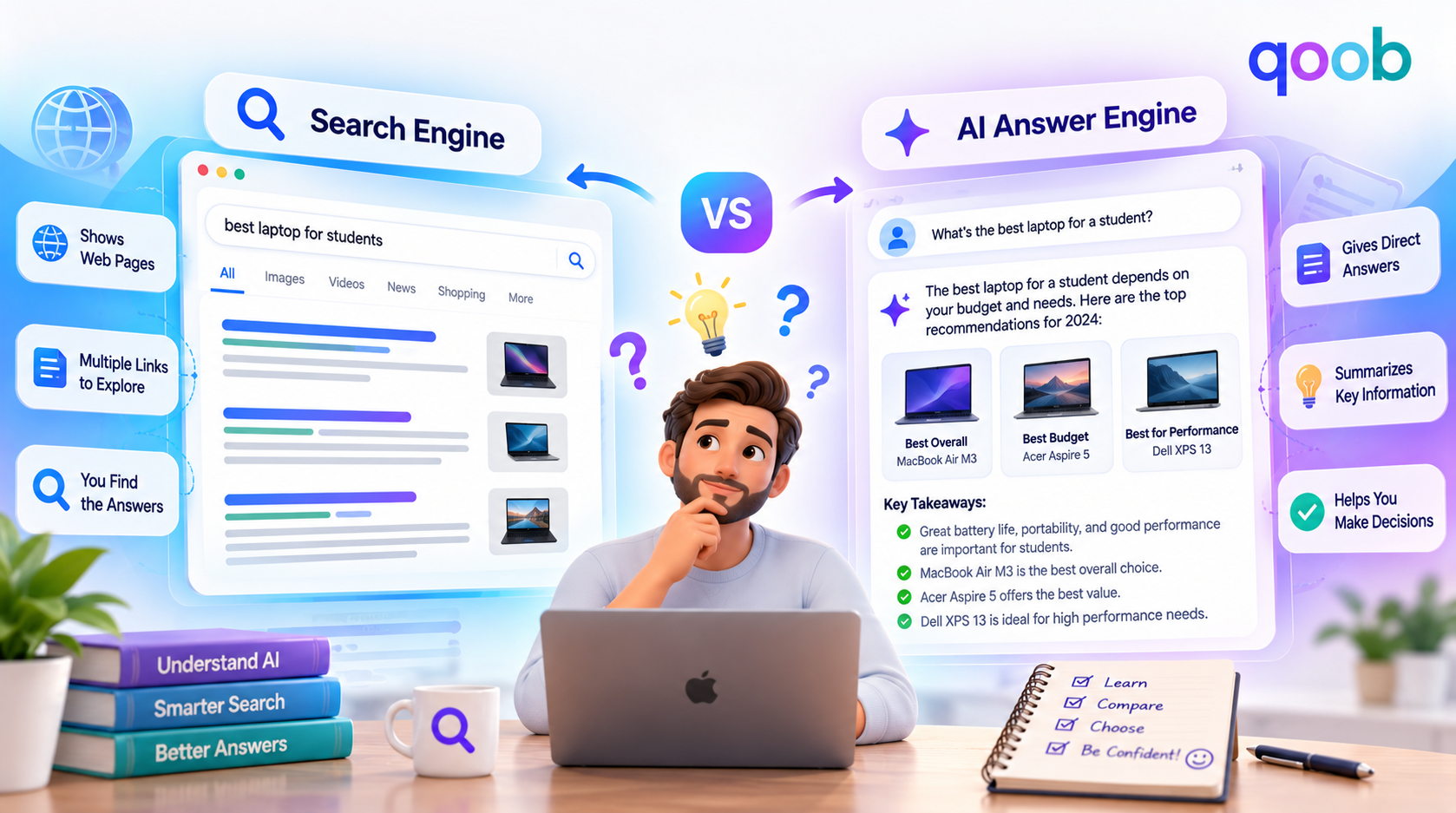
    Search Engine vs AI Answer Engine

    A traditional search engine is primarily designed to help you discover web pages.

    An AI answer engine is designed to help you get to the useful information within those pages and organise it around your question.

    Traditional Search Engine

    AI Answer Engine

    Returns a list of results

    Returns a direct response

    Focuses heavily on matching queries to pages

    Focuses on understanding intent

    Requires more browsing

    Reduces the need for repeated browsing

    You compare information yourself

    AI can summarise and organise information

    Useful for exploring many sources

    Useful for getting clear answers quickly

    This does not make traditional search obsolete.

    Search engines remain useful when you want to browse sources, locate a specific website, read original documents or explore a topic from multiple perspectives.

    The difference is that an AI answer engine is designed for the moments when your main goal is an answer rather than a list of places to look.

    Why Smart Answers Matter

    The phrase smart answers can sound vague, but the basic idea is simple.

    A useful answer should respond to the question you actually asked.

    Suppose you ask:

    “What should I cook tonight with chicken, rice and broccoli?”

    A traditional search engine may return recipes that contain those words.

    A smarter search experience can consider the context and provide a few options based on the ingredients you mentioned.

    That is particularly useful for everyday decisions.

    You are not trying to become an expert in recipes. You are trying to decide what to make for dinner.

    The Qoob describes this approach as smart search: understand the question, provide a concise response and help the user decide what to do next.

    Why Short Answers Can Be More Useful

    More information is not always better.

    Imagine asking:

    “Where should I go for a three-day weekend?”

    You could receive hundreds of articles, travel guides and destination pages.

    Or you could get a concise comparison of a few destinations based on your budget, interests and available time.

    That is the role of short answers.

    Short does not mean incomplete.

    It means the answer focuses on the information most relevant to the question instead of making the user work through unnecessary material.

    The Qoob’s search experience is specifically designed around short, useful answers instead of a long page of links or an oversized block of AI-generated text.

    Direct Answers Change the Search Experience

    A direct answer changes what happens after you enter a search.

    With traditional search, the next step is often another search.

    You find one result, open it, realise it does not quite answer your question and search again.

    With an AI answer engine, the first response can become the starting point for a more focused interaction.

    You can ask:

    “Why?”

    Then:

    “What are the cheaper alternatives?”

    Then:

    “Which one is better for a beginner?”

    The search becomes more conversational without requiring you to restart the process each time.

    AI Answer Engines Understand More Than Keywords

    Traditional search has become very good at interpreting queries, but its core output remains a ranked collection of pages.

    AI answer engines move further towards understanding the meaning behind a question.

    Consider these two searches:

    “running shoes”

    and

    “I run three times a week on pavement and need comfortable shoes for longer distances. What should I look for?”

    The second query tells the system much more about your goal.

    An AI answer engine can use that context to shape the response around your actual situation.

    That makes AI search particularly useful for recommendations, comparisons, explanations and everyday decisions. The Qoob’s current product positioning emphasises this decision-focused approach rather than simply returning pages that match keywords.

    An AI Answer Engine Is Not Just a Chatbot

    AI search and chat can look similar because both let you type questions.

    The purpose can still be very different.

    A general chatbot is often built around conversation, generation, brainstorming or open-ended interaction.

    An AI answer engine is more focused on finding information and turning it into an answer.

    The Qoob describes itself as a personal AI search and decision-making app rather than a general-purpose chatbot. Its purpose is to help users find useful information and make everyday decisions with concise responses.

    That narrower purpose can be useful.

    You do not always need an extended conversation.

    Sometimes you just need to know which option makes more sense.

    When Should You Use an AI Answer Engine?

    AI answer engines are particularly useful when your question has a clear decision or explanation behind it.

    For example:

    Comparison: “Which of these two phones is better for photography?”

    Planning: “How should I plan a four-day trip to Melbourne?”

    Explanation: “Explain compound interest in simple terms.”

    Recommendation: “What should I buy for a beginner home gym?”

    Everyday decisions: “What can I make with the ingredients in my fridge?”

    These questions are not just requests for webpages.

    They are requests for help understanding or deciding.

    When Traditional Search Is Still Better

    An AI answer engine should not replace traditional search for every task.

    There are times when you want the original source.

    You may need to find a government website, read a company’s official policy, inspect a scientific paper or compare several sources yourself.

    Traditional search is also useful when you want to discover information rather than receive a condensed answer.

    The distinction is discussed in our comparison of AI search and traditional search, where the two approaches are positioned around different user needs.

    The best approach is not always one or the other.

    It is knowing which experience fits the question.

    How an AI Answer Engine Builds a Better Response

    The exact technology can vary between products, but the basic process can be understood in a few stages.

    First, the system interprets the question.

    Then, it determines what information is relevant.

    It can retrieve or work with available information and organise it around the user’s intent.

    Finally, it generates a response in a format that is easier to understand and act on.

    That final step is important.

    The objective is not merely to collect information.

    It is to turn information into something useful.

    This is why an answer engine can feel different from a traditional search engine even when both ultimately rely on information from the web.

    Context Makes the Answer More Relevant

    The more specific your question, the easier it is to produce a useful response.

    Compare:

    “Best restaurants?”

    with:

    “I want a quiet Italian restaurant for two people near the city centre, with a moderate budget. What should I consider?”

    The second question gives the system a goal, constraints and context.

    That does not mean you need to write long prompts.

    The important information can often fit into one or two sentences.

    The Qoob’s approach encourages users to ask questions naturally rather than learn specialised AI prompting techniques.

    Why AI Answer Engines Are Useful for Everyday Questions

    Not every search is important enough to justify extensive research.

    Sometimes you want to settle a small question and move on.

    Which ingredients work together?

    Which neighbourhood should you stay in?

    What should you compare before buying something?

    What does a technical term mean?

    Which option fits your budget?

    These questions make up a large part of everyday search activity.

    An AI answer engine can reduce the amount of time spent turning those small questions into research projects.

    That is the basic philosophy behind The Qoob’s focus on concise answers for everyday decisions.

    What Makes a Good AI Answer Engine?

    The technology behind the answer matters, but so does the experience around it.

    A useful AI answer engine should make it easy to ask questions in plain language.

    It should provide answers that are relevant to the question rather than filling the screen with unnecessary information.

    It should also make it easy to refine the question when the first answer is not enough.

    And for information that matters, users should have a way to understand where the answer came from and verify important claims.

    These factors are what turn AI from a novelty into a useful search tool.

    The Qoob’s Approach to AI Answers

    The Qoob focuses on a specific problem with modern search: too often, a simple question turns into a long browsing session.

    Its smart search experience is built to provide concise answers and reduce the amount of manual searching needed for everyday decisions.

    The idea is straightforward.

    Ask naturally.

    Get a useful answer.

    Ask another question when you need more context.

    Then move on.

    You can see how this approach works through The Qoob’s AI answer engine, where the focus is on getting from a question to a useful response without unnecessary friction.

    How to Get Better Answers From an AI Answer Engine

    You do not need complicated prompting to improve your results.

    Start by saying exactly what you need.

    Instead of asking:

    “Laptop?”

    try:

    “What should I look for in a laptop for remote work under $1,000?”

    Then add constraints when they matter:

    “Battery life matters more than gaming performance.”

    Or:

    “I travel twice a month, so portability is important.”

    This gives the answer engine a better understanding of what matters to you.

    For more practical guidance, The Qoob’s guide to getting better answers from AI Search explains how simple changes in the way you ask a question can improve the usefulness of the response.

    Are AI Answer Engines Always Right?

    No.

    That is an important distinction.

    An AI answer engine can produce a clear and confident response and still be wrong.

    Information can be outdated, incomplete or misunderstood.

    For ordinary questions, that may simply mean asking a follow-up or checking another source.

    For important decisions involving health, finance, law, safety or other high-stakes matters, you should verify the information using reliable sources and qualified professionals where appropriate.

    Clear answers are useful.

    They should not be confused with guaranteed certainty.

    The Future of Search May Be About Answers

    For decades, search was built around the idea that users wanted to find pages.

    That remains useful.

    But people increasingly ask search engines questions that are really requests for help.

    They want comparisons.

    They want explanations.

    They want recommendations.

    They want to know what to do next.

    That is why the idea of an AI answer engine matters.

    It represents a shift from searching for information towards using information to answer a question.

    The technology will continue to evolve, but the basic expectation is simple: people want useful information without unnecessary friction.

    Final Thoughts

    An AI answer engine is different from a traditional search engine because its primary goal is not simply to return links. It is designed to understand what you are asking and provide a response that helps you understand, compare or decide.

    Traditional search remains valuable when you want to browse sources or find specific information.

    AI answer engines are useful when you want to move from a question to a clear response.

    For everyday searches, that difference can save time and reduce the work involved in finding useful information. The Qoob takes this approach further by focusing on smart answers, concise responses and search designed around everyday decisions.

    When you want search to feel more like getting an answer and less like opening another dozen tabs, The Qoob is built around that idea.

    Frequently Asked Questions

    What is an AI answer engine?

    An AI answer engine is a search system that uses artificial intelligence to understand a user’s question and provide a direct response rather than simply returning a list of webpages.

    How is an AI answer engine different from a search engine?

    A traditional search engine mainly helps users find webpages. An AI answer engine focuses on understanding the question and producing a concise response based on relevant information.

    Are smart answers the same as AI answers?

    Not necessarily. “Smart answers” is a broader term for answers that are designed to be relevant and useful to the user’s specific question. AI can be used to generate these answers.

    Why are short answers useful?

    Short answers can make everyday searches faster by presenting the key information without requiring users to open multiple pages and compare them manually.

    Can an AI answer engine replace Google?

    Not completely. Traditional search remains useful for finding specific websites, browsing sources and conducting broad research. An AI answer engine is better suited to questions where the main goal is a direct answer, comparison or recommendation.

    Are direct answers always accurate?

    No. AI-generated answers can contain mistakes or outdated information. Important information should be verified against reliable sources before you act on it.

    How can I get better answers from an AI answer engine?

    Ask clear questions and include useful context. Mention your goal, budget, preferences, timeframe or other constraints when they affect the answer. Follow-up questions can then help refine the result.

  • The Hidden Cost of Comparison Shopping: How an AI Shopping Assistant Saves You Hours

    The Hidden Cost of Comparison Shopping: How an AI Shopping Assistant Saves You Hours

    Comparison shopping sounds simple. Find a few products, compare their prices and features, read some reviews, and choose the one that makes the most sense. In reality, it can take hours. You open one store, then another. You compare specifications. You check reviews. You search for discounts. You look for a better price. Then you realize two products use different names for almost identical features, so you start comparing those too. An AI shopping assistant can simplify that process by helping you compare products, weigh options, and focus on the factors that actually matter to you. Instead of turning every purchase into a research project, AI can help narrow the choices and support a faster decision.

    Why Does Comparison Shopping Take So Long?

    The problem is not a lack of information. It is too much information. A single product category can include dozens or hundreds of options. Each product may have different specifications, prices, reviews, bundles, warranties, and availability. You might compare:
    • Price
    • Features
    • Brand
    • Size
    • Quality
    • Reviews
    • Warranty
    • Shipping
    • Compatibility
    • Long-term value
    The more expensive or important the purchase, the more time people usually spend comparing. That makes sense. But there is a point where more research stops improving the decision and simply makes the decision harder. This is often called decision fatigue.

    What Is an AI Shopping Assistant?

    An AI shopping assistant is a tool that uses artificial intelligence to help you research, compare, and evaluate products. Instead of manually opening multiple shopping pages, you can ask a question in natural language. For example: “Which laptop is best for travel, writing, and light photo editing under $1,000?” Or: “Compare these two headphones for commuting and long flights.” Or: “Which option gives me the best value if I use it every day?” The AI can help organize the relevant factors so you spend less time jumping between pages. The goal is not simply to find the cheapest product. It is to find the product that makes the most sense for your needs.

    How Does an AI Shopping Assistant Save Time?

    The biggest time savings come from reducing repetitive research. Without an AI assistant, comparison shopping may look like this: Search → Open product page → Check specifications → Read reviews → Open another product → Repeat → Compare notes → Search for price → Decide An AI-assisted process can be much shorter: Ask → Compare → Review the recommendation → Decide That does not mean you should blindly accept the answer. It means you can start with a more useful comparison instead of assembling all the information yourself. The fewer tabs you need to manage, the less likely you are to forget why you opened the first one.

    What Does an AI Shopping Assistant Actually Compare?

    The comparison depends on what you ask. A good shopping assistant can help you evaluate factors such as:

    Price

    Which options fit your budget?

    Features

    Which product includes the features you actually need?

    Compatibility

    Will the product work with the devices, systems, or accessories you already use?

    Size

    Does it fit your available space?

    Performance

    Does it meet the level of performance you require?

    Reviews

    What are customers consistently saying about the product?

    Value

    Does the additional cost of one option provide enough benefit to justify it? This is where AI can be more useful than a simple price comparison app. A price comparison tool focuses heavily on cost. An AI shopping assistant can consider the reason behind the purchase as well.

    Why Is the Cheapest Product Not Always the Best?

    Price is important. It is just not the entire decision. Suppose you are comparing two coffee machines. One costs $100. The other costs $160. The cheaper model looks like the obvious winner. Then you discover that the more expensive machine has the capacity, durability, and features you need for daily use. The extra $60 may represent better value. This is why value matters more than price alone. AI can help you frame the comparison around your priorities rather than simply sorting products from cheapest to most expensive.

    Can You Compare Products With AI?

    Yes. One of the useful applications of AI shopping tools is helping users compare products with AI. You can provide:
    • Product names
    • Links
    • Prices
    • Specifications
    • Your budget
    • Your preferences
    • Your intended use
    The more relevant context you provide, the more useful the comparison can become. Instead of asking: “Which is better?” you can ask: “Which is better for a college student who carries a laptop every day and wants long battery life?” Now the question has a clear purpose.

    Why Does Context Matter in Shopping?

    The “best” product is rarely universal. A professional photographer and a casual smartphone user may want completely different cameras. A runner and a casual walker may want different shoes. A frequent traveler and someone who drives everywhere may have completely different priorities when buying luggage. Generic rankings cannot fully account for those differences. A personalized AI shopping assistant can consider the context you provide. The result can be more useful because the comparison is based on your actual priorities rather than an imaginary average shopper. The Qoob is designed around this broader idea of personal AI search, where relevant context can influence the answers you receive.

    How Is an AI Shopping Assistant Different From a Price Comparison App?

    The distinction is straightforward. A price comparison app primarily helps you compare prices. An AI shopping assistant can help you compare products and decisions.
    Price Comparison App AI Shopping Assistant
    Focuses mainly on price Considers multiple factors
    Compares product costs Can compare products by use case
    Often shows retailer options Can explain trade-offs
    Useful for finding deals Useful for deciding what fits your needs
    Requires more interpretation Can summarize differences
    Usually more transactional More decision-oriented
    A price comparison tool can answer: “Where is this product cheapest?” An AI shopping assistant can help answer: “Is this actually the right product for me?” Both have value. They simply solve different problems.

    Why Do People Open So Many Shopping Tabs?

    Because every retailer has a slightly different page. One store highlights price. Another highlights reviews. Another highlights technical specifications. A fourth has a detailed product description. Now you have four tabs and four different ways of presenting the same information. Your job becomes translating all of that into one decision. AI can help organize the information into a consistent comparison. That is particularly useful when product pages use different terminology or bury important specifications halfway down the page.
    View this post on Instagram

    A post shared by Qoob (@qoobsearch)

    How Can AI Help With Product Specifications?

    Specifications can be difficult to compare manually. Different brands may emphasize different measurements. One laptop might emphasize processor generation. Another might focus on RAM. Another might make storage capacity the headline. The buyer has to determine which differences actually matter. AI can help organize specifications into categories that are easier to compare. For example:
    Factor Product A Product B
    Price Higher Lower
    Battery Longer Shorter
    Weight Lighter Heavier
    Storage Larger Smaller
    Best for Frequent travel Home use
    The table does not make the decision for you. It makes the trade-offs easier to see.

    Can AI Help You Avoid Unnecessary Features?

    Yes. More features do not automatically mean better value. A product may include capabilities you will never use. You could end up paying significantly more for functions that look impressive on a specification sheet but have no practical benefit for you. An AI shopping assistant can help you separate: Must have from: Nice to have from: Completely unnecessary That can make a surprising difference to the final purchase. You do not need the most powerful version of something. You need the version that fits your actual use.

    How Can an AI Shopping Assistant Help With Budget?

    Start by telling it your budget. Then explain what matters most. For example: “Find the best option under $500. Prioritize durability and battery life over extra features.” Now the comparison has a clear constraint. The AI can focus on products that fit the budget while considering your priorities. This is different from simply sorting by price. The cheapest item is not necessarily the best value. The most expensive item is not necessarily the best product. The right choice sits somewhere between price and usefulness.

    How Can AI Reduce Decision Fatigue?

    Decision fatigue happens when you make too many choices. Comparison shopping creates a lot of them. Which brand? Which model? Which size? Which color? Which features? Which retailer? Which price? Which warranty? After enough comparisons, people often stop researching and choose whatever feels easiest. That can lead to poor decisions. An AI shopping assistant can reduce the number of choices you need to consider at once. Instead of 30 products, you may be able to narrow the list to three realistic candidates. That is a much easier decision.

    Should You Read Reviews Before Buying?

    Yes. But reading every review is rarely practical. AI can help summarize recurring themes. For example, reviews may consistently mention:
    • Excellent battery life
    • Difficult setup
    • Strong build quality
    • Poor included accessories
    • Good value
    • Weak customer support
    The important word is recurring. One angry review should not necessarily outweigh hundreds of positive experiences. Likewise, dozens of similar complaints may be worth investigating. Use summaries to identify patterns, then verify important details yourself.

    Can AI Help Identify Product Trade-Offs?

    This is one of its strongest uses. Every product has trade-offs. A lighter laptop may have fewer ports. A cheaper appliance may use less durable materials. A premium product may have better performance but cost significantly more. Instead of asking: “Which product is best?” ask: “What am I giving up if I choose Product A instead of Product B?” That question produces a much more useful comparison.

    What Makes a Good Shopping Recommendation?

    A useful recommendation should explain why it fits. A list of product names is not enough. You should understand: Best overall: Which product is the strongest balance? Best budget: Which option saves money without sacrificing what matters? Best premium: Which option is worth paying more for? Best for a specific use: Which product best matches your actual needs? This structure gives you a reason to choose rather than simply another list to research.

    How Does Qoob Fit Into AI Shopping?

    Qoob is designed as a personal AI search and decision-making tool. Shopping is one of the everyday decision areas the platform is built to support. The idea is simple. Instead of opening a dozen shopping tabs, you can ask a question about the options you are considering. Qoob can help you compare them and focus on the factors that matter to you. The platform’s smart search experience is built around short, useful answers rather than a long list of links. That makes product comparison part of a broader decision-support approach.

    What Should You Tell an AI Shopping Assistant?

    You do not need a huge prompt. Start with the information that actually affects the decision.

    Your budget

    Set a realistic price range.

    Your use case

    Explain what you are buying the product for.

    Your priorities

    Say what matters most.

    Your restrictions

    Mention compatibility, size, location, timing, or other constraints.

    Your deal-breakers

    Tell the system what you absolutely do not want. For example: “I need headphones under $250 for daily commuting. Prioritize noise cancellation and comfort. I do not care about microphone quality.” That is enough context to create a useful comparison.

    Can an AI Shopping Assistant Help With Gift Shopping?

    Yes. Gift shopping is often a perfect example of a decision with too many options. You know the recipient. You know your budget. You may know a few interests. But finding the right product can still take hours. You can provide the person’s age range, interests, relationship to you, budget, and occasion. The AI can help narrow the search. It can also compare options once you have several candidates. Instead of searching for “best gifts for someone who likes cooking,” you could ask for a shortlist based on the person’s specific interests and your budget.

    How Can AI Help You Compare Online Retailers?

    Price is only one factor when comparing retailers. You may also care about:
    • Shipping
    • Delivery time
    • Return policies
    • Warranty
    • Availability
    • Customer service
    • Seller reputation
    A product that costs $10 less is not necessarily better if delivery takes two weeks and the return process is a nightmare. A useful shopping comparison should consider the complete purchase experience.

    What Are the Risks of Using AI for Shopping?

    AI can save time. It can also make mistakes. Product information changes. Prices change. Stock changes. Models can be updated. A product description may also be interpreted incorrectly. That means you should verify important information before making a significant purchase. Check the retailer’s current product page. Confirm the price. Review the return policy. Check compatibility. For expensive purchases, verify specifications directly with the manufacturer or retailer. AI should help with the research. It should not replace common sense.

    How Do You Know When to Stop Comparing?

    This is one of the biggest hidden costs of shopping. People often believe another five minutes of research will produce a better choice. Sometimes it does. Often it produces three more options and another hour of uncertainty. A useful stopping point is when:
    • You have two or three strong candidates
    • They all fit your basic requirements
    • You understand the main trade-offs
    • You know which option best matches your priorities
    • You have checked the important details
    At that point, additional research may not add much value. Make the decision. Close the tabs. Return to your life.

    AI Shopping Assistant vs. Doing Everything Manually

    Manual Shopping Research AI-Assisted Shopping
    Search multiple retailers Ask one focused question
    Open many product pages Compare selected options
    Copy specifications manually Summarize differences
    Read many reviews Identify recurring themes
    Track prices yourself Include price in the comparison
    Decide from scattered information Review a structured recommendation
    Often takes longer Designed to reduce research time
    AI does not eliminate the need for judgment. It reduces the administrative work around the judgment. That is the real time-saving opportunity.

    How Can You Use AI Without Over-Relying on It?

    Treat the AI as a research assistant. Not the final authority. Use it to:
    • Narrow your options
    • Identify differences
    • Organize specifications
    • Summarize patterns
    • Clarify trade-offs
    • Structure your decision
    Then verify the details that matter. This approach gives you the efficiency of AI without handing over complete control of your purchasing decisions.

    Is AI Shopping Better Than a Traditional Search?

    It depends on what you need. Traditional search is useful when you want to browse retailers, read original reviews, find product pages, or explore a large amount of information. AI shopping is useful when you already know the decision you need to make and want help comparing options. That distinction matters. If you want to discover everything, browse. If you want help deciding, ask.

    Final Thoughts

    Comparison shopping has a hidden cost. It is not only the money you spend. It is the time you spend researching, comparing, opening tabs, reading reviews, checking prices, and second-guessing the final decision. An AI shopping assistant can reduce some of that work by organizing product information around what actually matters to you. It can help compare products, identify trade-offs, narrow your options, and turn a huge list into a manageable shortlist. At The Qoob, shopping comparisons are part of a broader personal AI search experience built around everyday decisions. The goal is not to buy the most expensive product. It is not even necessarily to find the cheapest. It is to find the option that fits your needs well enough that you can stop researching and get on with your day. Because at some point, the tenth product comparison is not research. It is procrastination wearing a very convincing spreadsheet costume.

    Frequently Asked Questions

    What is an AI shopping assistant?

    An AI shopping assistant uses artificial intelligence to help you research, compare, and evaluate products based on factors such as price, features, use case, and personal preferences.

    Yes. AI can help compare product specifications, prices, features, use cases, and other criteria. You should verify important details before making a significant purchase.

    A price comparison app primarily focuses on finding and comparing prices. An AI shopping assistant can consider price alongside features, preferences, use case, and trade-offs.

    Yes. You can provide product names, specifications, links, budgets, and preferences and ask the AI to compare the options based on what matters to you.

    No. A useful recommendation should consider value and suitability rather than focusing only on the lowest price.

    Yes. Asking an AI to compare two specific products can be especially useful because the number of variables is easier to manage.

    Start with your budget, intended use, priorities, restrictions, and deal-breakers. This context helps produce a more relevant comparison.

    AI can help summarize recurring themes in product reviews. However, important claims should still be checked against current customer reviews and reliable product information.

    AI can be useful for organizing information and supporting decisions, but it can make mistakes or use outdated information. Verify current prices, specifications, availability, warranties, and return policies before buying.

    Yes. You can provide the recipient’s interests, age range, your relationship, budget, and occasion to generate and compare suitable gift options.

    Yes. An AI assistant can help compare factors such as price, shipping, delivery, returns, warranty, and availability when reliable information is available.

    Stop when you have a few strong options, understand the key trade-offs, and have enough information to make a confident decision. Continuing to compare indefinitely rarely improves every purchase.

    The Qoob is a personal AI search and decision-making app that includes shopping comparisons among its everyday use cases. Its purpose is broader than traditional price comparison.

    No. The Qoob is designed so users can ask questions in natural language without needing to learn specialized AI prompting.

    Yes. The Qoob is designed to help users compare options, understand information, and make everyday decisions with short, relevant answers.

  • Qoob vs. ChatGPT Search: Do You Need a Chatbot or a Decision Engine?

    Qoob vs. ChatGPT Search: Do You Need a Chatbot or a Decision Engine?

    AI has changed how people search for information. Instead of typing a few keywords into a search box, you can now ask a complete question and receive an answer. That shift has created a new question: should you use a general AI chatbot, or a tool designed specifically to help you search and make decisions?

    The difference becomes clearer when comparing Decision Engine with a general conversational AI experience. Qoob is designed around search and everyday decisions, while ChatGPT is a broader AI assistant built for conversation, writing, reasoning, research, and many other tasks. The better option depends on what you are actually trying to accomplish.

    What Is a Decision Engine?

    A decision engine is designed to help you move from information to action.

    That distinction matters.

    A traditional search engine helps you find information.

    A chatbot can discuss information with you.

    A decision-focused AI tool aims to help you answer a more practical question:

    “What should I do?”

    That might mean deciding where to eat, which product to buy, where to go for the weekend, what to cook, or which option best matches your preferences.

    Qoob is built around this use case.

    Rather than treating every question as the beginning of a long conversation, Qoob focuses on delivering a short, useful answer that helps you make an everyday decision.

    What Is ChatGPT Search?

    ChatGPT is a general-purpose AI assistant.

    It can help with writing, brainstorming, explaining concepts, summarizing information, problem-solving, coding, and many other tasks.

    Its search capabilities can also help users find and discuss current information from the web.

    That broad capability is useful when you need to explore a topic, ask follow-up questions, compare ideas, or work through a complicated task.

    But broad capability also means the experience can be more conversational.

    You may ask one question.

    Then ask another.

    Then clarify.

    Then request more detail.

    That can be useful when you want a dialogue.

    It is less useful when your actual goal is simply to make a quick everyday choice.

    Qoob vs. ChatGPT: What Is the Main Difference?

    The clearest distinction is purpose.

    ChatGPT is a broad AI assistant.

    Qoob is designed around personal search and everyday decisions.

    QoobChatGPT
    Search and decision focusedGeneral-purpose AI assistant
    Short answersCan provide detailed responses
    Built around everyday choicesBuilt for many different AI tasks
    Personal context is centralConversation and task completion are central
    Designed to reduce browsingCan support extended research and discussion
    Decision-oriented experienceBroad conversational experience

    This does not make one universally better.

    It makes them suited to different jobs.

    When Should You Use a Decision Engine?

    A decision engine makes the most sense when you already know the outcome you want.

    You want to decide.

    For example:

    “Where should I go this weekend?”

    “Which of these two products is better for my needs?”

    “What should I cook with what I already have?”

    “Which option makes the most sense for my budget?”

    These questions are different from:

    “Explain how this technology works.”

    The second question is primarily informational.

    The first group is about action.

    Qoob’s product is designed around that decision-making layer.

    When Is ChatGPT More Useful?

    A general AI assistant can be useful when your task requires more than a quick recommendation.

    For example:

    Writing

    You can use ChatGPT to draft, rewrite, summarize, or brainstorm content.

    Learning

    You can ask follow-up questions and explore a topic from different angles.

    Brainstorming

    You can develop ideas through an extended conversation.

    Coding

    You can work through technical problems, explanations, and iterations.

    Complex reasoning

    You can provide detailed context and work through a problem step by step.

    Research

    You can ask questions, request comparisons, and continue exploring a topic.

    These tasks benefit from conversation.

    Qoob is not trying to replace that experience.

    It has a narrower job.

    Find useful information.

    Help you decide.

    Move on.

    Why Does Qoob Focus on Short Answers?

    Most everyday decisions do not require a long explanation.

    Suppose you want to choose a restaurant.

    You could search Google, open review sites, check menus, read recommendations, compare locations, and make a decision yourself.

    Or you could ask an AI tool for a recommendation.

    Qoob is specifically designed around the second approach.

    Its smart search experience provides short answers instead of sending users through a long list of results.

    The goal is to reduce the work between asking a question and making a decision.

    That is the basic idea behind its decision-focused design.

    Does a Decision Engine Replace Search?

    Not completely.

    Traditional search is still useful when you want to browse.

    You may want to read several articles.

    You may need an official document.

    You may want to visit a specific website.

    You may want to compare original sources yourself.

    Search engines are excellent for these situations.

    A decision engine serves a different purpose.

    It helps when you would rather ask:

    “What is the best option for me?”

    instead of:

    “Show me 20 pages about this.”

    There is value in both workflows.

    How Does Personalization Change the Experience?

    Generic answers do not always work.

    Imagine two people ask:

    “Where should I go on vacation?”

    One wants a quiet beach.

    The other wants nightlife.

    A third wants a family-friendly destination.

    A fourth cares most about price.

    The exact same question can lead to very different decisions.

    Qoob’s approach to personal AI search is built around using relevant context and preferences to make answers more useful to the individual.

    That means the system is designed to consider more than just the current wording of your question.


    View this post on Instagram


    A post shared by Qoob (@qoobsearch)

    What Does Personal Context Actually Do?

    Personal context gives an AI system additional information about what matters to you.

    That can include preferences, previous questions, and other information you choose to share.

    The benefit is straightforward.

    You spend less time repeating yourself.

    Instead of explaining your preferences every time you ask a similar question, a personal search experience can use relevant context to make the answer more tailored.

    Qoob describes this as search that pays attention to what matters to you instead of producing the same generic response for everyone.

    Qoob vs. ChatGPT for Everyday Decisions

    This is where the difference becomes especially obvious.

    Imagine you want to buy a new pair of headphones.

    With a general chatbot, you might start a conversation about:

    • Your budget
    • Music preferences
    • Device compatibility
    • Noise cancellation
    • Battery life
    • Brands

    You can then continue refining the recommendation.

    That works.

    But it also takes time.

    A decision-focused search tool is designed to get you closer to the answer faster.

    You can provide the relevant context and ask which option makes the most sense.

    The goal is not a longer conversation.

    The goal is a useful decision.

    Does Qoob Give the Same Answer to Everyone?

    Not necessarily.

    Qoob’s personalization model is designed so answers can reflect user context.

    That matters because “best” is rarely universal.

    The best restaurant depends on your preferences.

    The best hotel depends on your budget and trip.

    The best laptop depends on your work.

    The best weekend activity depends on your interests.

    A decision engine becomes more useful when it understands those differences.

    What Does “Personal AI” Mean?

    Personal AI means the AI experience is shaped around an individual user’s context rather than treating every person identically.

    Qoob connects personalization with search.

    The idea is simple:

    You ask.

    Qoob considers what matters to you.

    You receive an answer that is more relevant to your situation.

    Its approach to personalization and privacy also emphasizes user control over the context the platform remembers.

    That is important because personalization should not require giving up control over your information.

    How Does Privacy Fit Into the Comparison?

    AI search becomes more personal when it has more context.

    That makes privacy important.

    Users need to understand what information is retained, how it is used, and what control they have over it.

    Qoob states that it does not sell users’ usage data and emphasizes user control over personal context.

    Its approach is built around personalization without treating your search history as something that automatically belongs to everyone else.

    That is an important part of comparing AI tools.

    The best search experience is not simply the one with the cleverest answer.

    It is also one you feel comfortable using.

    Does Qoob Require Prompt Engineering?

    No.

    Qoob is designed around natural questions.

    You do not need to learn complicated prompt structures just to ask an everyday question.

    That is different from approaches where users may spend as much time figuring out how to phrase the prompt as they would have spent solving the original problem.

    You can ask naturally.

    For example:

    “What’s a good place for dinner near me that’s casual and not too expensive?”

    That is enough context for a practical search.

    You can become more specific when the decision requires it.

    But you do not need a secret AI dialect.

    Which Is Better for Research?

    It depends on what you mean by research.

    If you are conducting detailed research that requires multiple sources, long explanations, comparisons, and follow-up questions, a general-purpose AI assistant can be useful.

    If you are doing quick personal research with a clear decision at the end, Qoob’s shorter, decision-focused approach may be more convenient.

    Consider these two questions:

    “Explain the history of renewable energy policy.”

    This requires detailed research.

    “Which renewable energy option makes the most sense for a small home?”

    This is much closer to a decision.

    The second question fits naturally into Qoob’s core use case.

    Which Is Better for Recommendations?

    Recommendations are a strong use case for decision-focused search.

    The reason is simple.

    People usually do not want a database of every available option.

    They want a shortlist or a recommendation that fits their situation.

    Qoob is designed around practical questions such as:

    • Where should I go?
    • What should I eat?
    • What should I cook?
    • Which product should I choose?
    • What should I do this weekend?

    Its goal is to turn information into something you can act on.

    What About Follow-Up Questions?

    This is where conversational AI has a natural advantage.

    Sometimes your first answer creates another question.

    You want to explore.

    You want to challenge the recommendation.

    You want to change the criteria.

    You want to keep discussing the problem.

    A general AI assistant is designed for this kind of back-and-forth interaction.

    Qoob is more focused on getting you to a useful answer without making the conversation unnecessarily long.

    That does not mean follow-up questions are impossible.

    It means the product philosophy is different.

    How Does Qoob Compare With Traditional Search?

    There are three different experiences worth separating.

    Traditional search

    You receive links.

    You browse.

    You compare.

    You decide.

    General AI chatbot

    You have a conversation.

    You ask.

    You clarify.

    You explore.

    Decision engine

    You ask.

    The system considers the relevant context.

    You receive a concise answer.

    You decide.

    The last workflow is what Qoob is designed to optimize.

    Why Does “Decide and Move On” Matter?

    Because not every search deserves your full attention.

    Every week contains dozens of tiny choices.

    Where to eat.

    What to buy.

    What to cook.

    Where to go.

    Which option to choose.

    Individually, they are small.

    Collectively, they consume time.

    Qoob’s Why Qoob philosophy focuses on reducing that friction by giving users direct answers rather than encouraging endless browsing.

    The objective is not to make every decision for you.

    It is to make the path from question to decision shorter.

    Can You Use Qoob and ChatGPT Together?

    Yes.

    They can serve different purposes.

    You might use Qoob to decide which option deserves your attention.

    Then use ChatGPT to explore that option further, write something about it, or work through additional questions.

    For example:

    Qoob: Which destination makes the most sense for my weekend?

    ChatGPT: Help me plan a detailed itinerary for that destination.

    The tools do not have to compete.

    They can solve different parts of the same problem.

    Which One Is Better for Business Users?

    That depends heavily on the task.

    A business user may use a general AI assistant for writing, brainstorming, analysis, presentations, coding, and research.

    A decision-focused search tool may be useful for faster everyday choices.

    For example:

    “Which business lunch location is best for a client meeting?”

    “Which laptop should I choose for frequent business travel?”

    “Where should our team hold a casual event?”

    The simpler the decision, the more valuable a concise recommendation can become.

    What About Information Overload?

    This is one of the biggest reasons decision-focused search exists.

    The internet has more information than any individual can reasonably process.

    More information sounds helpful.

    It often is not.

    If you are comparing ten restaurants, twenty hotels, or fifteen products, the sheer number of options can make the decision harder rather than easier.

    Qoob aims to reduce that overload by turning large amounts of online information into short answers aimed at practical choices.

    You still remain responsible for the decision.

    The system simply helps narrow the field.

    Can a Decision Engine Make Decisions for You?

    The goal should not be blind automation.

    A good decision-support tool helps you understand your options and choose more efficiently.

    You should still apply judgment.

    This is especially important for high-stakes areas such as medical, legal, financial, or safety decisions.

    For everyday choices, however, decision assistance can reduce unnecessary research.

    That is the space Qoob focuses on.

    How Should You Decide Which AI Tool to Use?

    Ask yourself one question:

    What am I trying to accomplish?

    If you want to write something, brainstorm, code, learn, or have a long conversation, a general AI assistant makes sense.

    If you want to search for information and make an everyday decision quickly, a decision-focused tool makes more sense.

    The technology matters.

    Your goal matters more.

    Quick Comparison: Qoob vs. ChatGPT

    NeedQoobChatGPT
    Quick everyday decisionsStrong fitUseful
    Short answersCore focusCan provide them
    Personal searchCore focusBroader AI experience
    RecommendationsStrong fitStrong
    Long conversationsNot the primary focusStrong fit
    WritingNot the primary focusStrong fit
    BrainstormingLimited focusStrong fit
    CodingNot the primary focusStrong fit
    Deep researchMore limitedStronger fit
    Decision supportCore focusUseful
    No prompt skills neededYesNatural-language interaction available

    How Can You Tell Which Experience You Prefer?

    Try asking both tools the same practical question.

    Do not judge them based on the first sentence.

    Look at the entire experience.

    How many steps did it take?

    How much information did you need to provide?

    Did the answer actually address your decision?

    Did you need to ask several follow-up questions?

    Did the result feel personalized?

    Did you get what you needed or another assignment?

    That final question is often the most revealing.

    Final Thoughts

    Qoob and ChatGPT are not simply two versions of the same product.

    They approach AI from different directions.

    ChatGPT is a broad AI assistant designed to support conversation, writing, reasoning, research, and a wide range of tasks.

    Qoob is designed around personal search and everyday decision-making.

    A Decision Engine is useful when your real question is not just “What is this?”

    It is:

    “What should I choose?”

    That is the space Qoob is built to address.

    At The Qoob, the focus is on short, relevant answers that consider what matters to you and help you make everyday decisions without sending you through another endless search session.

    You do not always need another conversation.

    Sometimes you just need a good answer.

    Frequently Asked Questions

    What is a Decision Engine?

    A Decision Engine is a tool designed to help users move from information to a practical decision. Instead of only returning information, it focuses on helping users evaluate options and determine what makes sense for their situation.

    Qoob is not positioned as a general-purpose chatbot. It is a personal AI search and decision-making app focused on short answers and everyday choices.

    ChatGPT can support decision-making, but it is designed as a broader AI assistant rather than a dedicated decision engine.

    Qoob focuses on personal search, short answers, and everyday decisions. ChatGPT is designed for a much broader range of tasks, including writing, conversation, research, brainstorming, coding, and reasoning.

    Neither is universally better. Qoob is designed for a specific purpose: personal search and everyday decision-making. ChatGPT is broader and better suited to many different AI tasks.

    Qoob is specifically designed for everyday decisions, recommendations, and quick personal research. ChatGPT can also help with decisions but has a broader overall purpose.

    Yes. Qoob is designed to use relevant context, previous questions, and user preferences to make answers more personalized.

    No. Qoob is designed so users can ask questions naturally without learning specialized prompting techniques.

    Qoob can help with quick personal research and practical decisions. For deep research requiring extensive source review, detailed analysis, or long conversations, a broader AI assistant may be more appropriate.

    Yes. You can use Qoob for quick recommendations and decisions, then use a broader AI assistant for additional research, writing, brainstorming, or detailed planning.

    Yes. Short, clear, useful answers are a central part of Qoob’s search experience.

    Qoob is designed around user-controlled context and states that it does not sell users’ usage data. Users should review the current privacy information before deciding what personal information to share.

    Traditional search is useful when you want to browse multiple sources, visit specific websites, read original documents, conduct detailed research, or explore a topic broadly.

    Qoob states that its service is free, with no subscription required.

    Qoob is designed for everyday decisions such as travel planning, food and recipe choices, shopping comparisons, weekend plans, hobbies, and other practical questions.