Comparison shopping sounds simple. Find a few products, compare their prices and features, read some reviews, and choose the one that makes the most sense.
In reality, it can take hours.
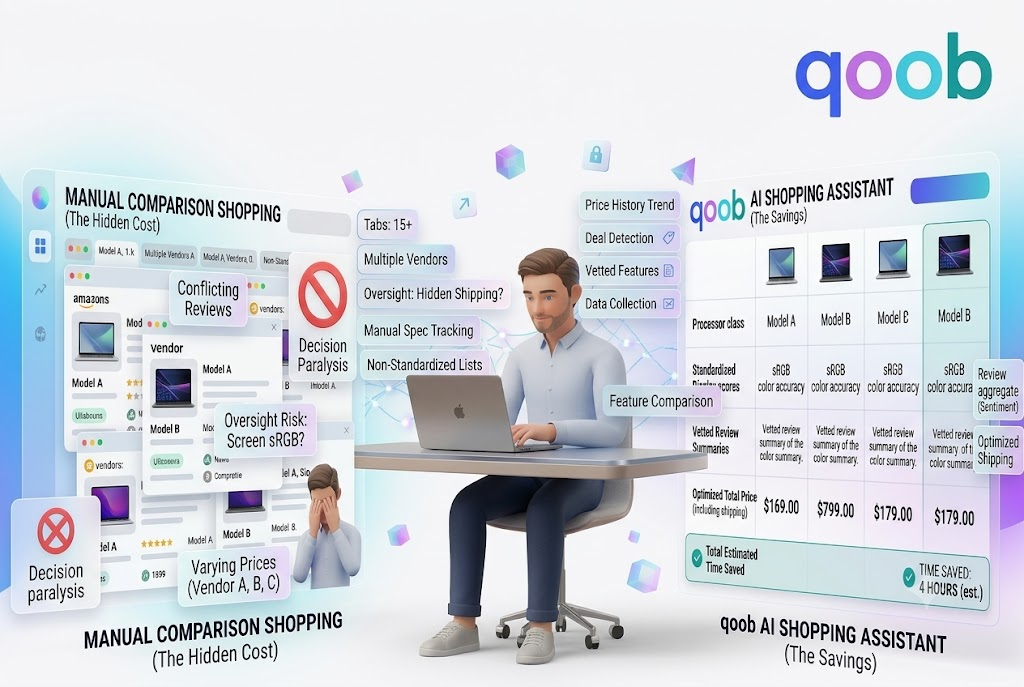
You open one store, then another. You compare specifications. You check reviews. You search for discounts. You look for a better price. Then you realize two products use different names for almost identical features, so you start comparing those too.
An AI shopping assistant can simplify that process by helping you compare products, weigh options, and focus on the factors that actually matter to you. Instead of turning every purchase into a research project, AI can help narrow the choices and support a faster decision.
A price comparison tool can answer:
“Where is this product cheapest?”
An AI shopping assistant can help answer:
“Is this actually the right product for me?”
Both have value.
They simply solve different problems.
The table does not make the decision for you.
It makes the trade-offs easier to see.
AI does not eliminate the need for judgment.
It reduces the administrative work around the judgment.
That is the real time-saving opportunity.
Why Does Comparison Shopping Take So Long?
The problem is not a lack of information. It is too much information. A single product category can include dozens or hundreds of options. Each product may have different specifications, prices, reviews, bundles, warranties, and availability. You might compare:- Price
- Features
- Brand
- Size
- Quality
- Reviews
- Warranty
- Shipping
- Compatibility
- Long-term value
What Is an AI Shopping Assistant?
An AI shopping assistant is a tool that uses artificial intelligence to help you research, compare, and evaluate products. Instead of manually opening multiple shopping pages, you can ask a question in natural language. For example: “Which laptop is best for travel, writing, and light photo editing under $1,000?” Or: “Compare these two headphones for commuting and long flights.” Or: “Which option gives me the best value if I use it every day?” The AI can help organize the relevant factors so you spend less time jumping between pages. The goal is not simply to find the cheapest product. It is to find the product that makes the most sense for your needs.How Does an AI Shopping Assistant Save Time?
The biggest time savings come from reducing repetitive research. Without an AI assistant, comparison shopping may look like this: Search → Open product page → Check specifications → Read reviews → Open another product → Repeat → Compare notes → Search for price → Decide An AI-assisted process can be much shorter: Ask → Compare → Review the recommendation → Decide That does not mean you should blindly accept the answer. It means you can start with a more useful comparison instead of assembling all the information yourself. The fewer tabs you need to manage, the less likely you are to forget why you opened the first one.What Does an AI Shopping Assistant Actually Compare?
The comparison depends on what you ask. A good shopping assistant can help you evaluate factors such as:Price
Which options fit your budget?Features
Which product includes the features you actually need?Compatibility
Will the product work with the devices, systems, or accessories you already use?Size
Does it fit your available space?Performance
Does it meet the level of performance you require?Reviews
What are customers consistently saying about the product?Value
Does the additional cost of one option provide enough benefit to justify it? This is where AI can be more useful than a simple price comparison app. A price comparison tool focuses heavily on cost. An AI shopping assistant can consider the reason behind the purchase as well.Why Is the Cheapest Product Not Always the Best?
Price is important. It is just not the entire decision. Suppose you are comparing two coffee machines. One costs $100. The other costs $160. The cheaper model looks like the obvious winner. Then you discover that the more expensive machine has the capacity, durability, and features you need for daily use. The extra $60 may represent better value. This is why value matters more than price alone. AI can help you frame the comparison around your priorities rather than simply sorting products from cheapest to most expensive.Can You Compare Products With AI?
Yes. One of the useful applications of AI shopping tools is helping users compare products with AI. You can provide:- Product names
- Links
- Prices
- Specifications
- Your budget
- Your preferences
- Your intended use
Why Does Context Matter in Shopping?
The “best” product is rarely universal. A professional photographer and a casual smartphone user may want completely different cameras. A runner and a casual walker may want different shoes. A frequent traveler and someone who drives everywhere may have completely different priorities when buying luggage. Generic rankings cannot fully account for those differences. A personalized AI shopping assistant can consider the context you provide. The result can be more useful because the comparison is based on your actual priorities rather than an imaginary average shopper. The Qoob is designed around this broader idea of personal AI search, where relevant context can influence the answers you receive.How Is an AI Shopping Assistant Different From a Price Comparison App?
The distinction is straightforward. A price comparison app primarily helps you compare prices. An AI shopping assistant can help you compare products and decisions.| Price Comparison App | AI Shopping Assistant |
| Focuses mainly on price | Considers multiple factors |
| Compares product costs | Can compare products by use case |
| Often shows retailer options | Can explain trade-offs |
| Useful for finding deals | Useful for deciding what fits your needs |
| Requires more interpretation | Can summarize differences |
| Usually more transactional | More decision-oriented |
Why Do People Open So Many Shopping Tabs?
Because every retailer has a slightly different page. One store highlights price. Another highlights reviews. Another highlights technical specifications. A fourth has a detailed product description. Now you have four tabs and four different ways of presenting the same information. Your job becomes translating all of that into one decision. AI can help organize the information into a consistent comparison. That is particularly useful when product pages use different terminology or bury important specifications halfway down the page.How Can AI Help With Product Specifications?
Specifications can be difficult to compare manually. Different brands may emphasize different measurements. One laptop might emphasize processor generation. Another might focus on RAM. Another might make storage capacity the headline. The buyer has to determine which differences actually matter. AI can help organize specifications into categories that are easier to compare. For example:| Factor | Product A | Product B |
| Price | Higher | Lower |
| Battery | Longer | Shorter |
| Weight | Lighter | Heavier |
| Storage | Larger | Smaller |
| Best for | Frequent travel | Home use |
Can AI Help You Avoid Unnecessary Features?
Yes. More features do not automatically mean better value. A product may include capabilities you will never use. You could end up paying significantly more for functions that look impressive on a specification sheet but have no practical benefit for you. An AI shopping assistant can help you separate: Must have from: Nice to have from: Completely unnecessary That can make a surprising difference to the final purchase. You do not need the most powerful version of something. You need the version that fits your actual use.How Can an AI Shopping Assistant Help With Budget?
Start by telling it your budget. Then explain what matters most. For example: “Find the best option under $500. Prioritize durability and battery life over extra features.” Now the comparison has a clear constraint. The AI can focus on products that fit the budget while considering your priorities. This is different from simply sorting by price. The cheapest item is not necessarily the best value. The most expensive item is not necessarily the best product. The right choice sits somewhere between price and usefulness.How Can AI Reduce Decision Fatigue?
Decision fatigue happens when you make too many choices. Comparison shopping creates a lot of them. Which brand? Which model? Which size? Which color? Which features? Which retailer? Which price? Which warranty? After enough comparisons, people often stop researching and choose whatever feels easiest. That can lead to poor decisions. An AI shopping assistant can reduce the number of choices you need to consider at once. Instead of 30 products, you may be able to narrow the list to three realistic candidates. That is a much easier decision.Should You Read Reviews Before Buying?
Yes. But reading every review is rarely practical. AI can help summarize recurring themes. For example, reviews may consistently mention:- Excellent battery life
- Difficult setup
- Strong build quality
- Poor included accessories
- Good value
- Weak customer support
Can AI Help Identify Product Trade-Offs?
This is one of its strongest uses. Every product has trade-offs. A lighter laptop may have fewer ports. A cheaper appliance may use less durable materials. A premium product may have better performance but cost significantly more. Instead of asking: “Which product is best?” ask: “What am I giving up if I choose Product A instead of Product B?” That question produces a much more useful comparison.What Makes a Good Shopping Recommendation?
A useful recommendation should explain why it fits. A list of product names is not enough. You should understand: Best overall: Which product is the strongest balance? Best budget: Which option saves money without sacrificing what matters? Best premium: Which option is worth paying more for? Best for a specific use: Which product best matches your actual needs? This structure gives you a reason to choose rather than simply another list to research.How Does Qoob Fit Into AI Shopping?
Qoob is designed as a personal AI search and decision-making tool. Shopping is one of the everyday decision areas the platform is built to support. The idea is simple. Instead of opening a dozen shopping tabs, you can ask a question about the options you are considering. Qoob can help you compare them and focus on the factors that matter to you. The platform’s smart search experience is built around short, useful answers rather than a long list of links. That makes product comparison part of a broader decision-support approach.What Should You Tell an AI Shopping Assistant?
You do not need a huge prompt. Start with the information that actually affects the decision.Your budget
Set a realistic price range.Your use case
Explain what you are buying the product for.Your priorities
Say what matters most.Your restrictions
Mention compatibility, size, location, timing, or other constraints.Your deal-breakers
Tell the system what you absolutely do not want. For example: “I need headphones under $250 for daily commuting. Prioritize noise cancellation and comfort. I do not care about microphone quality.” That is enough context to create a useful comparison.Can an AI Shopping Assistant Help With Gift Shopping?
Yes. Gift shopping is often a perfect example of a decision with too many options. You know the recipient. You know your budget. You may know a few interests. But finding the right product can still take hours. You can provide the person’s age range, interests, relationship to you, budget, and occasion. The AI can help narrow the search. It can also compare options once you have several candidates. Instead of searching for “best gifts for someone who likes cooking,” you could ask for a shortlist based on the person’s specific interests and your budget.How Can AI Help You Compare Online Retailers?
Price is only one factor when comparing retailers. You may also care about:- Shipping
- Delivery time
- Return policies
- Warranty
- Availability
- Customer service
- Seller reputation
What Are the Risks of Using AI for Shopping?
AI can save time. It can also make mistakes. Product information changes. Prices change. Stock changes. Models can be updated. A product description may also be interpreted incorrectly. That means you should verify important information before making a significant purchase. Check the retailer’s current product page. Confirm the price. Review the return policy. Check compatibility. For expensive purchases, verify specifications directly with the manufacturer or retailer. AI should help with the research. It should not replace common sense.How Do You Know When to Stop Comparing?
This is one of the biggest hidden costs of shopping. People often believe another five minutes of research will produce a better choice. Sometimes it does. Often it produces three more options and another hour of uncertainty. A useful stopping point is when:- You have two or three strong candidates
- They all fit your basic requirements
- You understand the main trade-offs
- You know which option best matches your priorities
- You have checked the important details
AI Shopping Assistant vs. Doing Everything Manually
| Manual Shopping Research | AI-Assisted Shopping |
| Search multiple retailers | Ask one focused question |
| Open many product pages | Compare selected options |
| Copy specifications manually | Summarize differences |
| Read many reviews | Identify recurring themes |
| Track prices yourself | Include price in the comparison |
| Decide from scattered information | Review a structured recommendation |
| Often takes longer | Designed to reduce research time |
How Can You Use AI Without Over-Relying on It?
Treat the AI as a research assistant. Not the final authority. Use it to:- Narrow your options
- Identify differences
- Organize specifications
- Summarize patterns
- Clarify trade-offs
- Structure your decision
Is AI Shopping Better Than a Traditional Search?
It depends on what you need. Traditional search is useful when you want to browse retailers, read original reviews, find product pages, or explore a large amount of information. AI shopping is useful when you already know the decision you need to make and want help comparing options. That distinction matters. If you want to discover everything, browse. If you want help deciding, ask.Final Thoughts
Comparison shopping has a hidden cost. It is not only the money you spend. It is the time you spend researching, comparing, opening tabs, reading reviews, checking prices, and second-guessing the final decision. An AI shopping assistant can reduce some of that work by organizing product information around what actually matters to you. It can help compare products, identify trade-offs, narrow your options, and turn a huge list into a manageable shortlist. At The Qoob, shopping comparisons are part of a broader personal AI search experience built around everyday decisions. The goal is not to buy the most expensive product. It is not even necessarily to find the cheapest. It is to find the option that fits your needs well enough that you can stop researching and get on with your day. Because at some point, the tenth product comparison is not research. It is procrastination wearing a very convincing spreadsheet costume.Frequently Asked Questions
What is an AI shopping assistant?
An AI shopping assistant uses artificial intelligence to help you research, compare, and evaluate products based on factors such as price, features, use case, and personal preferences.
Can AI compare products?
Yes. AI can help compare product specifications, prices, features, use cases, and other criteria. You should verify important details before making a significant purchase.
How is an AI shopping assistant different from a price comparison app?
A price comparison app primarily focuses on finding and comparing prices. An AI shopping assistant can consider price alongside features, preferences, use case, and trade-offs.
Can I compare products with AI?
Yes. You can provide product names, specifications, links, budgets, and preferences and ask the AI to compare the options based on what matters to you.
Does an AI shopping assistant always find the cheapest option?
No. A useful recommendation should consider value and suitability rather than focusing only on the lowest price.
Can AI help me choose between two products?
Yes. Asking an AI to compare two specific products can be especially useful because the number of variables is easier to manage.
What information should I give an AI shopping assistant?
Start with your budget, intended use, priorities, restrictions, and deal-breakers. This context helps produce a more relevant comparison.
Can AI summarize product reviews?
AI can help summarize recurring themes in product reviews. However, important claims should still be checked against current customer reviews and reliable product information.
Is AI shopping reliable?
AI can be useful for organizing information and supporting decisions, but it can make mistakes or use outdated information. Verify current prices, specifications, availability, warranties, and return policies before buying.
Can an AI shopping assistant help find gifts?
Yes. You can provide the recipient’s interests, age range, your relationship, budget, and occasion to generate and compare suitable gift options.
Can AI compare online retailers?
Yes. An AI assistant can help compare factors such as price, shipping, delivery, returns, warranty, and availability when reliable information is available.
When should I stop comparison shopping?
Stop when you have a few strong options, understand the key trade-offs, and have enough information to make a confident decision. Continuing to compare indefinitely rarely improves every purchase.
Is The Qoob a shopping comparison tool?
The Qoob is a personal AI search and decision-making app that includes shopping comparisons among its everyday use cases. Its purpose is broader than traditional price comparison.
Does The Qoob require special prompting skills?
No. The Qoob is designed so users can ask questions in natural language without needing to learn specialized AI prompting.
Can The Qoob help me make purchasing decisions?
Yes. The Qoob is designed to help users compare options, understand information, and make everyday decisions with short, relevant answers.