
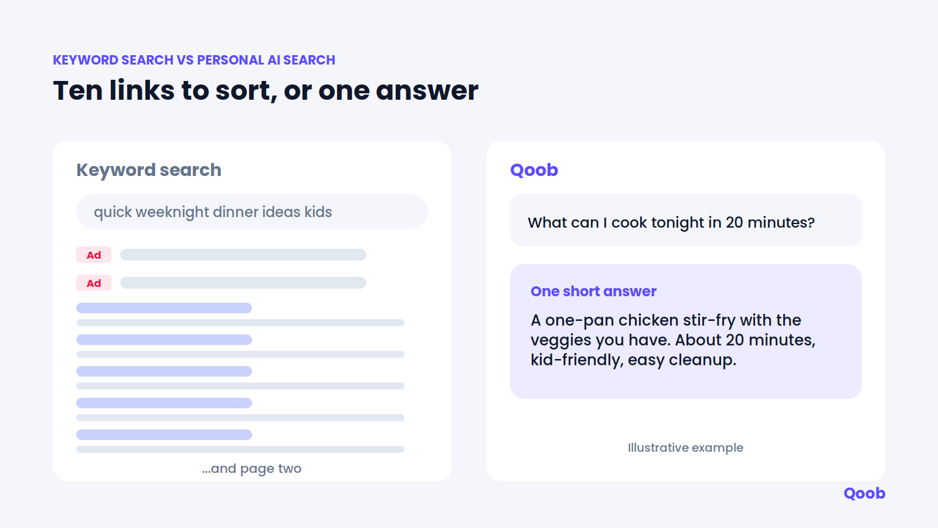
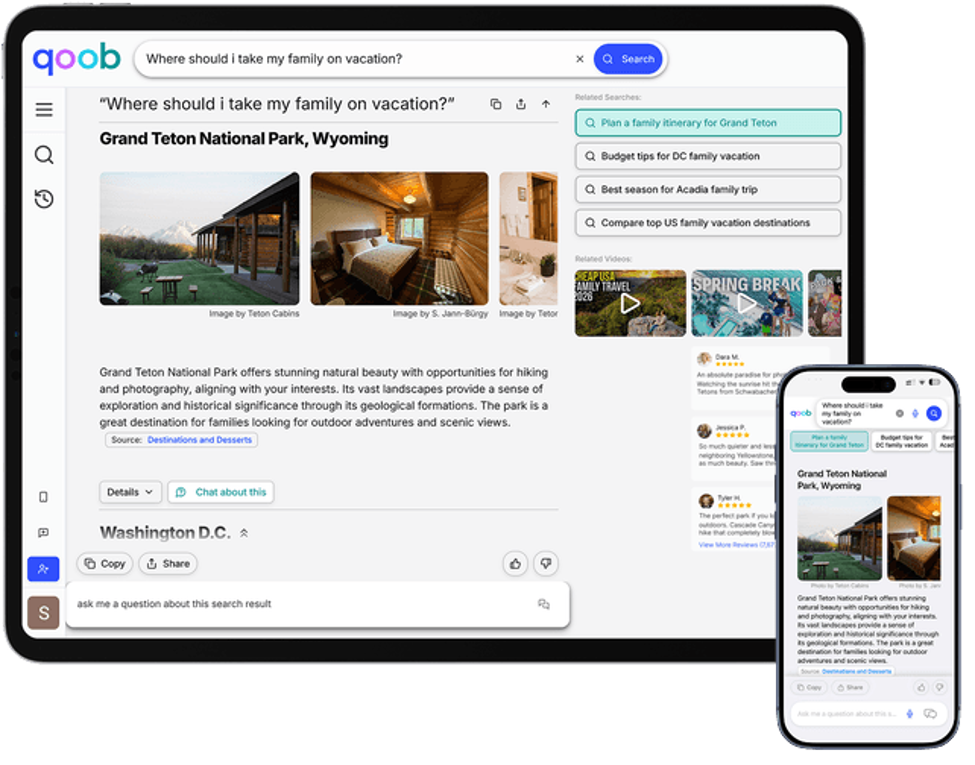
Quick Answer: Keyword search was a workaround, not the goal. Qoob CTO Mikael Quist argues that people learned to speak in search-engine shorthand because it was the only interface available. AI removes that step. Qoob, a personal AI search app, is built on that idea: ask a plain question, get one short, relevant answer, skip the list of links.
For 25 years, search has meant the same trade. Type a few keywords, get a page of links, do the rest yourself. Qoob CTO Mikael Quist thinks that model is hitting a real ceiling, and that the future of AI search looks very different. In a recent interview with Information Security Media Group (ISMG), he explained why, and what a personal AI search app like Qoob does differently.
From keywords to plain language
Quist’s central point is that keyword search was never what people wanted. It was a workaround. People learned to translate their real question into search-engine shorthand because that was the only option. With AI, that translation step disappears. You can ask in plain language and get a response that fits your intent.
He compares the shift to moving from BlackBerry to iPhone. Not a trend, but a more natural way to interact that permanently replaces the old one.
That thinking sits directly behind how Qoob works. Instead of making you search in keywords and sort results, Qoob is built to:
- Take a plain, everyday question
- Return one short, relevant answer
- Skip the list of links entirely
The real problem isn’t technology. It’s incentives.
Asked whether search’s problems are technical, economic, or about trust, Quist points first to economics. He sees two separate problems.
Traditional, ad-funded search:
- Built to show sponsored results and SEO-heavy content
- Serves publishers and advertisers as much as the person searching
- Makes you sort through ten links, ads, and page two to find an answer
AI-native search:
- Carries high inference costs, which make personalized answers expensive at scale
- Still needs to get better at saying “I’m not sure” instead of answering with false confidence
- Needs better retrieval to close the reliability gap
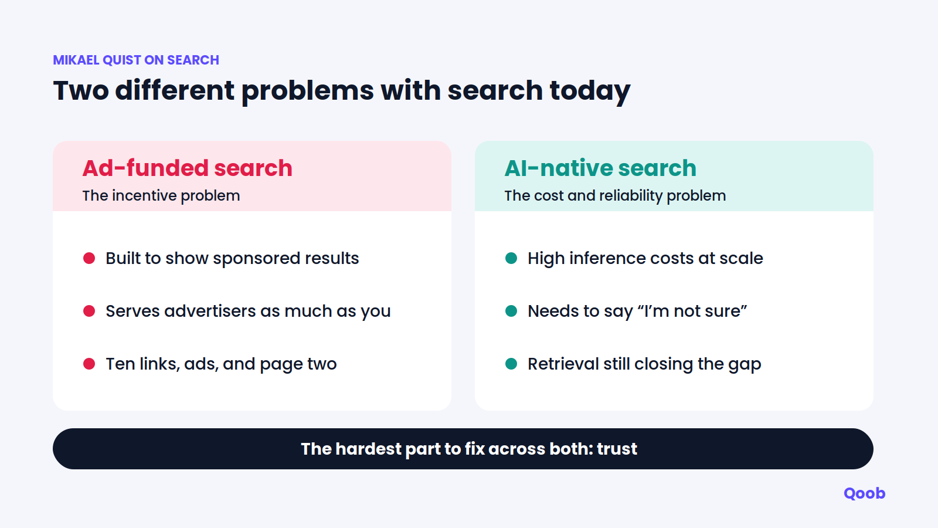
Across both, Quist names one thing as hardest to fix: trust. Trust isn’t something a product ships with. It’s earned through consistent behavior and aligned incentives over time. That’s why Qoob keeps the answer itself clean of ads, and why users stay in control of the personal context the app uses. Read more on the Qoob Difference.
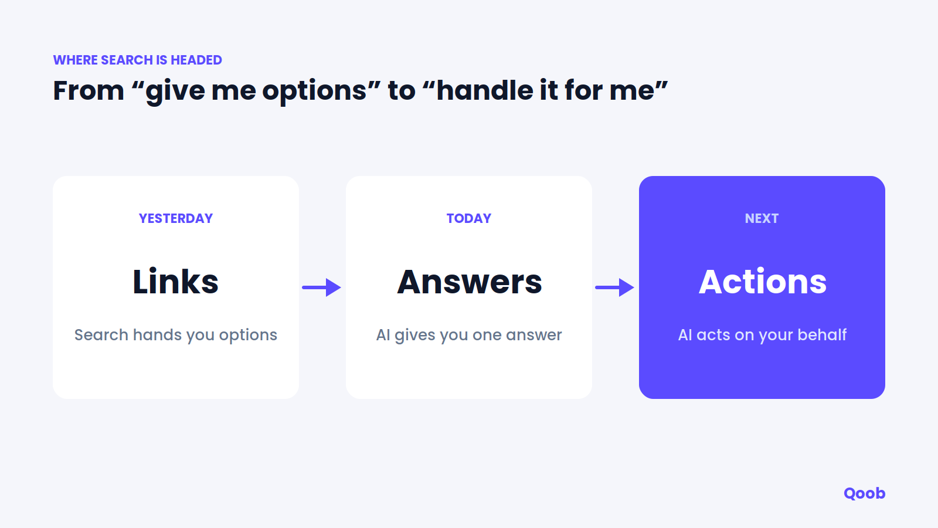
From “give me options” to “handle it for me”
Quist also points to a bigger change ahead. Agentic AI shifts the expectation from a good answer to a system that can act on your behalf. Most of today’s search infrastructure wasn’t built for that:
- Link-based results pages, designed to hand off traffic rather than finish a task
- Ad systems built around clicks and impressions rather than outcomes
His view is that bolting an “AI mode” onto an existing search engine doesn’t solve the mismatch. It would take rebuilding around real integrations and outcome-based value, something the big players are reluctant to risk against their ad businesses.
New risks worth watching
Quist is candid about the risks that come with this shift. As AI agents take on more tasks, he expects new forms of manipulation aimed at agents rather than human readers:
- Content designed to game how models parse and rank information
- Attempts to hijack an agent’s instructions through hidden text
- Fake trust signals meant to steer an agent’s decisions
Addressing this early, through better verification and incentive design, is how trust in agentic systems stays intact.
Why this matters for everyday users
This isn’t only industry commentary. It’s the thinking behind Qoob’s product decisions. If the assumption that “users want to visit websites” is becoming outdated, then a personal AI search app that skips the link list and gives a direct, trustworthy answer is a bet on where search is going, not a minor feature. That case is laid out in more detail on Why Qoob.
Before Qoob, Quist spent years leading technology, engineering, and compute infrastructure work at Amazon, including Amazon Prime’s technology and global freight routing systems. He holds an MS in Industrial and Systems Engineering from the University of Minnesota. That experience is what keeps Qoob simple on the surface and reliable underneath. See how Quist thinks about what runs underneath Qoob.
Want to try search without the link list? Get the app for free, or sign in if you already have an account.
FAQ
Who is Mikael Quist?
Mikael Quist is the CTO of Qoob Technologies, the company behind Qoob, a personal AI search app. He previously led technology and infrastructure work at Amazon, including Amazon Prime’s technology and global freight routing.
What does Mikael Quist think is wrong with traditional search?
He points to the ad-based business model. It rewards sponsored results and SEO-heavy pages over directly answering the user’s question.
What is the hardest problem in search to fix?
Trust. Quist argues it depends on consistent behavior and aligned incentives over time, not only better technology.
How does this thinking show up in Qoob?
Qoob gives short, direct answers with no ads inside the answer itself, and lets users stay in control of the personal context the app uses.
What is personal AI search?
Personal AI search is search that understands what matters to you and gives short, relevant answers instead of a list of links. Qoob is a personal AI search app built around this idea.
Where can I learn about the rest of the Qoob team?
Visit About Us to meet the full leadership team, including founder AJ Javan.
Leave a Reply