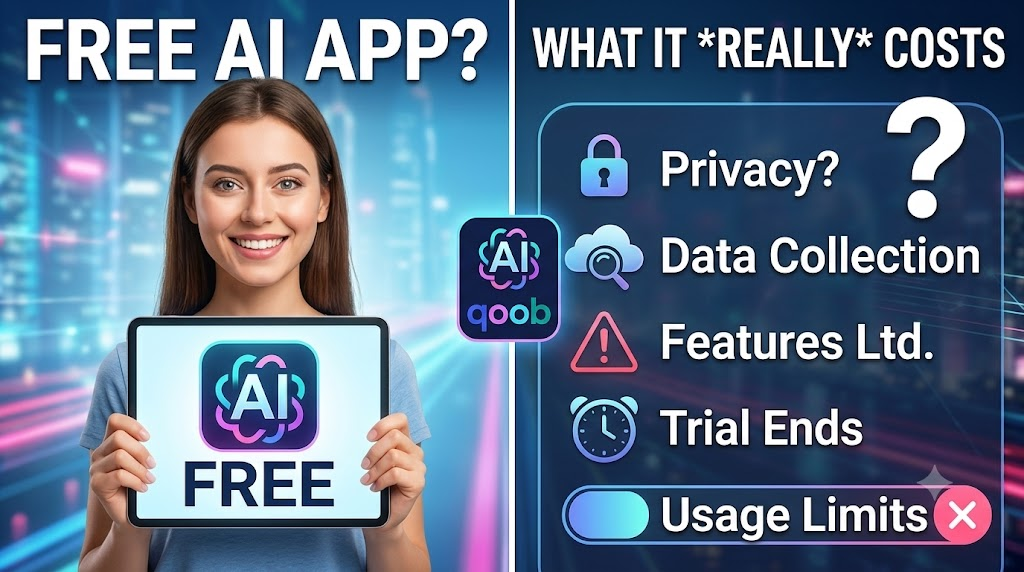
“Free” sounds straightforward. Download the app, create an account, and start using it without paying. Then you discover usage limits, premium features, subscriptions, advertisements, or restrictions that were not exactly obvious when you first signed up.That is why comparing Free AI Apps requires more than looking at the price tag. In 2026, AI apps use several different pricing models, and the word “free” can mean anything from genuinely free access to a limited trial designed to encourage an upgrade. The Qoob takes a different approach by offering its AI search and decision-making experience without requiring a subscription.
This gives you a much better picture than a simple “Free” label.
What Does “Free” Mean for an AI App?
A free AI app does not necessarily mean every feature is available at no cost.The term can describe several different models.Completely free
The app provides its core functionality without charging users.Freemium
You can use the basic version for free, but advanced features require payment.Free with usage limits
The app is free until you reach a daily, weekly, monthly, or feature-specific limit.Free trial
You get temporary access before a paid subscription begins.Free with advertising
The service does not charge you directly, but it generates revenue through advertisements.Free with optional upgrades
Core functionality remains available without payment while users can choose to purchase additional features.These models are not necessarily bad.The important part is understanding which one you are signing up for.Why Does “Free” Need More Explanation?
AI systems cost money to operate.They require computing power, storage, development, infrastructure, and ongoing maintenance.That means an AI company generally needs some way to support those costs.The business model may involve:- Subscriptions
- Advertising
- Paid upgrades
- Enterprise services
- Usage-based pricing
- Data or technology licensing
What Should You Check Before Calling an AI App “Free”?
Look beyond the download page.Check the actual product terms.Pay attention to:Usage limits
Does the free version limit how many questions you can ask?Feature restrictions
Are important tools reserved for paid users?Model access
Does the free version use a less capable model?Advertisements
Are ads part of the experience?Account requirements
Do you need to create an account before using the service?Trial periods
Does the free experience automatically become paid later?Data policies
What information does the service collect and how is it used?The price is only one part of the cost.Your time, attention, privacy, and frustration count too.Are Free AI Apps Actually Useful?
Absolutely.A free AI app can be extremely useful for everyday tasks.You might use one to:- Brainstorm ideas
- Draft emails
- Summarize information
- Ask questions
- Plan trips
- Compare options
- Generate recipes
- Learn a concept
- Organize information
- Get recommendations
What Is the Difference Between Free and Freemium?
This distinction causes plenty of confusion.A free product gives you access without requiring payment.A freemium product gives you a free starting tier while reserving some features, capacity, or functionality for paying customers.For example, a freemium AI app might allow a certain number of requests per day.After that, you may need to wait for the limit to reset or upgrade to a paid plan.That can still be a perfectly reasonable model.You just need to know that “free” does not mean unlimited.How Do Usage Limits Work?
Usage limits vary widely.An app may limit:- Number of prompts
- Number of image generations
- File uploads
- Advanced model usage
- Search requests
- API access
- Daily activity
- Monthly usage
What Is a Free AI App With No Subscription?
A no-subscription model means you can use the service without committing to a recurring monthly payment.This can be useful when you want AI for occasional tasks rather than heavy daily use.The Qoob states that it is free to use and does not require a subscription.That makes its model different from AI services built primarily around recurring premium plans.The distinction matters for users who want to experiment with AI without adding another monthly expense to their list.The modern human already has approximately 400 subscriptions to cancel.Are Free AI Apps Supported by Advertising?
Some are.Advertising can provide a revenue source without charging users directly.But the experience can vary.Some services place ads around the main interface.Others may show sponsored results.Some may use promoted content or other commercial placements.That does not automatically make the app bad.It does mean you should understand how advertising fits into the experience.The Qoob takes a different approach. It states that it does not place sponsored results inside its answers and instead uses a single non-intrusive advertisement at the bottom of the page.That keeps the answer itself separate from promotional content.Why Should Privacy Matter When an AI App Is Free?
This is one of the most important questions.People often assume:“If I am not paying, there is no cost.”That is not always true.You may provide:- Search queries
- Conversations
- Preferences
- Location information
- Account details
- Usage data
- Device information
What Does Qoob Say About Privacy?
Qoob positions privacy and personalization as connected parts of its product.The platform states that users control what context it remembers and that it does not sell users’ usage data.That matters because personal AI search becomes more useful when the system understands relevant preferences.At the same time, users need control over what they share.The relationship should be clear:More relevant context → More personalized answersnot:More personal data → More mysteryShould You Give a Free AI App Your Personal Information?
Be selective.You do not need to provide sensitive information simply because an app allows you to enter it.Before sharing personal details, ask:Does this information improve the result?Do I understand how it is stored?Can I control or delete it?Would I be comfortable if this information were retained?For high-stakes information, extra caution makes sense.Do not treat an AI app as a secure vault simply because it has a friendly interface.How Do Free AI Apps Make Money?
There is no single business model.Common options include:Subscriptions
Users pay monthly or annually for premium functionality.Advertising
The company earns revenue from advertisements or sponsored placements.Paid upgrades
Basic access remains free while advanced features cost extra.Enterprise services
Companies pay for business versions or specialized infrastructure.Developer access
Businesses pay to access AI models or APIs.Partnerships
Some companies generate revenue through commercial partnerships.Understanding the business model can help explain why a particular “free” product has certain restrictions.What Is the Difference Between a Free AI App and a Free Trial?
A free app is available without a mandatory payment.A free trial is temporary access to a paid product.This distinction is important because trials can sometimes require payment details upfront.Before starting a trial, check:- Trial length
- Renewal date
- Renewal price
- Cancellation process
- Which features remain after the trial
What Should You Look for in Free AI Apps in 2026?
The best free AI app depends on your use case.But several qualities matter regardless of the category.Clear pricing
You should understand what is actually free.Useful free functionality
The free version should do something meaningful.Reasonable limits
Usage restrictions should be understandable.Privacy controls
You should know what information the service collects and retains.Reliable performance
A free app should still provide a useful experience.Transparent upgrades
Paid features should be clearly separated from free ones.Ease of use
You should not need a technical manual to ask a question.Are All Free AI Apps the Same?
Not remotely.Some focus on writing.Others focus on images.Some are built around coding.Others specialize in research, search, meetings, productivity, education, or recommendations.That is why broad lists of the best AI apps can be useful as a starting point, but you still need to match the tool with the problem.The app that is excellent for writing may be terrible for personal recommendations.The app that is useful for coding may be unnecessarily complicated for someone who only wants help planning dinner.Start with the task.Then choose the tool.Where Does Qoob Fit Among Free AI Apps?
Qoob sits in a specific part of the AI landscape.It is designed as a personal AI search and decision-making app.The goal is not to be everything for everyone.Instead, it focuses on questions where the user wants a useful answer and a practical decision.Examples include:- Where should I eat?
- What should I cook?
- Which product should I choose?
- Where should I go this weekend?
- What option best fits my preferences?
How Does Personalization Work in a Free AI App?
Personalization can make recommendations more useful.Suppose you ask:“Where should I go for dinner?”A generic system may give you popular restaurants.A personalized system may consider preferences you have shared previously.Maybe you prefer vegetarian options.Maybe you dislike crowded places.Maybe you usually stay within a particular area.That context can improve the relevance of the answer.The Qoob approach combines personal context with AI search so users can receive answers that are more specific to their preferences.Does Personalization Make an AI App Less Private?
Not automatically.The important questions are what data is collected, how it is used, what the user controls, and whether the company clearly explains its policies.Qoob states that users control what context it remembers.That is an important principle.Personalization should be useful without becoming opaque.Can Free AI Apps Be Better Than Paid AI Apps?
Sometimes.A paid service may have more features, but those features may not matter to you.Suppose you only need:- Occasional questions
- Simple recommendations
- Basic summaries
- Everyday planning
What Should You Watch for When Comparing Free AI Apps?
A simple comparison table can help.| Factor | What to Ask |
| Price | Is it genuinely free or only a trial? |
| Usage | Are there daily or monthly limits? |
| Features | Which tools are included? |
| Models | Is the free tier limited to specific models? |
| Ads | Are advertisements part of the experience? |
| Privacy | What data is collected and retained? |
| Personalization | Can the app use relevant preferences? |
| Upgrade | What happens when you hit the limit? |
| Ease of use | Can you start without technical knowledge? |
| Purpose | Does the app fit your actual needs? |
This gives you a much better picture than a simple “Free” label.
Are Free AI Apps Safe to Use?
Safety depends on the app and how you use it.For everyday, low-risk tasks, many free AI tools can be useful.For sensitive information, be more cautious.Avoid entering confidential business information, passwords, private financial details, highly sensitive personal data, or anything else you would not want retained unless you understand the service’s policies and have a legitimate reason to share it.Also verify important outputs.AI can make mistakes.A free answer is still an answer that needs judgment.How Can You Get the Most From a Free AI App?
You do not need to use every feature.Start with your most common tasks.If you need recommendations, focus on recommendation quality.If you need writing support, test writing quality.If you need search, test factual relevance and clarity.Then examine the limits.Ask:How often can I use it?What happens when I reach the limit?Can I still use the service without upgrading?This helps you determine whether the free version is actually useful in your daily life.A Practical Checklist Before You Sign Up
Before creating another AI account, check five things:1. The business model
Understand how the company supports the service.2. The free tier
Read what is actually included.3. Usage limits
Know how much you can use it.4. Privacy
Understand what happens to your data.5. Upgrade pressure
Find out whether the free experience is genuinely useful or mainly a funnel toward a paid subscription.That last point matters.There is a big difference between a free product and a sales demo wearing a free-product costume.What If an AI App Is Free but Full of Ads?
Consider how intrusive the advertising feels.A small ad at the bottom of a page may be easy to tolerate.Sponsored answers that look like normal recommendations are a different issue.Advertising should be clearly distinguishable from the information you are asking for.The Qoob says it avoids sponsored results inside answers and uses a single advertisement at the bottom.That approach is intended to keep the search experience focused on the user’s question.How Does Qoob Compare With Other Free AI Apps?
The main distinction is not simply price.It is purpose.A writing assistant may help you draft content.An image generator may create visuals.A coding assistant may help write software.A general chatbot may support long conversations.Qoob focuses on personal search and decisions.That makes it particularly relevant when you want to ask:“What should I choose?”instead of:“Can you write something for me?”The right comparison therefore starts with the task, not the app store ranking.Should You Pay for an AI App?
Only when the paid features provide enough value to justify the cost.Ask:Do I use it often?Do the free limits get in my way?Do I need premium features?Does the paid version save meaningful time?Is there a free alternative that already solves the problem?If the answer to those questions is mostly no, you may not need the subscription.“AI subscription” is not a personality trait.You do not need one simply because everyone else downloaded it.Final Thoughts
“Free AI app” can mean many things.It may mean genuinely free access.It may mean a restricted free tier.It may mean a trial.It may mean a product supported by advertising.It may also mean a service that earns money somewhere else in the business.That is why you should look beyond the word “free.”Check usage limits.Check features.Check privacy.Check advertisements.Check what happens when you reach the limit.Most importantly, ask whether the free version actually solves your problem.The Qoob is designed around personal AI search and everyday decisions, and its service is available without a subscription.Explore The Qoob to see how a free, decision-focused AI search experience compares with the growing number of AI apps available in 2026.Free is useful.Free and transparent is better.Frequently Asked Questions
What are free AI apps?
Free AI apps are applications that provide some level of artificial intelligence functionality without requiring users to pay. They may still have usage limits, advertisements, premium upgrades, or restricted features.
Are free AI apps actually free?
Sometimes. Some provide meaningful free access, while others use freemium models, usage caps, free trials, or advertising. Always check the pricing and terms.
What is a freemium AI app?
A freemium AI app provides a basic version for free while charging for additional features, higher usage, or advanced capabilities.
Do free AI apps have usage limits?
Many do. Limits can apply to the number of prompts, messages, searches, image generations, file uploads, or access to advanced models.
Are free AI apps safe?
Safety depends on the specific service and how you use it. Check privacy policies and avoid sharing sensitive information unless you understand how the service handles it.
Do free AI apps use your data?
Many AI services collect some user or usage information. The exact practices vary, so review the service’s privacy policy before sharing personal or sensitive information.
What should I look for in a free AI app?
Look at the actual free features, usage limits, privacy practices, advertisements, upgrade requirements, ease of use, and whether the tool fits your needs.
Can a free AI app be better than a paid one?
Yes. If the free version provides everything you need, paying for additional features may not offer enough value to justify the cost.
What does Qoob offer for free?
The Qoob states that its AI search and decision-making service is free to use and does not require a subscription.
Does Qoob have a paid subscription?
Qoob states that it does not require a subscription for its service.
Does Qoob show advertisements?
Qoob states that it does not place sponsored results inside its answers and instead uses a single non-intrusive advertisement at the bottom of the page.
What is Qoob designed for?
Qoob is designed as a personal AI search and decision-making app for everyday questions, recommendations, planning, and practical choices.
Does Qoob use personalization?
Yes. Qoob is designed to use relevant user context and preferences to make answers more useful and personalized.
Can I use Qoob without AI prompting skills?
Yes. Qoob is designed around natural-language questions, so you can ask what you want without learning specialized prompt formats.
Should I use a free AI app for important decisions?
For high-stakes medical, legal, financial, safety, or other important decisions, do not rely on an AI app alone. Verify important information using appropriate authoritative sources and professional advice.