10 Everyday Questions You Didn’t Know an AI Search App Could Answer
People often think of search as something they use for big research tasks, complex work questions, or product comparisons. In reality, search tools are used for small daily decisions all the time. That is where a modern AI Search App can be more useful than many people expect. It can help with simple, practical questions that come up during the day and turn them into fast, clear answers.
The Qoob is designed around a more personal search experience, which makes it a useful example of how search can fit everyday life. If you are comparing how different tools work, the homepage is a good starting point for understanding the broader platform and how it is positioned around search that feels more natural to use.
Why everyday questions matter
Not every search starts with a serious project. Many start with a small problem, a basic need, or a quick decision. You may want to compare options, check a detail, or get a simple explanation before you move on with your day.
That is where AI search feels different from traditional search. Instead of making you sort through many pages, it can help you move from question to answer more directly. For repeated daily use, that speed can matter a lot.
The value of simple answers
A good search experience does not need to feel complicated. It should help you save time, reduce confusion, and give you enough context to act with confidence. That is especially useful when the question is small but still important.
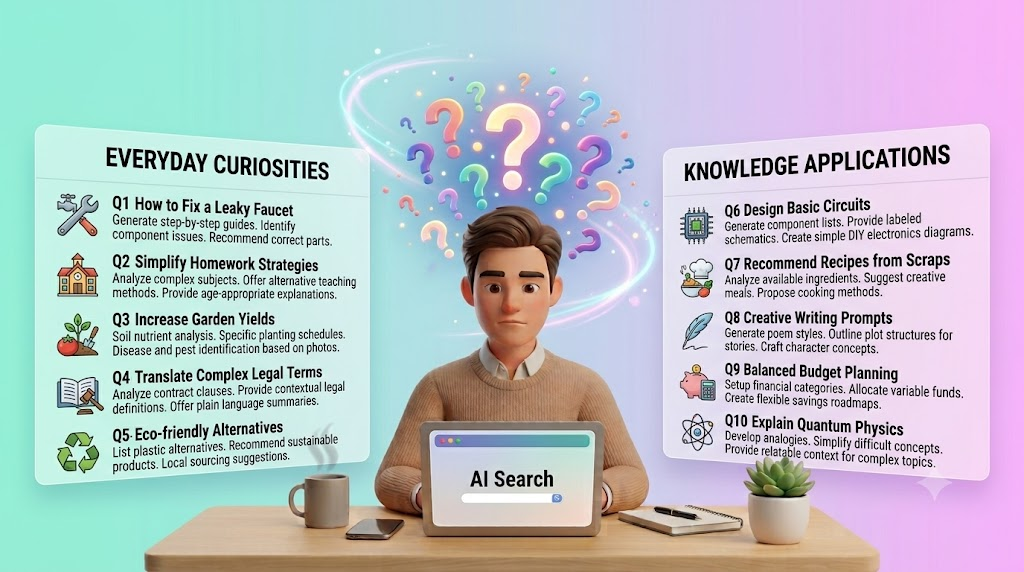
10 everyday questions an AI Search App can answer
The examples below show how an AI Search App can help with normal day-to-day needs, not just advanced research.
1. What is the quickest way to explain a topic?
Many people need a short, simple explanation of something before they can decide what to do next. This may be a concept, a product feature, a process, or even a word they do not fully understand.
An AI search tool can give a clear summary without making you read through long articles first. That makes it useful for busy users who just need the main point.
2. How do I compare two things?
Comparison questions come up all the time. You may want to compare tools, methods, services, or even everyday options like routes, plans, or features.
AI search can help frame the difference in a more direct way. Instead of scanning multiple sources one by one, you can ask for a side-by-side explanation and get a faster starting point.
3. What should I do first?
People often know they have a problem, but not the order of steps to solve it. That is common in work, travel, home tasks, and planning.
A search app can help break a question into a simple sequence. It can show the first step, the second step, and the next decision to make. That makes it easier to move forward without overthinking.
4. What does this term mean?
Many searches begin with a term that sounds familiar but is not fully clear. This could be a technical word, a policy term, a product label, or a business phrase.
An AI Search App can give a plain-language explanation. That is especially helpful when you want the meaning without getting stuck in jargon.
5. How do I choose between options?
People often search when they are stuck between two or three possible choices. The question might be about tools, services, prices, or features.
Search that supports direct comparison can help users narrow the field faster. The goal is not just to provide information. It is to help the user make a clearer decision.
6. What is the latest update on this topic?
Even everyday users need current information. That may include a product change, a policy shift, a service update, or a new way of doing something.
AI search can help surface recent context faster than a manual search session in some cases. It is useful when you want a quick status check before you move on.
For a wider discussion of how this style of search is changing daily behavior, the article on why AI search is replacing Google for everyday questions gives helpful background.
Video : https://www.instagram.com/qoobsearch/reel/DbT4YyLlN-w/
7. What is the best way to phrase this?
Sometimes the problem is not the answer. It is the wording. You may need to write a message, a question, or a search query, but you are not sure how to say it.
An AI search tool can help reframe your idea in simpler language. That saves time and often leads to better results because the query becomes more specific.
8. What can I do with this information?
Information is only useful if it leads to action. Many people search because they want to know the next practical step.
A good AI search experience can move beyond facts and help you think about what to do next. That could be a follow-up question, a comparison, a checklist, or a decision path.
9. How do I solve a small problem?
Everyday search is often about small issues that interrupt the day. Maybe something is not working, a process is unclear, or you need a quick fix.
AI search can help narrow down the likely cause and show a practical next step. That is useful because many small problems do not need a full research session. They just need a clear answer.
10. What should I remember from this?
People often search more than once for the same topic because the first answer was too broad. A better AI Search App can help reduce that repeat work by giving a cleaner summary and a stronger takeaway.
This matters because the best search tools do more than answer a single question. They help users remember what matters and continue the task with less friction.
Everyday questions and the kind of help they need
Not all searches need the same response. Some need a short definition. Others need a comparison or a next step. The table below shows how different kinds of questions usually map to different kinds of support.
Everyday question type
What the user needs
How AI search helps
Definition question
A simple explanation
Gives a clear summary in plain language
Comparison question
A direct side-by-side view
Helps sort options faster
How-to question
Step-by-step guidance
Breaks the task into manageable steps
Decision question
A practical recommendation
Helps narrow the choice
Update question
Recent information
Reduces time spent checking multiple sources
Rewording question
Better phrasing
Helps create a clearer query or message
Why this matters for daily use
The reason AI search is useful in everyday life is simple. Most people do not need a perfect research paper every time they type a question. They need a fast answer they can understand and use.
It saves time
When a tool gives a direct answer, users spend less time digging through pages. That matters most when the question is small but repeated often.
It reduces friction
A search app that understands natural language can feel easier to use. Users can ask questions the way they actually think, instead of trying to match exact keywords.
It helps users stay focused
The more quickly someone gets the right answer, the faster they can return to the task they were already doing. That is a major reason people keep using better search tools once they try them.
How The Qoob fits into this
The Qoob focuses on a more personal search experience, which can be useful for people who want search to feel simpler and more direct in daily use. If you want to understand how that experience is structured, the Qoob search page is the most relevant place to look.
That kind of approach matters because everyday questions are often small, but they still need clear answers. A tool that handles those questions well can become part of a user’s normal routine.
What makes an AI Search App useful in practice
A useful search app is not only fast. It is also easy to understand, easy to return to, and good at handling repeated questions without adding confusion.
Good signs to look for
Clear answers
Simple language
Fast follow-up support
Helpful comparisons
Easy navigation
Consistent results
When these pieces come together, search becomes less of a task and more of a habit.
FAQ
What is an AI Search App?
An AI Search App is a tool that uses artificial intelligence to answer questions, explain topics, compare options, and help users search in a more natural way.
Can an AI Search App answer simple daily questions?
Yes. It can help with definitions, comparisons, small decisions, how-to questions, and quick explanations that come up during the day.
Is an AI Search App better than regular search for everyday use?
It can be, especially when the user wants a direct answer instead of sorting through many links. The best option depends on the task and the tool design.
Do I need technical knowledge to use one?
No. Most people can use an AI Search App by typing questions in normal language. That is one of the main benefits.
Why do people use AI search for small questions?
Because it saves time and makes answers easier to understand. Small questions are often repeated often, so faster search can make a big difference.
An AI Search App is a tool that uses artificial intelligence to answer questions, explain topics, compare options, and help users search in a more natural way.
Yes. It can help with definitions, comparisons, small decisions, how-to questions, and quick explanations that come up during the day.
It can be, especially when the user wants a direct answer instead of sorting through many links. The best option depends on the task and the tool design.
No. Most people can use an AI Search App by typing questions in normal language. That is one of the main benefits.
Because it saves time and makes answers easier to understand. Small questions are often repeated often, so faster search can make a big difference.
Conclusion
An AI Search App is not only for big research jobs. It can also answer the small questions people ask every day, from simple definitions to quick comparisons and next steps. That makes it useful in a way many people do not expect at first.
If you are comparing tools or want to see how a more personal search experience works, visit The Qoob to explore the platform and see how it fits into everyday search habits.