The way people search is changing. Traditional search engines have helped us find websites for decades, but most of us want more than a list of links now. We want a direct answer, something relevant, and we do not want to open six tabs to get it. That shift is why personal AI search apps are catching on, and it is the gap Qoob is built to fill.
Where traditional search falls short
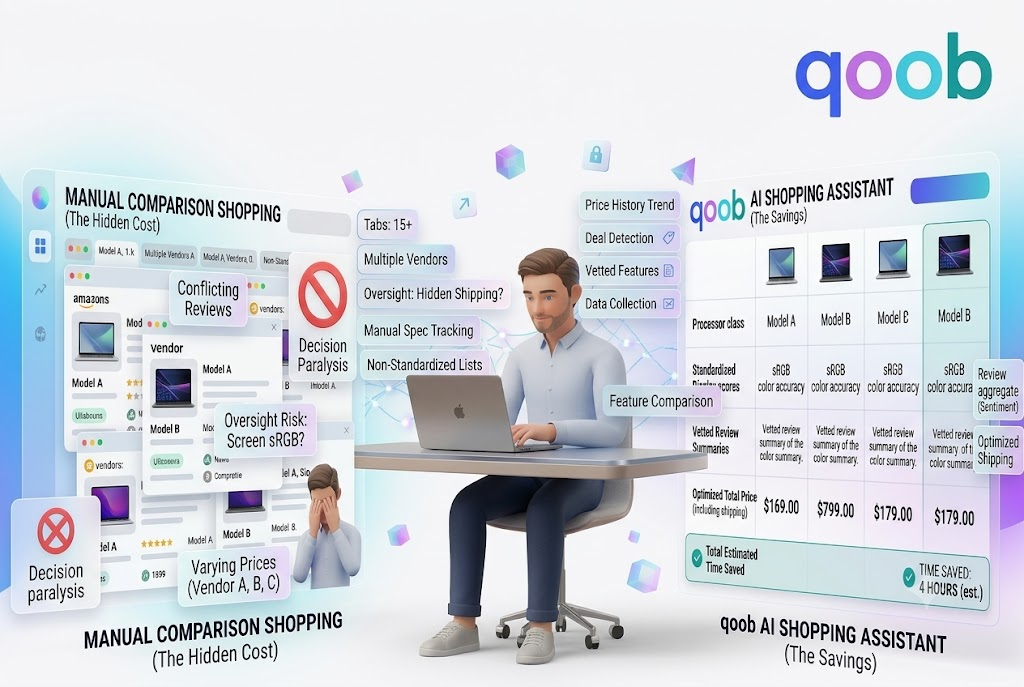
Traditional search runs on keywords and rankings. You type a query, it returns pages that might have what you need, and then the real work starts: open a few, compare them, and figure out which to trust.
For big research that is fine. For an everyday question it is a lot. The usual result is information overload, time lost, and conflicting answers across sites. Traditional search is still useful, but it hands you raw material when you often want a finished answer.
What is personal AI search?
Personal AI search is a different way to find information. Instead of matching keywords, it looks at what you mean and what is relevant to you, then gives back a useful answer.
The short version: personal AI search helps you find answers based on what you actually mean, not the exact words you typed. Qoob is built around this. The result feels more natural and more personal than a search box, and it is pointed at helping you decide rather than sending you somewhere else to read.
Qoob for everyday questions
Plenty of AI tools are built to generate content. Everyday users usually need something simpler: a quick, clear answer to a practical question.
As an AI app for everyday questions, Qoob focuses on answers that are:
- Easy to understand
- Relevant to what you asked
- Quick to get
- Useful for an actual decision
Whether you are researching something, comparing two products, learning a new thing, or planning, Qoob cuts the effort it takes to get to a useful answer.
How Qoob compares to other tools
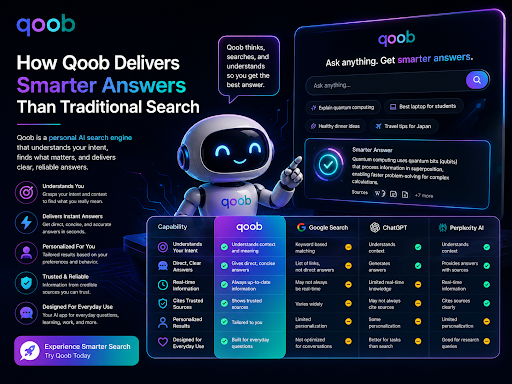
Qoob is not trying to be everything. It is a personal AI search app, so it is built for a specific job:
finding and deciding. Here is the short version of how it sits next to the tools people ask about.
Google is built to send you to websites. Qoob is built to give you the answer. More in our Qoob vs Google comparison.
ChatGPT is a general assistant for writing and conversation. Qoob is search-first and decision-focused. See how Qoob works as a ChatGPT alternative for personal search.
Perplexity is strong for research with citations. Qoob leans toward personal, everyday answers and remembered context. See Qoob as a Perplexity alternative.
Each link goes deeper. The point here is simple: Qoob’s lane is personal search for everyday decisions.
Smarter answers for everyday life
Search is moving from keywords and links toward clear, relevant answers. Most people do not want to sort through results. They want something that gets what they are asking and gives back something useful right away.
That is the job Qoob is built for. For the everyday questions that fill a normal week, a short, personal answer beats a page of blue links.
FAQs
1.What is personal AI search?
Personal AI search uses AI to focus on what you mean and what is relevant to you, then gives a short, useful answer instead of a list of links. It is more personal than a traditional search engine.
2.How is Qoob different from Google Search?
Google Search sends you to websites to find information. Qoob is a personal AI search app that gives you a short, relevant answer directly, which is faster for everyday questions.
3.Is Qoob an AI app for everyday questions?
Yes. Qoob is built to help with everyday questions like planning, recipes, shopping, and quick research. You ask, and you get a clear answer you can use.
4.What is the difference between Qoob and ChatGPT?
ChatGPT is a general assistant built for writing and conversation. Qoob is search-first and focused on finding answers and supporting decisions, not generating text.
5.Is AI search replacing traditional search?
Not entirely. AI search is growing because it gives direct, personal answers, but traditional search is still useful for some tasks. For everyday questions, many people now prefer a personal AI search app like Qoob.