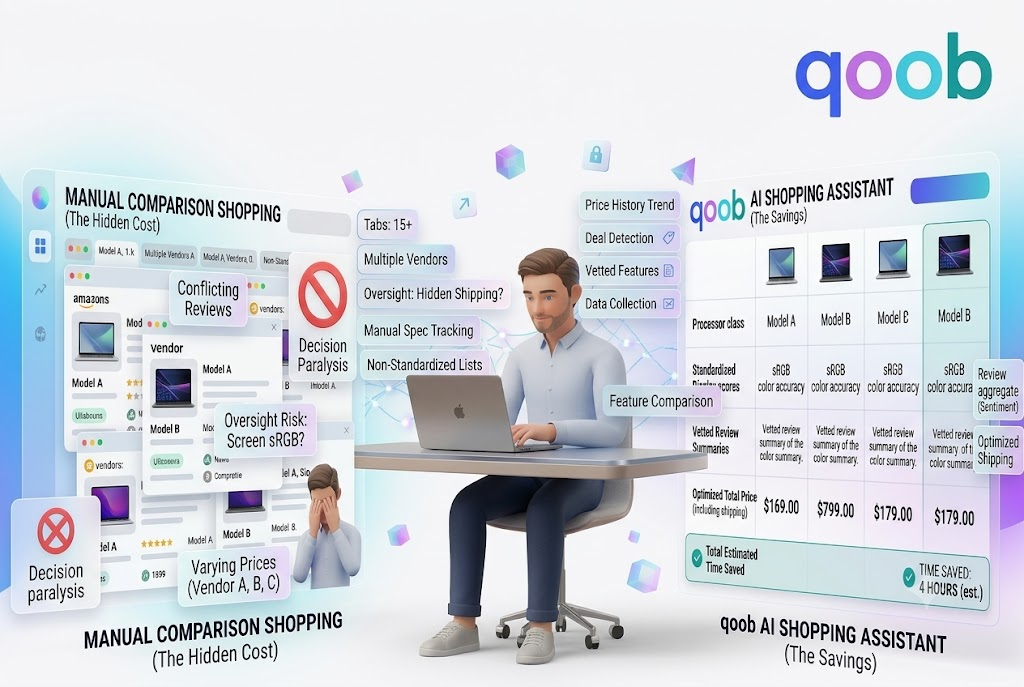
AI has changed how people search for information. Instead of typing a few keywords into a search box, you can now ask a complete question and receive an answer. That shift has created a new question: should you use a general AI chatbot, or a tool designed specifically to help you search and make decisions?The difference becomes clearer when comparing Decision Engine with a general conversational AI experience. Qoob is designed around search and everyday decisions, while ChatGPT is a broader AI assistant built for conversation, writing, reasoning, research, and many other tasks. The better option depends on what you are actually trying to accomplish.
This does not make one universally better.It makes them suited to different jobs.
What Is a Decision Engine?
A decision engine is designed to help you move from information to action.That distinction matters.A traditional search engine helps you find information.A chatbot can discuss information with you.A decision-focused AI tool aims to help you answer a more practical question:“What should I do?”That might mean deciding where to eat, which product to buy, where to go for the weekend, what to cook, or which option best matches your preferences.Qoob is built around this use case.Rather than treating every question as the beginning of a long conversation, Qoob focuses on delivering a short, useful answer that helps you make an everyday decision.What Is ChatGPT Search?
ChatGPT is a general-purpose AI assistant.It can help with writing, brainstorming, explaining concepts, summarizing information, problem-solving, coding, and many other tasks.Its search capabilities can also help users find and discuss current information from the web.That broad capability is useful when you need to explore a topic, ask follow-up questions, compare ideas, or work through a complicated task.But broad capability also means the experience can be more conversational.You may ask one question.Then ask another.Then clarify.Then request more detail.That can be useful when you want a dialogue.It is less useful when your actual goal is simply to make a quick everyday choice.Qoob vs. ChatGPT: What Is the Main Difference?
The clearest distinction is purpose.ChatGPT is a broad AI assistant.Qoob is designed around personal search and everyday decisions.| Qoob | ChatGPT |
| Search and decision focused | General-purpose AI assistant |
| Short answers | Can provide detailed responses |
| Built around everyday choices | Built for many different AI tasks |
| Personal context is central | Conversation and task completion are central |
| Designed to reduce browsing | Can support extended research and discussion |
| Decision-oriented experience | Broad conversational experience |
When Should You Use a Decision Engine?
A decision engine makes the most sense when you already know the outcome you want.You want to decide.For example:“Where should I go this weekend?”“Which of these two products is better for my needs?”“What should I cook with what I already have?”“Which option makes the most sense for my budget?”These questions are different from:“Explain how this technology works.”The second question is primarily informational.The first group is about action.Qoob’s product is designed around that decision-making layer.When Is ChatGPT More Useful?
A general AI assistant can be useful when your task requires more than a quick recommendation.For example:Writing
You can use ChatGPT to draft, rewrite, summarize, or brainstorm content.Learning
You can ask follow-up questions and explore a topic from different angles.Brainstorming
You can develop ideas through an extended conversation.Coding
You can work through technical problems, explanations, and iterations.Complex reasoning
You can provide detailed context and work through a problem step by step.Research
You can ask questions, request comparisons, and continue exploring a topic.These tasks benefit from conversation.Qoob is not trying to replace that experience.It has a narrower job.Find useful information.Help you decide.Move on.Why Does Qoob Focus on Short Answers?
Most everyday decisions do not require a long explanation.Suppose you want to choose a restaurant.You could search Google, open review sites, check menus, read recommendations, compare locations, and make a decision yourself.Or you could ask an AI tool for a recommendation.Qoob is specifically designed around the second approach.Its smart search experience provides short answers instead of sending users through a long list of results.The goal is to reduce the work between asking a question and making a decision.That is the basic idea behind its decision-focused design.Does a Decision Engine Replace Search?
Not completely.Traditional search is still useful when you want to browse.You may want to read several articles.You may need an official document.You may want to visit a specific website.You may want to compare original sources yourself.Search engines are excellent for these situations.A decision engine serves a different purpose.It helps when you would rather ask:“What is the best option for me?”instead of:“Show me 20 pages about this.”There is value in both workflows.How Does Personalization Change the Experience?
Generic answers do not always work.Imagine two people ask:“Where should I go on vacation?”One wants a quiet beach.The other wants nightlife.A third wants a family-friendly destination.A fourth cares most about price.The exact same question can lead to very different decisions.Qoob’s approach to personal AI search is built around using relevant context and preferences to make answers more useful to the individual.That means the system is designed to consider more than just the current wording of your question.What Does Personal Context Actually Do?
Personal context gives an AI system additional information about what matters to you.That can include preferences, previous questions, and other information you choose to share.The benefit is straightforward.You spend less time repeating yourself.Instead of explaining your preferences every time you ask a similar question, a personal search experience can use relevant context to make the answer more tailored.Qoob describes this as search that pays attention to what matters to you instead of producing the same generic response for everyone.Qoob vs. ChatGPT for Everyday Decisions
This is where the difference becomes especially obvious.Imagine you want to buy a new pair of headphones.With a general chatbot, you might start a conversation about:- Your budget
- Music preferences
- Device compatibility
- Noise cancellation
- Battery life
- Brands
Does Qoob Give the Same Answer to Everyone?
Not necessarily.Qoob’s personalization model is designed so answers can reflect user context.That matters because “best” is rarely universal.The best restaurant depends on your preferences.The best hotel depends on your budget and trip.The best laptop depends on your work.The best weekend activity depends on your interests.A decision engine becomes more useful when it understands those differences.What Does “Personal AI” Mean?
Personal AI means the AI experience is shaped around an individual user’s context rather than treating every person identically.Qoob connects personalization with search.The idea is simple:You ask.Qoob considers what matters to you.You receive an answer that is more relevant to your situation.Its approach to personalization and privacy also emphasizes user control over the context the platform remembers.That is important because personalization should not require giving up control over your information.How Does Privacy Fit Into the Comparison?
AI search becomes more personal when it has more context.That makes privacy important.Users need to understand what information is retained, how it is used, and what control they have over it.Qoob states that it does not sell users’ usage data and emphasizes user control over personal context.Its approach is built around personalization without treating your search history as something that automatically belongs to everyone else.That is an important part of comparing AI tools.The best search experience is not simply the one with the cleverest answer.It is also one you feel comfortable using.Does Qoob Require Prompt Engineering?
No.Qoob is designed around natural questions.You do not need to learn complicated prompt structures just to ask an everyday question.That is different from approaches where users may spend as much time figuring out how to phrase the prompt as they would have spent solving the original problem.You can ask naturally.For example:“What’s a good place for dinner near me that’s casual and not too expensive?”That is enough context for a practical search.You can become more specific when the decision requires it.But you do not need a secret AI dialect.Which Is Better for Research?
It depends on what you mean by research.If you are conducting detailed research that requires multiple sources, long explanations, comparisons, and follow-up questions, a general-purpose AI assistant can be useful.If you are doing quick personal research with a clear decision at the end, Qoob’s shorter, decision-focused approach may be more convenient.Consider these two questions:“Explain the history of renewable energy policy.”This requires detailed research.“Which renewable energy option makes the most sense for a small home?”This is much closer to a decision.The second question fits naturally into Qoob’s core use case.Which Is Better for Recommendations?
Recommendations are a strong use case for decision-focused search.The reason is simple.People usually do not want a database of every available option.They want a shortlist or a recommendation that fits their situation.Qoob is designed around practical questions such as:- Where should I go?
- What should I eat?
- What should I cook?
- Which product should I choose?
- What should I do this weekend?
What About Follow-Up Questions?
This is where conversational AI has a natural advantage.Sometimes your first answer creates another question.You want to explore.You want to challenge the recommendation.You want to change the criteria.You want to keep discussing the problem.A general AI assistant is designed for this kind of back-and-forth interaction.Qoob is more focused on getting you to a useful answer without making the conversation unnecessarily long.That does not mean follow-up questions are impossible.It means the product philosophy is different.How Does Qoob Compare With Traditional Search?
There are three different experiences worth separating.Traditional search
You receive links.You browse.You compare.You decide.General AI chatbot
You have a conversation.You ask.You clarify.You explore.Decision engine
You ask.The system considers the relevant context.You receive a concise answer.You decide.The last workflow is what Qoob is designed to optimize.Why Does “Decide and Move On” Matter?
Because not every search deserves your full attention.Every week contains dozens of tiny choices.Where to eat.What to buy.What to cook.Where to go.Which option to choose.Individually, they are small.Collectively, they consume time.Qoob’s Why Qoob philosophy focuses on reducing that friction by giving users direct answers rather than encouraging endless browsing.The objective is not to make every decision for you.It is to make the path from question to decision shorter.Can You Use Qoob and ChatGPT Together?
Yes.They can serve different purposes.You might use Qoob to decide which option deserves your attention.Then use ChatGPT to explore that option further, write something about it, or work through additional questions.For example:Qoob: Which destination makes the most sense for my weekend?ChatGPT: Help me plan a detailed itinerary for that destination.The tools do not have to compete.They can solve different parts of the same problem.Which One Is Better for Business Users?
That depends heavily on the task.A business user may use a general AI assistant for writing, brainstorming, analysis, presentations, coding, and research.A decision-focused search tool may be useful for faster everyday choices.For example:“Which business lunch location is best for a client meeting?”“Which laptop should I choose for frequent business travel?”“Where should our team hold a casual event?”The simpler the decision, the more valuable a concise recommendation can become.What About Information Overload?
This is one of the biggest reasons decision-focused search exists.The internet has more information than any individual can reasonably process.More information sounds helpful.It often is not.If you are comparing ten restaurants, twenty hotels, or fifteen products, the sheer number of options can make the decision harder rather than easier.Qoob aims to reduce that overload by turning large amounts of online information into short answers aimed at practical choices.You still remain responsible for the decision.The system simply helps narrow the field.Can a Decision Engine Make Decisions for You?
The goal should not be blind automation.A good decision-support tool helps you understand your options and choose more efficiently.You should still apply judgment.This is especially important for high-stakes areas such as medical, legal, financial, or safety decisions.For everyday choices, however, decision assistance can reduce unnecessary research.That is the space Qoob focuses on.How Should You Decide Which AI Tool to Use?
Ask yourself one question:What am I trying to accomplish?If you want to write something, brainstorm, code, learn, or have a long conversation, a general AI assistant makes sense.If you want to search for information and make an everyday decision quickly, a decision-focused tool makes more sense.The technology matters.Your goal matters more.Quick Comparison: Qoob vs. ChatGPT
| Need | Qoob | ChatGPT |
| Quick everyday decisions | Strong fit | Useful |
| Short answers | Core focus | Can provide them |
| Personal search | Core focus | Broader AI experience |
| Recommendations | Strong fit | Strong |
| Long conversations | Not the primary focus | Strong fit |
| Writing | Not the primary focus | Strong fit |
| Brainstorming | Limited focus | Strong fit |
| Coding | Not the primary focus | Strong fit |
| Deep research | More limited | Stronger fit |
| Decision support | Core focus | Useful |
| No prompt skills needed | Yes | Natural-language interaction available |
How Can You Tell Which Experience You Prefer?
Try asking both tools the same practical question.Do not judge them based on the first sentence.Look at the entire experience.How many steps did it take?How much information did you need to provide?Did the answer actually address your decision?Did you need to ask several follow-up questions?Did the result feel personalized?Did you get what you needed or another assignment?That final question is often the most revealing.Final Thoughts
Qoob and ChatGPT are not simply two versions of the same product.They approach AI from different directions.ChatGPT is a broad AI assistant designed to support conversation, writing, reasoning, research, and a wide range of tasks.Qoob is designed around personal search and everyday decision-making.A Decision Engine is useful when your real question is not just “What is this?”It is:“What should I choose?”That is the space Qoob is built to address.At The Qoob, the focus is on short, relevant answers that consider what matters to you and help you make everyday decisions without sending you through another endless search session.You do not always need another conversation.Sometimes you just need a good answer.Frequently Asked Questions
What is a Decision Engine?
A Decision Engine is a tool designed to help users move from information to a practical decision. Instead of only returning information, it focuses on helping users evaluate options and determine what makes sense for their situation.
Is Qoob a chatbot?
Qoob is not positioned as a general-purpose chatbot. It is a personal AI search and decision-making app focused on short answers and everyday choices.
Is ChatGPT a Decision Engine?
ChatGPT can support decision-making, but it is designed as a broader AI assistant rather than a dedicated decision engine.
What is the main difference between Qoob and ChatGPT?
Qoob focuses on personal search, short answers, and everyday decisions. ChatGPT is designed for a much broader range of tasks, including writing, conversation, research, brainstorming, coding, and reasoning.
Is Qoob better than ChatGPT?
Neither is universally better. Qoob is designed for a specific purpose: personal search and everyday decision-making. ChatGPT is broader and better suited to many different AI tasks.
Which is better for everyday decisions?
Qoob is specifically designed for everyday decisions, recommendations, and quick personal research. ChatGPT can also help with decisions but has a broader overall purpose.
Can Qoob personalize answers?
Yes. Qoob is designed to use relevant context, previous questions, and user preferences to make answers more personalized.
Does Qoob require prompt engineering?
No. Qoob is designed so users can ask questions naturally without learning specialized prompting techniques.
Should I use Qoob for complex research?
Qoob can help with quick personal research and practical decisions. For deep research requiring extensive source review, detailed analysis, or long conversations, a broader AI assistant may be more appropriate.
Can I use Qoob and ChatGPT together?
Yes. You can use Qoob for quick recommendations and decisions, then use a broader AI assistant for additional research, writing, brainstorming, or detailed planning.
Does Qoob provide short answers?
Yes. Short, clear, useful answers are a central part of Qoob’s search experience.
Does Qoob use my personal information?
Qoob is designed around user-controlled context and states that it does not sell users’ usage data. Users should review the current privacy information before deciding what personal information to share.
When should I use traditional search instead?
Traditional search is useful when you want to browse multiple sources, visit specific websites, read original documents, conduct detailed research, or explore a topic broadly.
Is Qoob free?
Qoob states that its service is free, with no subscription required.
What types of decisions can Qoob help with?
Qoob is designed for everyday decisions such as travel planning, food and recipe choices, shopping comparisons, weekend plans, hobbies, and other practical questions.