
Tag: AI Search Tool

  • Qoob vs. ChatGPT Search: Do You Need a Chatbot or a Decision Engine?

    Qoob vs. ChatGPT Search: Do You Need a Chatbot or a Decision Engine?

    AI has changed how people search for information. Instead of typing a few keywords into a search box, you can now ask a complete question and receive an answer. That shift has created a new question: should you use a general AI chatbot, or a tool designed specifically to help you search and make decisions?

    The difference becomes clearer when comparing Decision Engine with a general conversational AI experience. Qoob is designed around search and everyday decisions, while ChatGPT is a broader AI assistant built for conversation, writing, reasoning, research, and many other tasks. The better option depends on what you are actually trying to accomplish.

    What Is a Decision Engine?

    A decision engine is designed to help you move from information to action.

    That distinction matters.

    A traditional search engine helps you find information.

    A chatbot can discuss information with you.

    A decision-focused AI tool aims to help you answer a more practical question:

    “What should I do?”

    That might mean deciding where to eat, which product to buy, where to go for the weekend, what to cook, or which option best matches your preferences.

    Qoob is built around this use case.

    Rather than treating every question as the beginning of a long conversation, Qoob focuses on delivering a short, useful answer that helps you make an everyday decision.

    What Is ChatGPT Search?

    ChatGPT is a general-purpose AI assistant.

    It can help with writing, brainstorming, explaining concepts, summarizing information, problem-solving, coding, and many other tasks.

    Its search capabilities can also help users find and discuss current information from the web.

    That broad capability is useful when you need to explore a topic, ask follow-up questions, compare ideas, or work through a complicated task.

    But broad capability also means the experience can be more conversational.

    You may ask one question.

    Then ask another.

    Then clarify.

    Then request more detail.

    That can be useful when you want a dialogue.

    It is less useful when your actual goal is simply to make a quick everyday choice.

    Qoob vs. ChatGPT: What Is the Main Difference?

    The clearest distinction is purpose.

    ChatGPT is a broad AI assistant.

    Qoob is designed around personal search and everyday decisions.

    QoobChatGPT
    Search and decision focusedGeneral-purpose AI assistant
    Short answersCan provide detailed responses
    Built around everyday choicesBuilt for many different AI tasks
    Personal context is centralConversation and task completion are central
    Designed to reduce browsingCan support extended research and discussion
    Decision-oriented experienceBroad conversational experience
    This does not make one universally better.

    It makes them suited to different jobs.

    When Should You Use a Decision Engine?

    A decision engine makes the most sense when you already know the outcome you want.

    You want to decide.

    For example:

    “Where should I go this weekend?”

    “Which of these two products is better for my needs?”

    “What should I cook with what I already have?”

    “Which option makes the most sense for my budget?”

    These questions are different from:

    “Explain how this technology works.”

    The second question is primarily informational.

    The first group is about action.

    Qoob’s product is designed around that decision-making layer.

    When Is ChatGPT More Useful?

    A general AI assistant can be useful when your task requires more than a quick recommendation.

    For example:

    Writing

    You can use ChatGPT to draft, rewrite, summarize, or brainstorm content.

    Learning

    You can ask follow-up questions and explore a topic from different angles.

    Brainstorming

    You can develop ideas through an extended conversation.

    Coding

    You can work through technical problems, explanations, and iterations.

    Complex reasoning

    You can provide detailed context and work through a problem step by step.

    Research

    You can ask questions, request comparisons, and continue exploring a topic.

    These tasks benefit from conversation.

    Qoob is not trying to replace that experience.

    It has a narrower job.

    Find useful information.

    Help you decide.

    Move on.

    Why Does Qoob Focus on Short Answers?

    Most everyday decisions do not require a long explanation.

    Suppose you want to choose a restaurant.

    You could search Google, open review sites, check menus, read recommendations, compare locations, and make a decision yourself.

    Or you could ask an AI tool for a recommendation.

    Qoob is specifically designed around the second approach.

    Its smart search experience provides short answers instead of sending users through a long list of results.

    The goal is to reduce the work between asking a question and making a decision.

    That is the basic idea behind its decision-focused design.

    Does a Decision Engine Replace Search?

    Not completely.

    Traditional search is still useful when you want to browse.

    You may want to read several articles.

    You may need an official document.

    You may want to visit a specific website.

    You may want to compare original sources yourself.

    Search engines are excellent for these situations.

    A decision engine serves a different purpose.

    It helps when you would rather ask:

    “What is the best option for me?”

    instead of:

    “Show me 20 pages about this.”

    There is value in both workflows.

    How Does Personalization Change the Experience?

    Generic answers do not always work.

    Imagine two people ask:

    “Where should I go on vacation?”

    One wants a quiet beach.

    The other wants nightlife.

    A third wants a family-friendly destination.

    A fourth cares most about price.

    The exact same question can lead to very different decisions.

    Qoob’s approach to personal AI search is built around using relevant context and preferences to make answers more useful to the individual.

    That means the system is designed to consider more than just the current wording of your question.


    View this post on Instagram


    A post shared by Qoob (@qoobsearch)

    What Does Personal Context Actually Do?

    Personal context gives an AI system additional information about what matters to you.

    That can include preferences, previous questions, and other information you choose to share.

    The benefit is straightforward.

    You spend less time repeating yourself.

    Instead of explaining your preferences every time you ask a similar question, a personal search experience can use relevant context to make the answer more tailored.

    Qoob describes this as search that pays attention to what matters to you instead of producing the same generic response for everyone.

    Qoob vs. ChatGPT for Everyday Decisions

    This is where the difference becomes especially obvious.

    Imagine you want to buy a new pair of headphones.

    With a general chatbot, you might start a conversation about:

    • Your budget
    • Music preferences
    • Device compatibility
    • Noise cancellation
    • Battery life
    • Brands
    You can then continue refining the recommendation.

    That works.

    But it also takes time.

    A decision-focused search tool is designed to get you closer to the answer faster.

    You can provide the relevant context and ask which option makes the most sense.

    The goal is not a longer conversation.

    The goal is a useful decision.

    Does Qoob Give the Same Answer to Everyone?

    Not necessarily.

    Qoob’s personalization model is designed so answers can reflect user context.

    That matters because “best” is rarely universal.

    The best restaurant depends on your preferences.

    The best hotel depends on your budget and trip.

    The best laptop depends on your work.

    The best weekend activity depends on your interests.

    A decision engine becomes more useful when it understands those differences.

    What Does “Personal AI” Mean?

    Personal AI means the AI experience is shaped around an individual user’s context rather than treating every person identically.

    Qoob connects personalization with search.

    The idea is simple:

    You ask.

    Qoob considers what matters to you.

    You receive an answer that is more relevant to your situation.

    Its approach to personalization and privacy also emphasizes user control over the context the platform remembers.

    That is important because personalization should not require giving up control over your information.

    How Does Privacy Fit Into the Comparison?

    AI search becomes more personal when it has more context.

    That makes privacy important.

    Users need to understand what information is retained, how it is used, and what control they have over it.

    Qoob states that it does not sell users’ usage data and emphasizes user control over personal context.

    Its approach is built around personalization without treating your search history as something that automatically belongs to everyone else.

    That is an important part of comparing AI tools.

    The best search experience is not simply the one with the cleverest answer.

    It is also one you feel comfortable using.

    Does Qoob Require Prompt Engineering?

    No.

    Qoob is designed around natural questions.

    You do not need to learn complicated prompt structures just to ask an everyday question.

    That is different from approaches where users may spend as much time figuring out how to phrase the prompt as they would have spent solving the original problem.

    You can ask naturally.

    For example:

    “What’s a good place for dinner near me that’s casual and not too expensive?”

    That is enough context for a practical search.

    You can become more specific when the decision requires it.

    But you do not need a secret AI dialect.

    Which Is Better for Research?

    It depends on what you mean by research.

    If you are conducting detailed research that requires multiple sources, long explanations, comparisons, and follow-up questions, a general-purpose AI assistant can be useful.

    If you are doing quick personal research with a clear decision at the end, Qoob’s shorter, decision-focused approach may be more convenient.

    Consider these two questions:

    “Explain the history of renewable energy policy.”

    This requires detailed research.

    “Which renewable energy option makes the most sense for a small home?”

    This is much closer to a decision.

    The second question fits naturally into Qoob’s core use case.

    Which Is Better for Recommendations?

    Recommendations are a strong use case for decision-focused search.

    The reason is simple.

    People usually do not want a database of every available option.

    They want a shortlist or a recommendation that fits their situation.

    Qoob is designed around practical questions such as:

    • Where should I go?
    • What should I eat?
    • What should I cook?
    • Which product should I choose?
    • What should I do this weekend?
    Its goal is to turn information into something you can act on.

    What About Follow-Up Questions?

    This is where conversational AI has a natural advantage.

    Sometimes your first answer creates another question.

    You want to explore.

    You want to challenge the recommendation.

    You want to change the criteria.

    You want to keep discussing the problem.

    A general AI assistant is designed for this kind of back-and-forth interaction.

    Qoob is more focused on getting you to a useful answer without making the conversation unnecessarily long.

    That does not mean follow-up questions are impossible.

    It means the product philosophy is different.

    How Does Qoob Compare With Traditional Search?

    There are three different experiences worth separating.

    Traditional search

    You receive links.

    You browse.

    You compare.

    You decide.

    General AI chatbot

    You have a conversation.

    You ask.

    You clarify.

    You explore.

    Decision engine

    You ask.

    The system considers the relevant context.

    You receive a concise answer.

    You decide.

    The last workflow is what Qoob is designed to optimize.

    Why Does “Decide and Move On” Matter?

    Because not every search deserves your full attention.

    Every week contains dozens of tiny choices.

    Where to eat.

    What to buy.

    What to cook.

    Where to go.

    Which option to choose.

    Individually, they are small.

    Collectively, they consume time.

    Qoob’s Why Qoob philosophy focuses on reducing that friction by giving users direct answers rather than encouraging endless browsing.

    The objective is not to make every decision for you.

    It is to make the path from question to decision shorter.

    Can You Use Qoob and ChatGPT Together?

    Yes.

    They can serve different purposes.

    You might use Qoob to decide which option deserves your attention.

    Then use ChatGPT to explore that option further, write something about it, or work through additional questions.

    For example:

    Qoob: Which destination makes the most sense for my weekend?

    ChatGPT: Help me plan a detailed itinerary for that destination.

    The tools do not have to compete.

    They can solve different parts of the same problem.

    Which One Is Better for Business Users?

    That depends heavily on the task.

    A business user may use a general AI assistant for writing, brainstorming, analysis, presentations, coding, and research.

    A decision-focused search tool may be useful for faster everyday choices.

    For example:

    “Which business lunch location is best for a client meeting?”

    “Which laptop should I choose for frequent business travel?”

    “Where should our team hold a casual event?”

    The simpler the decision, the more valuable a concise recommendation can become.

    What About Information Overload?

    This is one of the biggest reasons decision-focused search exists.

    The internet has more information than any individual can reasonably process.

    More information sounds helpful.

    It often is not.

    If you are comparing ten restaurants, twenty hotels, or fifteen products, the sheer number of options can make the decision harder rather than easier.

    Qoob aims to reduce that overload by turning large amounts of online information into short answers aimed at practical choices.

    You still remain responsible for the decision.

    The system simply helps narrow the field.

    Can a Decision Engine Make Decisions for You?

    The goal should not be blind automation.

    A good decision-support tool helps you understand your options and choose more efficiently.

    You should still apply judgment.

    This is especially important for high-stakes areas such as medical, legal, financial, or safety decisions.

    For everyday choices, however, decision assistance can reduce unnecessary research.

    That is the space Qoob focuses on.

    How Should You Decide Which AI Tool to Use?

    Ask yourself one question:

    What am I trying to accomplish?

    If you want to write something, brainstorm, code, learn, or have a long conversation, a general AI assistant makes sense.

    If you want to search for information and make an everyday decision quickly, a decision-focused tool makes more sense.

    The technology matters.

    Your goal matters more.

    Quick Comparison: Qoob vs. ChatGPT

    NeedQoobChatGPT
    Quick everyday decisionsStrong fitUseful
    Short answersCore focusCan provide them
    Personal searchCore focusBroader AI experience
    RecommendationsStrong fitStrong
    Long conversationsNot the primary focusStrong fit
    WritingNot the primary focusStrong fit
    BrainstormingLimited focusStrong fit
    CodingNot the primary focusStrong fit
    Deep researchMore limitedStronger fit
    Decision supportCore focusUseful
    No prompt skills neededYesNatural-language interaction available

    How Can You Tell Which Experience You Prefer?

    Try asking both tools the same practical question.

    Do not judge them based on the first sentence.

    Look at the entire experience.

    How many steps did it take?

    How much information did you need to provide?

    Did the answer actually address your decision?

    Did you need to ask several follow-up questions?

    Did the result feel personalized?

    Did you get what you needed or another assignment?

    That final question is often the most revealing.

    Final Thoughts

    Qoob and ChatGPT are not simply two versions of the same product.

    They approach AI from different directions.

    ChatGPT is a broad AI assistant designed to support conversation, writing, reasoning, research, and a wide range of tasks.

    Qoob is designed around personal search and everyday decision-making.

    A Decision Engine is useful when your real question is not just “What is this?”

    It is:

    “What should I choose?”

    That is the space Qoob is built to address.

    At The Qoob, the focus is on short, relevant answers that consider what matters to you and help you make everyday decisions without sending you through another endless search session.

    You do not always need another conversation.

    Sometimes you just need a good answer.

    Frequently Asked Questions

    What is a Decision Engine?

    A Decision Engine is a tool designed to help users move from information to a practical decision. Instead of only returning information, it focuses on helping users evaluate options and determine what makes sense for their situation.

    Qoob is not positioned as a general-purpose chatbot. It is a personal AI search and decision-making app focused on short answers and everyday choices.

    ChatGPT can support decision-making, but it is designed as a broader AI assistant rather than a dedicated decision engine.

    Qoob focuses on personal search, short answers, and everyday decisions. ChatGPT is designed for a much broader range of tasks, including writing, conversation, research, brainstorming, coding, and reasoning.

    Neither is universally better. Qoob is designed for a specific purpose: personal search and everyday decision-making. ChatGPT is broader and better suited to many different AI tasks.

    Qoob is specifically designed for everyday decisions, recommendations, and quick personal research. ChatGPT can also help with decisions but has a broader overall purpose.

    Yes. Qoob is designed to use relevant context, previous questions, and user preferences to make answers more personalized.

    No. Qoob is designed so users can ask questions naturally without learning specialized prompting techniques.

    Qoob can help with quick personal research and practical decisions. For deep research requiring extensive source review, detailed analysis, or long conversations, a broader AI assistant may be more appropriate.

    Yes. You can use Qoob for quick recommendations and decisions, then use a broader AI assistant for additional research, writing, brainstorming, or detailed planning.

    Yes. Short, clear, useful answers are a central part of Qoob’s search experience.

    Qoob is designed around user-controlled context and states that it does not sell users’ usage data. Users should review the current privacy information before deciding what personal information to share.

    Traditional search is useful when you want to browse multiple sources, visit specific websites, read original documents, conduct detailed research, or explore a topic broadly.

    Qoob states that its service is free, with no subscription required.

    Qoob is designed for everyday decisions such as travel planning, food and recipe choices, shopping comparisons, weekend plans, hobbies, and other practical questions.
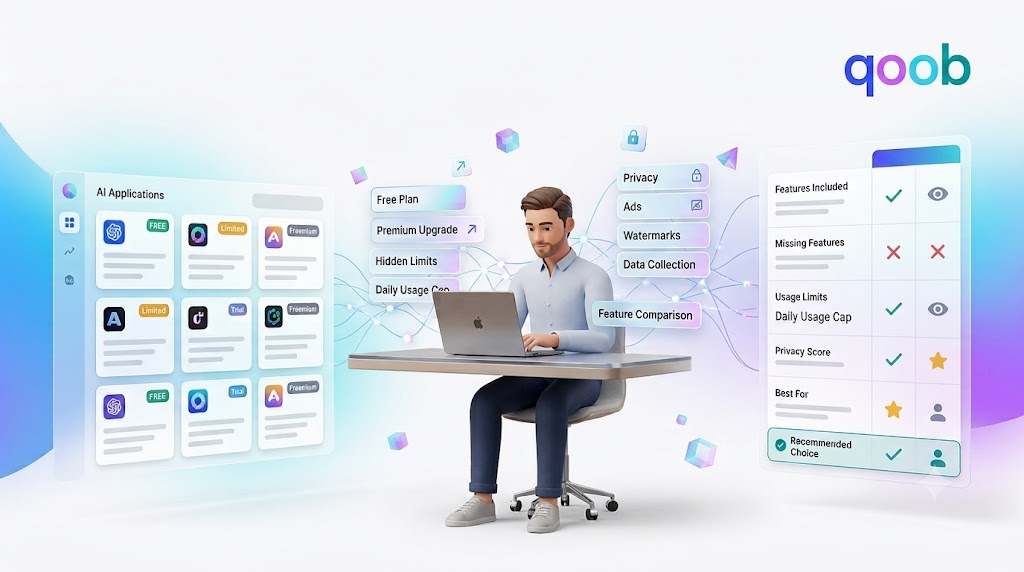
  • From Google to AI Search: How to Break the Habit of Scrolling Through Links

    From Google to AI Search: How to Break the Habit of Scrolling Through Links

    For years, searching the internet has meant typing a question into Google and opening a list of results. You scan a few headlines, skip the sponsored placements, open a couple of pages, scroll past introductions, and try to figure out which answer actually matters.

    That habit is changing. AI Search gives you another way to find information by focusing on the answer instead of making you work through a long list of links. The Qoob is built around this idea, giving users short, useful answers for everyday questions and decisions.

    Why Are People Tired of Scrolling Through Search Results?

    Traditional search is useful when you want to explore.

    The problem starts when exploration becomes the default.

    A simple question can quickly become a research task.

    You search for a restaurant.

    You open review pages.

    You compare menus.

    You check locations.

    You search again for opening hours.

    You read comments.

    Eventually, your original five-second question becomes a fifteen-minute project.

    The internet has somehow turned “Where should I eat?” into an administrative task.

    That is one reason AI Search has gained attention.

    Instead of sending you somewhere else to find the answer, AI-powered search can bring relevant information together and present it directly.

    What Is AI Search?

    AI Search uses artificial intelligence to understand a user’s question and provide a direct response.

    Traditional search generally matches your query with pages that may contain the information you need.

    AI Search focuses more heavily on understanding intent and generating a useful answer from relevant information.

    That changes the experience.

    Instead of asking:

    “Which page should I open?”

    You can ask:

    “Which option makes the most sense for me?”

    The first question is about finding information.

    The second is about making a decision.

    The Qoob positions its smart search experience around this second use case, giving users direct answers designed to help them decide and move on.

    How Is AI Search Different From Google?

    Google and AI Search can both help you find information, but they approach the task differently.

    Traditional Google Search usually gives you a collection of pages to explore.

    AI Search aims to interpret the question and provide a direct answer.

    Traditional SearchAI Search
    Gives you a list of linksGives you a direct response
    Requires more browsingReduces the need to browse
    You compare multiple pagesThe system can synthesize information
    Search is often keyword drivenSearch can focus more on intent
    You do more of the evaluationThe answer helps narrow the decision
    Useful for broad researchUseful for quick questions and decisions

    This does not mean AI Search should replace traditional search completely.

    Google is still useful when you want original sources, specific websites, detailed research, or broad exploration.

    AI Search simply provides another workflow.

    Why Do Short Answers Matter?

    Most everyday questions are not academic research projects.

    You may want to know:

    • What should I cook tonight?
    • Which hotel makes more sense?
    • Where should I go this weekend?
    • Which product fits my needs?
    • What is the simplest way to do something?
    These questions do not necessarily require twenty tabs.

    They require a useful answer.

    The Qoob is designed around short answers that help users get to a decision without excessive scrolling or unnecessary text.

    That creates a different relationship with search.

    You are not searching for the perfect webpage.

    You are searching for an answer.

    How Does AI Search Understand What You Mean?

    One weakness of traditional keyword search is that your wording matters a lot.

    You may know exactly what you mean, but the search engine only sees the words you typed.

    AI Search can interpret natural-language questions more effectively by considering the intent behind them.

    For example:

    “Best restaurants”

    is broad.

    “Where can I get a casual dinner near downtown that is good for a quick meal?”

    contains much more useful context.

    The second question gives the system a better idea of what you actually want.

    The Qoob describes this as understanding intent. Its system is designed to interpret what you are trying to find even when your question is not perfectly worded.

    Do You Need Special AI Prompting Skills?

    No.

    This is one of the biggest differences between modern AI tools.

    Some AI systems expect you to learn how to write detailed prompts.

    That can be useful for complex tasks.

    But everyday search should not require a course in prompt engineering.

    The Qoob is designed so you can ask questions in plain language.

    You can type the question the way you would say it to another person.

    That makes the search process feel much more natural.

    How Can Personal AI Search Change the Experience?

    A generic answer is not always useful.

    Two people can ask exactly the same question while wanting different outcomes.

    Consider:

    “Where should I go on vacation?”

    One person wants a quiet beach.

    Another wants nightlife.

    Another wants a family-friendly destination.

    Another wants to spend as little as possible.

    That is where personal AI search becomes useful.

    The system can consider relevant context and preferences rather than treating every question as if it came from the same anonymous person.

    The Qoob describes this approach on its personalization and privacy page, where answers are designed around what the user has shared and what matters to them.


    View this post on Instagram


    A post shared by Qoob (@qoobsearch)

    What Does Personalization Actually Mean?

    Personalization means the system can use relevant information about your preferences and previous interactions to make answers more useful.

    You still ask the question.

    The difference is that the system has more context for interpreting what you mean.

    This can help with repeated decisions.

    For example, suppose you frequently ask about restaurants.

    Knowing that you prefer casual places, avoid certain foods, or usually eat within a particular area can make future answers more relevant.

    The goal is not to make decisions for you.

    It is to reduce the amount of explanation needed each time.

    Why Is Context Important in AI Search?

    Context is often what turns a generic response into a useful one.

    Compare:

    “What laptop should I buy?”

    with:

    “What laptop should I buy for travel, writing, and light photo editing?”

    The second question gives the system a better target.

    Personalized search takes that idea further by allowing relevant preferences and previous context to influence the experience.

    The Qoob describes this as search that pays attention to what matters to you rather than treating every query as completely isolated.

    Is AI Search Better for Everyday Questions?

    It can be.

    Everyday searches usually have a clear practical objective.

    You want an answer.

    You want to choose something.

    You want to know what to do.

    You usually do not want to spend ten minutes reading about the topic first.

    This is where AI Search can reduce friction.

    The Qoob focuses on everyday decisions such as planning, shopping, recipes, travel, hobbies, and quick personal research.

    These are small decisions.

    There are lots of them.

    Saving a few minutes on each one adds up.

    What Happens When You Stop Searching for Pages?

    Your behavior changes.

    Instead of thinking:

    “Which result should I open?”

    You start thinking:

    “What exactly do I want to know?”

    That is an important shift.

    The quality of the search experience becomes less dependent on your ability to scan dozens of links.

    You can focus on the actual problem.

    For example, instead of searching:

    “best weekend trips near me”

    you might ask:

    “Where should I go this weekend for a quiet two-day trip with good food and minimal driving?”

    That is a much more useful question.

    AI Search is designed for this style of interaction.

    Does AI Search Eliminate the Need for Traditional Search?

    No.

    Traditional search still has clear advantages.

    You may want to:

    • Read original research
    • Visit a specific website
    • Compare multiple sources
    • Check official documentation
    • Follow breaking news
    • Browse images or videos
    • Research a topic in depth
    In those situations, a list of links can be exactly what you need.

    AI Search is most useful when the goal is a practical answer rather than exhaustive browsing.

    The two approaches can coexist.

    How Is Qoob Different From a General AI Chatbot?

    A general chatbot is often built around conversation.

    You ask something.

    It responds.

    You ask a follow-up.

    It responds again.

    That can be useful for writing, brainstorming, learning, and extended discussions.

    Qoob focuses more narrowly on search and decisions.

    The company’s positioning is simple: it is designed to help you find useful information and decide what to do, rather than keep you in a long AI conversation.

    That distinction is explained in The Qoob’s guide to how it differs from other AI apps.

    Why Does No-Scroll Search Feel Different?

    Because the workflow is shorter.

    Traditional search can look like:

    Question → Results → Links → Reading → Comparing → Deciding

    AI Search aims for:

    Question → Answer → Deciding

    The second path does not eliminate thinking.

    It reduces the amount of browsing required before you can think clearly about the decision itself.

    That is the point.

    What Kinds of Questions Work Well With AI Search?

    The best questions usually have a practical outcome.

    Recommendations

    “Which restaurant should I choose?”

    Comparisons

    “Which of these two products is better for a small apartment?”

    Planning

    “How should I plan a three-day trip?”

    Explanations

    “Explain this concept in simple terms.”

    Everyday decisions

    “What should I cook tonight?”

    Quick research

    “What should I know before choosing this option?”

    These searches benefit from concise answers.

    They do not necessarily require a long chain of webpages.

    How Can You Ask Better AI Search Questions?

    You do not need long prompts.

    You need useful context.

    A good question usually makes three things clear:

    What do you want?

    State the actual outcome.

    What matters?

    Include the factors that influence your decision.

    What constraints do you have?

    Budget, location, time, preferences, or other limits can make the answer much more useful.

    For example:

    Instead of:

    “Hotels in Miami”

    try:

    “Which Miami hotels are best for a three-night couples trip near the beach with a mid-range budget?”

    The second question gives the system something to work with.

    For additional guidance, see How to Get Better Answers From AI Search.

    Does AI Search Save Time?

    That is one of its main goals.

    The Qoob positions its search experience around saving time by reducing the need to scroll through long result pages, close pop-ups, and navigate sponsored content.

    The platform also reports survey results indicating that users found its answers shorter and easier to understand than answers from several other search and AI tools.

    The practical idea is simple.

    If a question takes one minute to answer instead of ten minutes to research, that is time you get back.

    One decision does not seem like much.

    Hundreds of small searches over a year are another story.

    What About Ads in AI Search?

    Advertising is one of the biggest differences between search experiences.

    Traditional search engines often place sponsored results near the top of the results page.

    Those placements can compete visually with the information you actually wanted.

    The Qoob states that it does not place sponsored results inside the answer and instead uses a single non-intrusive advertisement at the bottom of the page.

    The goal is to keep the answer itself focused.

    That is part of the company’s broader effort to create a less cluttered search experience.

    Why Does Trust Matter in AI Search?

    A short answer is only useful if you can trust it enough to act on.

    That creates a challenge for every AI-powered search product.

    Users need answers that are understandable, relevant, and based on reliable information.

    The Qoob positions trust as an important part of its product experience and describes its answers as short and trustworthy.

    That does not mean users should blindly accept every AI-generated response.

    For high-stakes decisions, you should still verify important information and consult authoritative sources.

    AI Search should reduce effort.

    It should not eliminate judgment.

    Can AI Search Make You More Productive?

    It can reduce the time you spend on low-value browsing.

    Consider all the tiny searches you make during a normal week.

    Where should you eat?

    What should you buy?

    How do you solve a small problem?

    What is the easiest way to do something?

    None of these questions is individually huge.

    Together, they can consume a surprising amount of time.

    An AI Search tool that gives you a clear answer can reduce that repeated research overhead.

    The Qoob is specifically positioned as a tool for everyday decisions, where speed and clarity matter more than endless exploration.

    What Is the Difference Between AI Search and “Ask AI”?

    “Ask AI” is a broad phrase that describes asking an artificial intelligence system a question.

    AI Search is a broader product category focused specifically on finding information and answering search questions using AI.

    The difference is largely about purpose.

    An AI assistant may help you write a message.

    An AI Search product focuses on helping you find an answer.

    Qoob combines this search-first approach with personalization and decision support.

    How Can You Break the Scrolling Habit?

    The first step is changing what you expect from search.

    You do not always need ten sources.

    You do not always need the longest article.

    You do not always need to read everything before making a simple decision.

    Instead, try asking a direct question.

    Then make the question specific.

    Then evaluate the answer.

    When you need deeper research, go back to traditional browsing.

    The point is not to stop scrolling forever.

    It is to stop scrolling when you do not need to.

    When Should You Still Use Traditional Search?

    Use traditional search when you need breadth.

    For example:

    Deep research: You want multiple perspectives and original sources.

    Specific websites: You know exactly where you want to go.

    Official information: You need a government, manufacturer, university, or other authoritative source.

    Detailed comparison: You want to examine several options yourself.

    Current events: You want to see how multiple publishers are reporting an event.

    AI Search is better suited to the question behind those searches when the goal is simply to make a decision faster.

    How Does Qoob Fit Into the Search Landscape?

    The search experience is changing.

    Traditional search gives you pages.

    Chatbots give you conversations.

    Personal AI Search aims to sit between those models.

    It can understand your question, use relevant context, and provide a concise answer aimed at helping you make a decision.

    The Qoob describes itself as a search and decision-making app built for everyday use.

    That is a narrower purpose than a general AI assistant.

    It is also different from a conventional search engine.

    The focus is not on keeping you exploring.

    It is on helping you move forward.

    What Does the Future of Search Look Like?

    Search is moving toward more natural interaction.

    People are becoming less interested in remembering the right keywords and more interested in simply asking questions.

    They also expect technology to understand context.

    Instead of:

    “Hotels New York cheap”

    users increasingly ask:

    “Where should I stay in New York for a weekend if I want to be close to restaurants but keep the room under my budget?”

    That is a natural question.

    AI Search is designed for that kind of interaction.

    The technology still has to improve.

    Accuracy matters.

    Privacy matters.

    Trust matters.

    But the direction is clear.

    Search is becoming less about finding pages and more about understanding intent.

    Final Thoughts

    For years, searching meant opening links and deciding which page deserved your attention.

    AI Search offers another approach.

    Ask a natural question.

    Give the system useful context.

    Get a concise answer.

    Then decide.

    You will still need traditional search for deep research, original sources, and specific websites. But you do not need to treat every small question like a research project.

    The Qoob is built around this simpler workflow.

    Its personal AI search approach focuses on relevant answers, user context, and everyday decisions rather than endless lists of links.

    At The Qoob, the goal is straightforward: give you useful information without making you work through unnecessary clutter first.

    The future of search may not be about finding more links.

    It may be about needing fewer of them.

    Frequently Asked Questions

    What is AI Search?

    AI Search uses artificial intelligence to understand questions and provide direct answers rather than relying only on a list of webpages.

    Traditional Google Search generally gives users links to explore. AI Search focuses more on understanding the question and producing a direct response.

    No. AI Search and traditional search are useful for different tasks. AI Search can be useful for quick questions and decisions, while traditional search remains valuable for detailed research and finding specific sources.

    Personal AI Search uses relevant context and preferences to make answers more tailored to the individual user rather than giving the same generic response to everyone.

    Not necessarily. The Qoob is designed around plain-language questions, so users do not need to learn specialized AI prompting techniques.

    Questions involving recommendations, comparisons, planning, explanations, and everyday decisions are particularly suitable for an answer-focused AI Search experience.

    It can reduce the need to open and compare multiple pages for simple questions. The amount of time saved depends on the task and the quality of the answer.

    No AI system should be treated as infallible. For important or high-stakes decisions, verify information using reliable and authoritative sources.

    AI Search focuses primarily on finding information and helping users reach answers. AI chatbots are generally built for broader conversation, writing, brainstorming, and content generation.

    Qoob is a personal AI search and decision-making app designed to provide short, relevant answers for everyday questions.

    Yes. Qoob is designed to use relevant user context and preferences to make answers more useful and personal.

    Qoob states that it does not place sponsored results inside its answers and instead uses a single non-intrusive advertisement at the bottom of the page.

    No. The best approach is to use the right tool for the task. Use AI Search for quick answers and decisions, and traditional search when you need deeper research or original sources.

    Ask clear questions, include the context that matters, mention important constraints, and state what kind of answer you want.

    The Qoob states that its service is free and does not require a subscription.

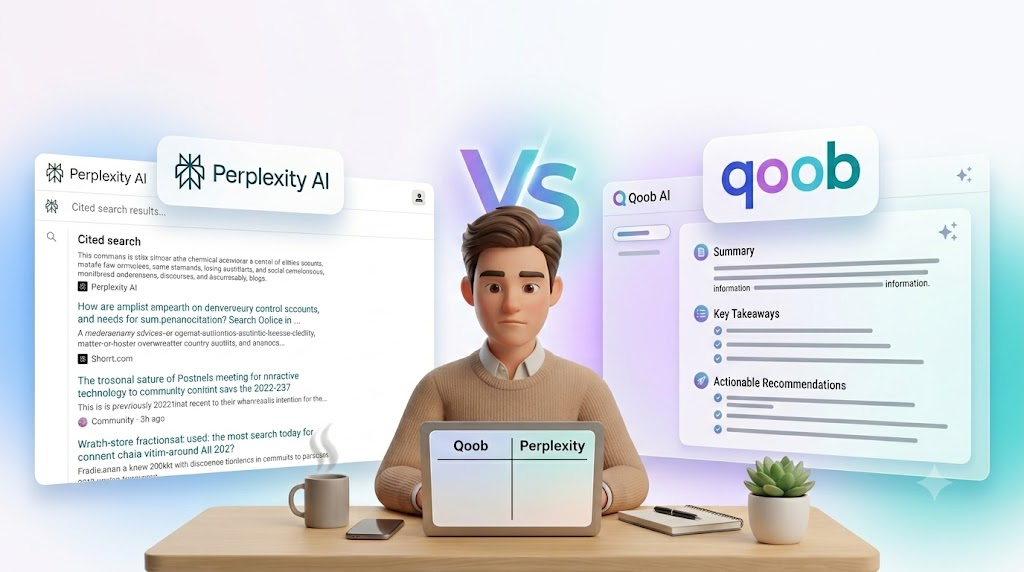
  • Qoob vs. Perplexity: Which AI Search Tool Is Right for You?

    Qoob vs. Perplexity: Which AI Search Tool Is Right for You?

    Choosing an AI Search Tool is no longer just about finding answers quickly. It is also about how those answers fit into your workflow, how easy they are to trust, and whether the tool helps you move from search to action without extra effort. For some users, that means a broad conversational search engine. For others, it means a more personal research experience built around their own needs.

    The Qoob positions itself around personal AI search, which makes it a useful option to evaluate if you want search that feels more tailored to your day-to-day work. You can start by looking at the AI search tool offering and then comparing it with Perplexity based on how each one handles discovery, organisation, and follow-up research.

    What each tool is trying to solve

    At a basic level, both tools aim to make searching faster and more useful than a traditional search bar. The difference is in how they organise that experience.

    Perplexity is generally used as a conversational search tool that helps users ask questions and receive summaries, sources, and follow-up paths in one place. The Qoob, on the other hand, is framed more around personal AI search, which suggests a more focused experience for users who want search to support their own information habits.

    That difference matters because the best tool is not always the one with the widest reach. It is often the one that matches the way you actually work.

    The main decision point

    If you need a general-purpose research companion, you may lean toward a tool designed for broad exploration. If you want search that feels more personalised and aligned with your own information needs, The Qoob may be the better fit.

    How to compare AI search tools in a practical way

    The easiest way to compare tools is to ignore the buzzwords and look at use case, output quality, and workflow fit.

    Ask these questions before choosing

    • Does the tool help me get answers faster?
    • Does it reduce the number of steps between question and decision?
    • Can I use it for recurring research tasks?
    • Does it help me organise what I find?
    • Does it fit the way I already work?
    These questions are more useful than comparing labels alone. A tool can sound advanced and still be awkward in practice if it does not support your daily process.

    Video Embed : https://www.instagram.com/qoobsearch/reel/DbMQ1J6mWl7/

    Qoob vs. Perplexity at a glance

    The table below gives a simple comparison based on typical user needs rather than hype.

    CategoryThe QoobPerplexityWhat it means for you
    Search stylePersonal AI search focusConversational AI search focusOne may feel more tailored, the other more broad
    Best forUsers wanting a more individual search experienceUsers wanting general research and explorationDepends on how personal your workflow is
    Research flowMay suit repeat use and focused discoveryMay suit open-ended question answeringUseful for different kinds of tasks
    Learning curveOften best when the user wants a simple routineOften intuitive for broad search questionsEase of use matters when search is frequent
    Output useUseful when search needs to support personal workflowUseful when answers need quick context and sourcesThe right choice depends on your research habits
    Product fitFocused on personal search needsFocused on wider search use casesCompare based on what you need most often
    This kind of comparison helps because many people do not actually need every feature an AI tool offers. They need one tool that works well for the kind of search they do most often.

    When The Qoob may be the better choice

    The Qoob may appeal to users who want a more personal approach to search. That can matter if your work involves repeated research, topic tracking, or a workflow where information needs to feel easier to return to.

    Good fit for repeat research

    If you search around similar topics often, a personal AI search experience can save time. Instead of starting from scratch every time, the tool may support a more consistent way of retrieving and using information.

    Good fit for structured thinking

    Some users do not just want answers. They want a search experience that helps them think through a topic in a more organised way. That is where The Qoob’s positioning around personal search may be valuable.

    You can also read more about the product approach on the Why Qoob page, which helps explain the thinking behind the platform in broader terms.

    When Perplexity may be the better choice

    Perplexity is often attractive to users who want quick conversational search with a wider exploration style. That can be useful when the goal is to scan a topic, compare ideas, or ask follow-up questions in a natural way.

    Good fit for broad discovery

    If you are researching a new subject and need fast context, Perplexity’s style can feel efficient. It works well for users who are still shaping the question as they search.

    Good fit for short, direct tasks

    For one-off questions, users often want a clean answer with enough context to keep going. In that setting, a general AI search experience can be more than enough.

    Why workflow matters more than branding

    A lot of AI products sound similar at first. They all promise speed, clarity, and smarter search. But the tool that wins in real use is usually the one that fits the user’s habits.

    Consider how you actually search

    Some people search in short bursts. Others revisit the same themes over and over. Some users need broad exploration, while others need a more personal system for keeping research manageable. That is why choosing an AI Search Tool should start with workflow, not marketing.

    Think about what success looks like

    A good tool should make your research easier to repeat, easier to understand, and easier to act on. If it only gives you a fast answer but does not support the rest of your process, it may not be the right long-term fit.

    Where The Qoob stands out as a concept

    The Qoob’s value is not just in answering questions. It is in the idea that search should support a more personal and structured way of working. That makes it relevant for users who want something beyond a generic query-response experience.

    If you are trying to understand how this differs from conventional search, the article on AI search vs traditional search is a helpful companion piece. It gives more context for why these tools matter in the first place.

    Better search is not always more search

    One of the biggest mistakes people make is assuming that more features automatically mean better results. In reality, the better tool is the one that gives you useful information with less friction.

    For some users, that will be The Qoob. For others, it may be Perplexity. The point is not to pick the most popular name. It is to pick the one that matches your work style.

    A simple way to decide

    Use this quick breakdown:

    Choose The Qoob if you want

    • A personal AI search experience
    • A tool that supports repeat research
    • A more organised way to handle information
    • Search that feels closer to your own workflow

    Choose Perplexity if you want

    • Broad topic exploration
    • Conversational question answering
    • Quick research across many subjects
    • A familiar general-purpose AI search format
    This kind of decision is usually easier when you focus on the tasks you do most often. A tool that feels perfect in one scenario may be less useful in another.

    The role of onboarding and adoption

    Even a strong tool can be ignored if it feels hard to adopt. That is why onboarding, clarity, and first-time experience matter.

    If a search tool is too complex, people stop using it. If it is too shallow, they outgrow it quickly. The sweet spot is a tool that feels simple at the start but still useful over time.

    That is one reason many users evaluate AI search through a practical lens rather than a technical one. They want to know whether it will become part of their routine.

    Table of real-world use cases

    Use caseBetter fitWhy
    Ongoing personal researchThe QoobA personal search model can support repeat use
    Broad topic discoveryPerplexityConversational search is useful for exploration
    Comparing many ideas quicklyPerplexityIt is often suited to open-ended questioning
    Building a search routineThe QoobA more personal approach can feel easier to repeat
    Learning a new topicPerplexityFast context and follow-up questions help with early research
    Managing recurring information needsThe QoobPersonal search is better aligned with repeat workflows

    FAQ

    What is an AI Search Tool?
    An AI Search Tool uses artificial intelligence to help users find, summarise, and explore information in a more conversational or structured way than traditional search.

    No. They are different tools with different positioning. The Qoob is framed around personal AI search, while Perplexity is usually used for broader conversational search.

    That depends on your workflow. If you want a more personal search experience, The Qoob may be the better fit. If you want broad exploration, Perplexity may be more useful.

    Because a tool only becomes valuable when you actually use it regularly. The best AI Search Tool is the one that fits your habits, not just the one that sounds impressive.

    Some users do. Using both can make sense if your research needs vary, but most people are better off choosing the one that matches their most common tasks.

    Conclusion

    The best AI Search Tool is not always the one with the biggest name. It is the one that helps you search in a way that feels natural, efficient, and repeatable. Perplexity is a strong option for broad conversational research, while The Qoob is positioned around a more personal search experience that may suit users who want a tighter fit with their workflow.

    If you are still comparing options, it helps to look at both the product model and the daily task it is meant to support. For a deeper look at the platform and next steps, visit The Qoob and compare it with the kind of search experience you actually need.