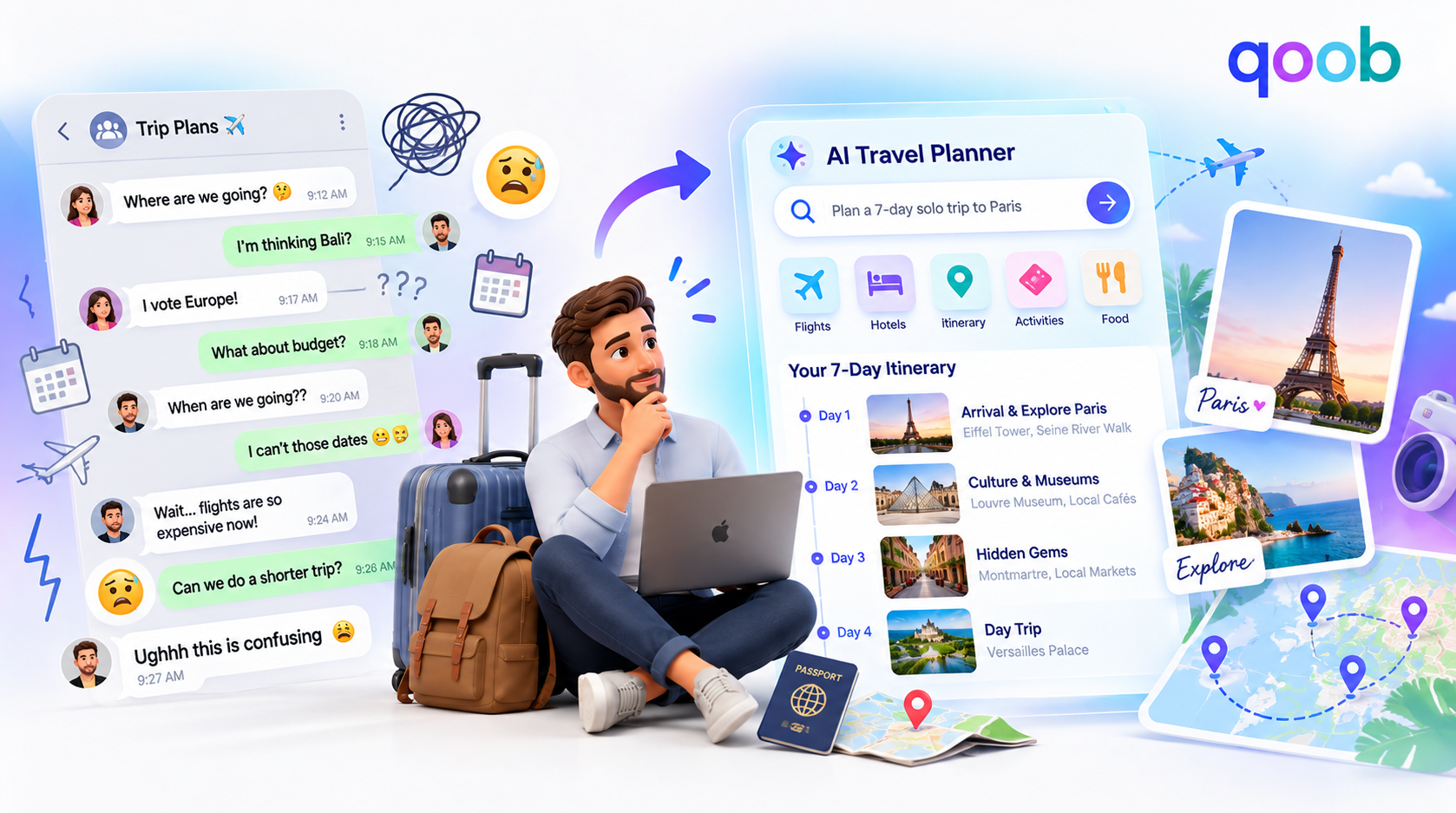
Planning a trip with friends can be exciting until the group chat starts moving.
One person wants beaches. Another wants museums. Someone else wants nightlife. One person has a strict budget, another wants the nicest hotel, and half the group has not even decided which dates work.
Then the messages begin.
“Where are we staying?”
“What should we do on Saturday?”
“Is this place too expensive?”
“Has anyone checked how far the airport is?”
“Wait, I thought we were going somewhere else.”
Planning a solo trip removes the group-chat problem, but it can create another one: you have to make every decision yourself.
That is where an AI travel planner can be useful.
Instead of opening dozens of tabs and piecing together information on your own, you can describe what you want in normal language and use AI to organise the possibilities around your trip.
Why Solo Travel Planning Can Still Get Complicated
Solo travel gives you complete control.
That is one of its biggest advantages.
You do not have to compromise on where to stay, what to eat, when to wake up or how much time to spend at an attraction.
But freedom creates more decisions.
You may need to think about:
- Where to go
- When to go
- How long to stay
- What to do
- Where to stay
- How much to spend
- How much travel time you can handle
- Whether you want a packed itinerary or a slower trip
None of these decisions is especially difficult on its own.
The problem is the volume.
A simple weekend away can become a long research session because every decision creates three more.
What Does an AI Travel Planner Actually Do?
An AI travel planner is designed to help with the planning process by understanding your request and turning it into useful travel suggestions.
Instead of searching separately for:
“best places for solo travel”
“things to do in Lisbon”
“Lisbon weekend itinerary”
and
“cheap things to do in Lisbon”
you can describe your trip more naturally.
For example:
“I want a four-day solo trip with good food, walkable areas, cultural attractions and a moderate budget. I do not want a packed schedule.”
That gives the system more context than a short keyword search.
The goal is not simply to produce more travel information.
It is to reduce the amount of work between having an idea and having a workable plan.
The Qoob is built around this broader idea of using search to support everyday decisions. Its current search experience highlights travel planning as one of the situations where a person can ask a natural-language question and get a concise answer rather than sorting through a large list of links.
AI Travel Planner vs Traditional Travel Search
Traditional travel planning often follows this pattern:
Search → open pages → compare options → open more pages → make notes → decide
That process can work well when you want to research deeply.
But for a simple trip, it can also create unnecessary friction.
An AI travel planner changes the starting point.
Instead of asking, “What information can I find?” you ask, “What am I trying to decide?”
That distinction matters.
You are not necessarily looking for every hotel in a city or every attraction within a ten-kilometre radius. You may simply want to know which area fits your style, how to spend three days, or which destination makes the most sense for your budget.
The Qoob describes its search experience in similar terms: ask a question naturally, let the system understand the context, and receive a concise answer aimed at the decision in front of you.
Why Context Makes Trip Planning Better
A generic travel recommendation can only go so far.
Suppose you ask:
“Where should I go in Europe?”
You could receive dozens of valid answers.
Now add context:
“I am travelling alone for five days, prefer mild weather, enjoy food and architecture, want a walkable destination, and have a moderate budget.”
The range of useful options gets much smaller.
That is the real value of context.
You can tell an AI travel planner what actually matters to you instead of forcing it to guess.
This approach is especially useful for solo travel because there is no group to balance against your own preferences. The entire plan can be built around your priorities.
A Travel Planning App Should Reduce Decisions, Not Create More
The phrase travel planning app can mean many things.
Some apps focus on bookings. Others focus on maps, itineraries, reservations or travel documents.
A decision-focused AI tool serves a different purpose.
Its job is to help you answer questions such as:
Where should I go?
How long should I stay?
Which area should I choose?
What should I do with three days?
Which option fits my budget and interests?
This is useful because the hardest part of trip planning is often not finding information.
It is deciding which information matters.
The Qoob positions itself as a search and decision-making app rather than a general-purpose chatbot, with travel planning listed as one of its everyday use cases.
How to Plan a Solo Trip With AI
You do not need a complicated prompt.
Start with five basic details:
1. Destination or destination type
Tell the tool where you want to go, or describe the kind of place you want.
For example:
“I want a relaxed European city break.”
2. Dates or trip length
A three-day city break needs a different plan from a two-week trip.
3. Budget
Your budget helps separate realistic options from attractive but impractical ones.
4. Interests
Mention what you actually enjoy.
Food, museums, beaches, hiking, nightlife, architecture, shopping and photography can all change the recommendation.
5. Travel style
This is easy to overlook.
Tell the AI whether you want:
- A packed itinerary
- A relaxed schedule
- Early mornings
- Late nights
- Lots of walking
- Minimal travel between places
- Plenty of free time
That information helps turn a generic itinerary into something closer to your actual travel style.
Use AI to Narrow the Destination First
One of the biggest mistakes in trip planning is choosing a destination before deciding what kind of trip you want.
Start with the experience.
For example:
“I have four days, want good food and architecture, prefer a walkable city, and do not want to rent a car. Which destinations should I consider?”
Now the question is not simply about geography.
It is about fit.
An AI travel planner can help you compare destinations against the criteria that matter to you rather than giving you a generic list of popular places.
Once you have narrowed the choice to two or three destinations, the next step becomes much easier.
Then Build the Itinerary Around Your Energy
A common mistake with travel itineraries is trying to maximise every hour.
That looks productive on paper.
It often feels exhausting in reality.
For solo travel, build the plan around your energy level.
You might want:
Morning: one major attraction
Afternoon: lunch and a flexible activity
Evening: dinner and a neighbourhood walk
That gives you structure without making the entire trip feel like a checklist.
You can ask an AI travel planner to create different versions:
“Give me a relaxed itinerary.”
Then:
“Now give me a more active version.”
Then:
“Combine the best parts of both.”
The benefit is not that AI knows the one perfect itinerary.
It is that you can explore alternatives quickly.
One of the Best Uses of AI: Comparing Two Trips
Sometimes you already have options.
Maybe you are choosing between two cities.
Or two neighbourhoods.
Or two hotel areas.
Or a city break and a nature trip.
Instead of researching each option separately, ask the AI to compare them using the same criteria.
For example:
“Compare these two destinations for a five-day solo trip. Consider cost, walkability, food, cultural activities, weather and how easy it is to get around without a car.”
Now you have a decision framework.
The same principle applies beyond travel. The Qoob’s broader search philosophy is based on helping users compare options and reach everyday decisions without opening a large number of pages.
What a Good Solo Trip Planning Prompt Looks Like
You can get more useful results by describing the problem instead of simply naming the destination.
Try:
“Plan a five-day solo trip to Tokyo for someone who enjoys food, neighbourhood walks, design and local culture. Keep the schedule relaxed, avoid expensive tourist activities where possible, and group activities by area so there is less unnecessary travel.”
That request gives the system:
- Destination
- Trip length
- Number of travellers
- Interests
- Budget preference
- Pace
- Planning constraint
You can then refine it.
“Make day three quieter.”
“Add more food-focused options.”
“Remove anything that requires a reservation.”
“Give me a rainy-day alternative.”
The interaction becomes an iterative planning process instead of one massive search.
How an AI Travel Planner Can Reduce the Group-Chat Chaos
The irony of solo travel is that the planning problem becomes easier in one way and harder in another.
You no longer have to negotiate with six people.
But you also do not have six people contributing ideas.
An AI planner can partly fill that organisational gap by helping you structure the choices.
Instead of asking friends:
“What should I do on Saturday?”
then waiting for seven different answers, you can start with your own preferences and generate a few options.
Then you choose.
That is much closer to the real purpose of travel planning.
Not collecting suggestions forever.
Making the plan.
Do Not Let AI Plan Every Minute
AI can make planning easier, but it can also make over-planning easier.
That is worth watching.
A perfectly optimised itinerary may not leave room for the best parts of a trip.
You might discover a small café.
Meet another traveller.
Spend two hours in a neighbourhood that was not on your list.
Change your mind.
Stay longer somewhere you like.
Good travel planning leaves room for those moments.
Use AI to remove unnecessary decisions, not to remove spontaneity.
Check the Details Before You Travel
An AI planner can help with structure, but important travel details still need verification.
Check things such as:
Opening hours
Attractions, restaurants and museums may have changing schedules.
Travel times
Estimated travel times can change based on traffic, public transport and time of day.
Booking requirements
Some activities require advance reservations or have limited availability.
Current entry rules
Visa, entry and other official travel requirements should always be confirmed through the relevant official source.
Weather
Weather can change quickly and may affect outdoor plans.
AI is useful for building the framework.
You should verify time-sensitive details before relying on them.
Why Short Answers Can Be Better for Travel Decisions
Trip planning does not always require a long response.
Sometimes you need a full itinerary.
Sometimes you need one answer:
“Which neighbourhood should I stay in?”
A useful travel planning tool should adapt to the question.
The Qoob’s search model is built around concise answers that help users make decisions instead of forcing them to scroll through a large list of results. Its website specifically describes travel planning as a use case for this style of search.
You can explore that approach through Qoob Search, where travel planning is presented alongside other everyday decision-making tasks.
Solo Travel Is the Perfect Test for Personalised Planning
Solo travel is personal by definition.
There is no universal “best itinerary” because there is no universal traveller.
One person wants six attractions a day.
Another wants one museum, a long lunch and nowhere else to be.
One person chooses the cheapest room possible.
Another cares more about staying in the right neighbourhood.
This is where personalised planning can help.
Instead of asking, “What do people normally do here?” you can ask:
“What makes sense for me?”
That is a more useful question.
The Qoob’s product approach centres on personal context, with the platform describing its answers as being shaped around what matters to the individual user.
When a Trip Planning App Still Makes More Sense
An AI planner is not a replacement for every travel tool.
You may still want dedicated apps for:
- Flight and hotel bookings
- Navigation
- Offline maps
- Reservations
- Travel documents
- Live transport updates
Think of AI as the planning layer.
Use it to decide what makes sense, then use specialised services for the parts that require live booking, mapping or transaction functionality.
That division of labour can make the entire planning process simpler.
The Qoob’s Role in Everyday Travel Decisions
The Qoob is designed around a simple idea: many things people search for are really decisions in disguise.
Travel is a clear example.
You are rarely searching because you want to read every page about a destination.
You are usually searching because you want to know:
Where should I go?
What should I do?
Which option fits me?
How should I organise this trip?
The Qoob is built to answer those kinds of everyday questions in plain language and provide a concise response that helps you decide what to do next.
Its approach to smarter search is built around reducing unnecessary browsing and helping people move from information to action.
And when the question is specifically about travel, you can start with an AI travel planning approach that puts your own preferences and trip requirements at the centre.
A Better Way to Think About Solo Trip Planning
The best use of an AI travel planner is not to hand over the entire trip.
It is to hand over the tedious parts.
Let AI help you brainstorm destinations.
Let it compare options.
Let it organise an itinerary.
Let it suggest alternatives when your first plan does not work.
Then use your own judgement to make the final call.
That keeps the technology in the right role: an assistant, not the traveller.
For another practical way to approach destination decisions, our guide to choosing where to go this weekend looks at how time, budget, energy and trip style can help narrow down the choices.
Final Thoughts
Solo travel gives you something group travel rarely can: complete freedom.
But that freedom can also mean a long list of decisions.
An AI travel planner can reduce that friction by helping you describe what you want, compare realistic options and build a plan around your preferences.
It can also make a travel planning app more useful by shifting the focus from collecting information to making decisions.
The important thing is to use AI as a planning partner, not as a substitute for judgement. Verify important details, leave room for spontaneity and build a trip that fits how you actually want to travel.
Frequently Asked Questions
What is an AI travel planner?
An AI travel planner is a tool that uses artificial intelligence to help with travel decisions such as destination selection, itinerary ideas, activity planning and comparisons. It can use details such as budget, interests, trip length and travel style to make suggestions more relevant.
Can an AI travel planner plan a solo trip?
Yes. Solo travel can be a particularly useful case because the plan can be built around one person’s preferences without needing to balance a group’s different priorities.
Is an AI travel planner the same as a trip planning app?
Not always. A trip planning app can include features for bookings, maps, reservations and travel documents. An AI travel planner focuses more on understanding your preferences and helping you make planning decisions.
How do I get better results from an AI travel planner?
Give it useful context. Include your destination, dates or trip length, budget, interests, preferred pace and any practical restrictions. You can then refine the result with follow-up questions.
Can AI create a complete itinerary?
It can suggest and organise an itinerary, but you should verify important details such as opening hours, transportation, reservations and current travel requirements before relying on the plan.
Is The Qoob useful for travel planning?
The Qoob is designed for everyday search and decision-making, and its current product information specifically includes travel planning as a use case. It lets users ask questions naturally and receive concise answers designed to help them decide.